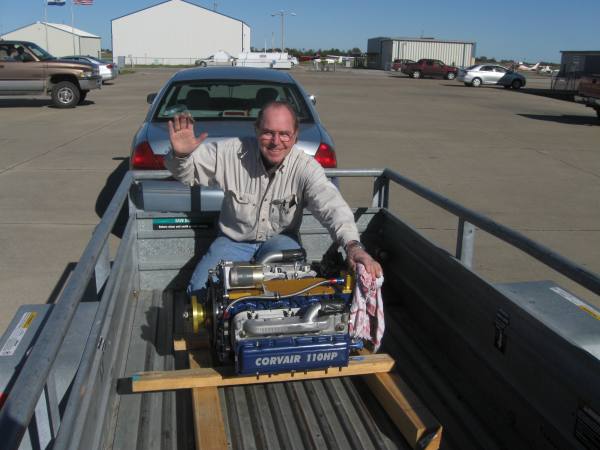
New Photos of JAG-2, a Corvair powered twin.

Builders,

A while back we shared the story of Jim and Ginger (JaG) Tomaszewski’s twin-engine project. You can read the original story in Jim’s words at this link:

JAG-2, Corvair Powered Twin, Jim Tomaszewski, N.Y.

Jim just sent in two more photos of his progress, seen below.

blogtwin050113

Above, a look at the wing extension. Having the engine on the wing is a ‘releving load’ on the wing spar, much in the same way that tip tanks are. Even though the wing is extended, it may feel no higher bending load at the root.

blogjag050313

There was a time when the EAA was made of builders, when a guy like Jim was still a stand out, but his work and motivation to create would have been understood by any EAA member. We still have plenty of people like that, but we now have a more ‘inclusive’ EAA membership and a management to go with them, that often seems to forget what the first word in the acronym EAA stands for.

 In the Corvair movement we have never lost our respect for the dedicated craftsman willing to put forth the extra effort to design, test, and fly his own creation, to build something really original. To my perspective, you do not have to build an original design to be a ‘real homebuilder.’ I think that the guy who builds a good Zenith, RV, Sonex or Rans that is the mechanical equivalent of other proven examples of his design is just as much a homebuilder as Jim, and I think Jim would agree with that.

The distinction to me is easier made on this dividing line: If you are the kind of builder that supports Jim’s right and passion to develop his own unique machine, even if it is not something you would choose for yourself, or even a design that you appreciate or fully understand, then you are a real homebuilder. You understand that at the very core of homebuilding is individual choice, challenge and achievement, something that we each should be able to pursue on a path of our own choosing.

I expect people from outside aviation to miss the point of home building. I can even see a person from a far branch of flight not ‘getting’ a project like Jim’s. But if a person in the EAA would criticise or seek to restrict the freedom to do original designs, I believe they forfeit the right to call themselves a ‘homebuilder.’

Such a person is too dull to see the connection that leads from Jim’s plane, through Dan and his Panther, through countless creative craftsmen. It is the same compelling force that was present with the Wright’s at Kitty hawk.  Any person who suggests that we should all build O-320 powered RV-6a’s and that flying them in regular patterns at controlled airports is homebuilding, has missed why Americans wrote much of the history of aviation, they have missed what homebuilding is about, and they understand nothing about being an individual. Their self-inflicted punishment is that they live in a ‘safer’ but far lesser world,  a place that traded Heros and Champions for living in fear and hoping for a tiny bit of safety increase.

At it’s very core, homebuilding has the power to liberate you from allowing thoughts like that to creep into your mind. If you are going to spend thousands of hours building a machine to seek your own freedom, then it makes sense to start by rejecting anyone who has a smaller deffiniton of freedom already picked out for you.-ww

Flying Zenith 750, Tom Siminski, 2700cc, PA.

Builders;

I have been meaning to post a longer story about Tom Siminski’s flying 750, but for now here is a quick glance at a 750 that has been flying since last year.

027

 Above, Tom’s completed bird. A very sharp-looking plane. It has a 2700cc engine with a Dan bearing and all of our installation components. Tom is flying the plane out of Eastern PA. I first met Tom at CC#14 in Lowell Mass, four years ago. Looking back at the event, many of the people who were there, like Louis Leung and Rodger Pritchard and Tom are now flying. Since then we have held 10 more Colleges, and I have spoken with countless builders along the way. However, two sentences that Tom said as an observation on that day have stuck with me as if he said it 3 minutes ago. I like building engines, working with tools and making parts, but it is working with the builders that is the rewarding part of my work. After a couple of hundred engines, they all begin to look alike, but their builders all remain unique individuals, each with his own perspectives, motivations and observations.

Hats off to Tom Siminski, builder of a flying Zenith 750.-ww.


From our website about Corvair College #14 in 2009:With me above is Thomas Siminski, a highly skilled machinist of the Old School variety. He had some very helpful suggestions about prepping threaded holes that he shared with builders. When I got a chance to speak with him one-on-one later, he impressed me with his broad personal experience from a candid perspective.”


Looking for Piper PA-22 or 22-108 (Tripacer/Colt) part….

Builders:

I am putting a regular windshield back in  our Wagabond in place of the 3 piece one the aircraft originally had. I already have the plexiglass windshield itself, but I do not have the metal strip that goes between the boot cowl and the plexiglass.  I could make this out of fiberglass if I really had to, but I would rather save the time and buy an old piper part. Our wagabond started out life as a 1964 Colt, PA-22-108, but I am pretty sure that the PA22 part would fit it also. If anyone has a friend with a pile of Piper PA-22 parts, I would greatly appreciate asking them if they have a spare one of these.

Thanks in advance,-ww.


Flying Zenith 750 w/3000cc Corvair, Doug Stevenson, California

Builders,

Below is a picture of Doug Stevenson’s Zenith 750. It did it’s first flight two years ago, it was the first Zenith 750 to fly on Corvair power. Doug keeps the aircraft at French Valley, in the scenic desert area of inland Southern California.

blog050213stevenson

Doug’s plane is powered by a 3,000 cc Corvair with a Roy bearing. The engine was a joint project done by Roy and myself, completed and test run as a demonstration at Corvair College #18 in Northern California. A few days after the College, I drove down to the other end of the state and delived the engine to Doug, one of hundreds of in-person house calls I have done over the years.

 At CC#18, we focused on builders engines, and as a consequence, It took one extra day to take our time on Doug’s engine. It was a memorable Sunday evening of wrenching, a chance to reflect with Roy about all the things builders had accomplished.  Roy and I finished the engine and prepped it for an early run on Monday, seen above. It fired up after 2 seconds of cranking and ran flawlessly throughout the early break-in period, It was a nice wrap up for the College #18

Above is a photo taken a day or two later at Doug’s place in the southern end of the state. His aircraft is fitted with all of our installation parts for Zenith aircraft. Doug finished the plane just months after I dropped the engine off. He is a very productive builder.

Hats off to Doug Stevenson, Builder of the first Corvair powered 750.-ww

Dick Otto in California, S.R.B. (Senior Ranking Builder)

Builders:

Our man on the West Coast, Zenith 601XL Builder/flyer Woody Harris made another house call last weekend, to Dick Otto’s place to be on hand for the first run of Dick’s 2700/Dan bearing engine. Woody reported that it fired right up and ran very well. He snapped the photo below to capture the first run of the engine, while it was bolted to Dick’s plans-built 601XL.

050213otto

 If you have not met Dick yet, I highly suggest that you read this story I wrote about him a while back:  Mail Sack – Letter of the month – Dick Otto, 601XL Calif. I refer to Dick as our “SRB ” because he is 92 years old!

The story above gives you a glimpse into the life of a member of “The Greatest Generation.” I have enjoyed every hour I have spent in the man’s company. Hats off to Dick for getting his engine up and running, and many thanks to Woody for investing the time to assist West Coast builders.

Because Dick now has a running engine, I have submitted him as a new member for our Zenith/Corvair private discussion group, moderated by Zenith 601XL builder/flyer Phil Maxson. The group is fairly active, and has already generated several hundred posts in its technical archive. As a direct peer-to-peer group, the members can work directly with each other to exchange information. The ‘invatational” nature of the membership (it is open to anyone with a flying ww conversion on a Zenith, and to Zenith builders with a running Corvair.) allows the flyers on in the group to share their information with builders advanced enough to appreciate it, and the flyers are also insulated from ‘peanut gallery’ comments by internet trolls and ‘experts’ who can not resist criticizing the flying work of others, even though they will never do anything themselves.

We are now less than three months from Brodhead and Oshkosh, where we look forward to seeing many builders, friends old and new. Spring is now on hand, even in the northern parts of the country, and it is a good time to put your ‘plan for progress’ in action. Do not let the time pass without getting things done.  The big aviation events this summer will be a lot more satisfying to attend if you do so knowing that you have significantly advanced your project since last year.-ww

Gary Burdett, 2,850cc Zenith 750, now flying. (engine selection)

Builders,

A few days ago, I spoke with Gary Burdett of Lincoln Illinois and covered some notes on his upcoming first flight of his Zenith 750. The conversation was fairly short because Gary had done all his homework, he knew what he was planning on doing and all his bases were covered. Near the end of today, (Sunday) Gary called to say he had done a 30 minute first flight, and all went well, absolutely no surprises. Again the conversation was fairly short. He is planning on going up again as soon as his local weather improves. We didn’t have to speak about any corrections nor issues, he didn’t have any to speak of.

Above, Gary Burdett with the 2,850cc Dan bearing engine we built for his 750. It is rated at 110HP. He picked it up at the 2012 Zenith open house.  His firewall forward is made of our standard off the shelf components for Zenith installations. Gary decided that he was going to take full advantage of our 9 years of successful Corvair installations on Zeniths by sticking directly to our the step by step notes in our Zenith installation manual. This is the best way to insure an uneventful first flight just like Gary’s. On his first flight, Gary stayed aloft for 30 minutes. He said the OAT was a cool 60F, but the CHT on the engine never exceeded 300F. Not bad for a brand new motor, on a design with a factory 575F limit. In hot summer weather with a fully broken in engine Gary’s instalation should run 350F in climb and 325F in cruise, a very large cooling reserve on the 750. 

One of the reasons why Zenith aircraft are so popular is the amount of engine choices available to builders. Compare two well-known LSA aircraft the Van’s RV-12 and the Zenith 601/650 series. The only engine allowed on the RV-12 is the Rotax 912.  The Zenith can use a 912 also, but there are also seven other popular engines commonly installed. Zenith believes that if you are smart enough to build and fly a plane, you can probably select an engine that matches your needs. Sebastien Heintz, Zenith’s president, has demonstrated his commitment to this path by inviting many engine companies to his open houses and having a day at Oshkosh were there companies simultaneously met builders in the Zenith booth. To me, this fits with my perspective that homebuilding is about making educated decisions for yourself. The concept that a Homebuilder would be restricted to a single engine suggests both an inflexible airframe design and philosophy of post-sale control, neither of which are particularly appealing. Even the owners of certificated aircraft can select different engines through STC’s, homebuilts should have at least as much freedom.

At Sun N Fun this year, I had at least 100 people a day walk into our Flycorvair booth and ask the same two questions: What does it weigh? and How much does it cost? Any builder who has these as the primary two questions is not ready to choose an engine, period. Notice above, I said I am in favor of builders making educated choices. I told every one of the people with the two standard questions that they needed to do more homework, specifically evaluating what they wanted out of an engine, and which characteristics were important. To open their mind a bit, I pointed out that even if an engine weighed only 100 pounds and cost just $1000, it would do you no good if it wasn’t reliable. The first thing you need to know about any aircraft power plant is simply it’s reliability.

Many people think that this can be evaluated by simply asking the sales rep. What is the TBO? First, in the experimental world, companies often make up any number they like for TBO, particularly auto conversion companies. I have seen companies claim a 3,000 hour TBO on engines that had yet to have a single example fly more than 100 hours. If the engine made 100hp at 5000 rpm in a compact car, then the car would have done about 120mph at the power output that is used to fly a draggy plane. A 3,000 hr TBO says that you could take the same compact car and drive it at 120 mph for 360,000 miles without wearing it out or expecting it to break. Does that sound realistic? Think you could get a car to do 25 coast to coast trips at 120 mph /5,000 rpm? That is a pretty big goal, and it is only 500 hours.

Real reliability is a much more complex issue than a TBO number. First, reliability is about how long between a power plant breaking, not how long it is before it wears out. In WWII, a Rolls Royce Merlin was considered a very reliable engine, but the TBO was only about 250 hours. It was not an issue of how long it lasted, the vital question was would it break without warning? An engine getting tired over time is acceptable, and engine breaking is not. My perspective on how to achieve reliability is to lower the stress on the engine by running it at a fraction of the automotive rpm and HP, increase the strength of internal components by using parts like forged pistons, make the fuel and ignition systems as simple as possible, and then train the operators to really care for the engine by allowing each of them to become his own mechanic/engine expert. I would love to take credit for this as an original idea, but two other engine companies thought of it first. You may have heard of them, they had some pretty good success with the concept. Their names are Lycoming and Continental.

Beyond the basic engine, we offer several things for Zenith builders:

1) Conversion, installation and flight ops manuals.

2) The availability of every single installation component, flight proven over nine years and 70 flying aircraft.

3) We have a separate on-line peer-to-peer discussion group just for Corvair/Zenith flyers to directly and freely share information and data with each other in a civilized productive format.

4) We have free Colleges and I still make free house calls.

5) the Corvair is fully insurable from hour number one, at the best rates.

With all of the above and the Corvair’s 53 year flight history, you might think that the majority of Zeniths would be Corvair powered. In reality, the portion of  Zenith builders we are working with is about 20%. The Corvair isn’t for everyone. If I said it was, I would be no different from an airframe guy who told you there was just one engine for his design. Over the years the 20% number has largely remain unchanged. A business man would be focused on “market share”, but I am first and foremost a Homebuilder, and I recognize that the Corvairs greatest appeal is to ‘traditional’ homebuilders, the people who are in it to learn new skills and be the master of their creation, not just it owner. That attitude was once 100% of the EAA, but today, all kinds of people are attracted to homebuilding. Most of them don’t think like I do, (some are hardly thinking at all) but nor are they required to. I am just here to work with the builders who have carefully thought out and evaluated their needs, and have made a selection at a much higher level than What does it weigh? and How much does it cost? -ww

Mail Sack, 4/28/13, Various topics;

Builders;

Here is a sample of the mail:

.

On the topic of Carl Sagan and the value of individuality:

601XL builder/flyer Dr Gary Ray writes:

“If each Individual strives to be the best that they can be and follows their own course, then they are the primary beneficiary and all of society benefits as a secondary beneficiary. The Individual is free and society evolves in a positive direction. There are benefits not immediately obvious. Such as a huge increase in mentors and role models. I know now that I am only half as much as I could have been because there was not enough quality science exposure in my early education.
This mental malnurishment takes a toll. It burns time and we know now that a human brain will truncate pathways that are not used (use it or loose it). Each year another thousand doors of opportunity slam shut. So my advice to everybody is, start early and “Go for it”. Associate with those that know much more than you do if you want to learn and grow quickly.”

Pietenpol Builder/flyer, 2012 Cherry Grove trophy winner Kevin Purtee writes:

“I’ve mentioned that I can’t read the website at work anymore so I have to set aside time to get caught up at home. Read all the philosophy tonight. Good stuff. I’m not smart enough to understand a lot of it, but I get enough, I think. I really enjoyed the risk management series. I’ve been doing aviation safety professionally since 1989 and you continue to help me evolve with fresh insights. -Kevin”

601XL Builder w/running 2700/Dan engine William Dominguez writes:

“I’m also a big admirer of Carl Sagan and its work. I was in my early 20s when I watched Cosmos for the first time and it influenced heavily in the formation of the world view I have today.- William”

Builder Bruce Culver writes:

“You see, William, as Ronald Reagan would say, there you go again – enriching my literary understanding of the world. I read Orwell’s review of “Darkness at Noon” and it was everything you said, and so was the quote from Carl Sagan, disturbingly (and accurately, alas) prescient. Both are now safe on my computer for future reference and reflection. And I do reflect on things like this, as I consider what kind of society and culture we are leaving our kids. I am glad I grew up in the 1940s and 50s, when kids could and did ‘go out to play’, sometimes staying away from home for the whole day, exploring streets, neighborhoods, woods – all sorts of places – when we could express our curiosity without being labeled ‘hyperactive’ or ‘ADD’ and get pumped full of drugs, when we could be independent and learn on our own, when we weren’t scheduled to a fare-thee-well to make sure we would get into Harvard Medical School. We had it so good, even if we had no idea at the time just how good it was. Nero once championed ‘bread and circuses’ to keep the people distracted and content, and I see much of that in today’s culture, in “reality” TV and talk radio. The bride and I choose not to participate. You may be, in the truest sense of the term, one of the best-educated people I know and it is a pleasure to read and reflect on what you wrote here – it is so rare to have this kind of philosophy discussed, but it does lead us to consider at least the value of being our own person, pursuing our own dreams, making our own mark, refusing to be one of “those cold and timid souls who neither know victory nor defeat.” Bravo”

601XL Builder/Flyer Phil Maxson writes:

“While teaching another builder how to polish aluminum in my hangar last night, my friend lamented an $80 part he had ruined due to an error. After looking under my workbench at the many, many parts I had made and was not satisfied with, I responded, “If you stay with this project to completion two things will happen: 1) you will waste far more than $80, and 2) you will gain an education that is better than your college degree.” Sure, we are building airplanes, but in reality we are building men and women.-Phil”


On the topic of engine availability:

Merlin on floats Builder/flyer Jeff Moores of Newfoundland writes:

“Hi William, I’ve been trying to think of something clever to say all week but can’t think of anything, but I feel the need to send a small message of encouragement. I look forward to every evening after a long day at work, (sometimes followed by an evening flight if I’m lucky) when I read your blog. All of the positive things people are saying are right on. Keep up what you are doing and please don’t change! You are both informative and entertaining. I have said this before but again thank you for all of the help you have given me since I started my engine build.

I find it odd for someone to question the “availability” of Corvair parts, and the future thereof. I am probably the most out-in-the-sticks Corvair pilot around, yet I have managed to find a complete core engine locally as well as two spare blocks, a crank (currently at Moldex) and four spare heads. My engine is working so well that I don’t anticipate ever needing these spares but I’m building a QEC (quick engine change) just in case. I do not want any down time! I’m probably farther from Corvair parts than any builder in North America. With all the new stuff from Clark’s and Dan it’s a non issue. The ice on our lake has melted so now I’m back on the water and having tons of fun!!-Jeff, Corvair/Merlin”

Pietenpol builder Dave Aldrich writes:

“If you’d like a counterpart in the automotive community, look at the Ford Model A. Henry built 4.3 million of them (less than 3 times the Corvair total) and the last one was built over 80 years ago. Virtually every piece has been reproduced (in varying degrees of quality) so you can literally build a new Model A, except for maybe the engine block and one or two other castings. The point is that, if there is a demand, there WILL be a supply. People are still building racing parts for that engine, for heaven’s sake. I submit the same thing is true for the Corvair engine, even within the very small aviation community market.”

Builder Jackson Ordean writes:

“Great reality check, especially for us noobs at the bottom of the ‘hiking trail up the hill’. It’s notable that folks critical of even your very high level of ‘transformation’ (I like better than ‘conversion’) of the motor, don’t seem to do any research on O-200 part failures.

5th bearing, de-rating power, non-aerobatic rating, and propeller choice wisdom (and of course, airframe choice), are all parameters you have created that have highly reduced risk down to a non-issue in general. Therefore, specific follow up in craftsmanship and quality part choices falls to the builder.

Re your personality (at least the 2% that can be gleaned from a person’s writing and ‘public persona’) and philosophic bent and expression thereof: Don’t waste an erg more. Say what you want. Besides, we like it. If it’s ‘too real’ for some, that’s their problem. Finally, this post re tech issues is a pretty perfect balance of personal expression, truth, facts, and re-challenge to any questions doubtful or critical of your Corvair program. Thanks!-JO”

 Jackson also shared the thought: “A handy ‘ruler’ to measure the validity of our beliefs is whether it helps, encourages, builds up, validates, saves, touches others. Simple, really. The bumper sticker version of this is: “Stay stoked ’til you croak!” – usually covers all the above. {;^)”


Builder Dan Branstrom writes:

Amen!

.

On the Dragonfly flight report from “One Sky Dog”

Dragonfly builder Guy Bowen from TX writes:

“Congrats on 20hrs.OSD! I hope to learn a great deal from your experiences with this air frame and engine combo. I’ve been following your latest exchanges on engine baffling/temp and prop performance experimentation and it seems you are seeing some progress. Things are proceeding well on my 2850 and I hope to get the core finished before the end of the year. By that time you will probably have more issues worked out.”

.

Some parting shots on the topic of “Plain Speaking”

Builder Harold Bickford writes:

“Lots of good commentary here William, which took more than a few minutes to read and consider. I happen to appreciate the openness and honesty and am never put off. The idea is to learn and develop and that applies to more than just flying machinery. – Harold”

601XL Builder w/running 2700/Dan engine (CC#22), Becky Shipman writes:

“Hi William, I feel confident you will keep writing your mind, so no worries here. People worry about attracting new people to aviation, so one approach is to sugarcoat the risks. I think it’s better to encourage people with a healthy approach to risk management. As a smart but initially uninformed person, knowledge of the actual risks and ways to mitigate them is my way of overcoming fear. That’s what you lay out in your manual and website, and I think the stories just fit in w/ risk management. My recent injury is an example of letting my guard down after 23 years of attention to safety detail.

Ethically I don’t like the idea of making aviation seem easy, then letting mother nature sort out the worthy. I think we do the same thing w/ motorcycles, BTW. It’s the quick sale over the long-term customer. Unfortunately, I think the fact it takes a lot of money to get into aviation means the people who can afford it are not those who have the mindset to succeed at it. Take care, Becky”

Corvair College #25, In Photos

If the photos are small, try hitting the “F5” button at the very top of your keyboard.

Builders:

It has taken a little while to regroup after SnF and CC#25, but here is a pack of photos from CC#25 for everyone to enjoy. It was a very positive event. We had 55 builders pre-register, and many more stop in for part of the event. Arnold’s crew from EAA Chapter 534 did an outstanding job as our local hosts, and they did the lion’s share of the work on making the event logistics go smoothly. Hats off to every one of them.

We had four pilots bring in their Corvair powered aircraft. Ron Lendon flew his 601 XL in from Michigan, Lynn Dingfelder flew his 601 XL in from Pennsylvania, Chuck Custer flew his Cleanex the “Corvex” from the Florida panhandle, and Bob Lester flew his Pietenpol in from North Central Florida. We had a number of different engines run on the test stand, we had a lot of builders get a good start on an engine build, and we had many people on hand learn a lot of detailed information on the engine. On the fun side, we also had a number of builders, veterans of several Colleges, who just came to have a good time with fellow builders. By any measure it was a successful event. Before it was over, builders were already speaking of making this an every year event, always a sure sign that people really enjoyed themselves and had a productive time. -ww

68190

Above: Every College is a mixture of individual supervised work and group learning, shown in the scene above. In the photo, I am giving everyone a detailed look at, and Corvair specific training, on a differential compression test.

68197

Above, the engine we are instructing on is Larry Magruder’s (in the maroon shirt at right) 2700 cc/Weseman bearing engine. It is going into his Zenith 650.

 68202

Pietenpol builder and veteran of several Colleges Dave Aldrich with a high thrust line Pietenpol motor mount we made for him. It is powdercoated white. He saved $80 on shipping by picking it up in person. We are always glad to ship mounts, we do it all the time, but it is nice to head to a College also.

68209

Bob Lester strikes the “Intrepid Aviator” pose with his Pietenpol.  He is good at this because he has seen every old aviation movie ever made. He built his 2,700/Weseman bearing engine at CC #17, and flew it back to CC #25.

68211

Ron Lendon’s 601 XL, flown in from the Detroit area. His engine is a 2,850 cc/Roy bearing engine, also built at CC #17.

68225

Above, several of us get a detail session in on setting valves. Larry Magruder multi-tasks with Scoob E sitting duty while Grace takes photos.

68235

Spencer Gould, Embry Riddle trained, Pratt and Whitney engineer, sets his 2,700/Weseman bearing engine on the run stand. He is getting close to the finish line on his original design, composite, single-seat plane, the SP-500.

68248

William Dominguez of Miami strikes a pose with his 2,700/Weseman bearing engine. He started with parts that he had prepped before the College, and did the complete assembly at the event in two days. The engine ran beautifully. It was the first engine he ever built. He had previously brought a core to CC #23, had a good look at how things are done, and then took action to make things work for him. The engine will power his 601 XL.

68246

Spencer with his engine. It is the only Corvair I have seen that not only has gold parts, but is also painted gold. It ran great.

68250

Joe Sarcione with his 3,000/Weseman bearing engine on the last day of the College. He also started with just raw parts. His prep work consisted of doing a lot of reading, including all the on-line installation directions that are in our parts catalog. The engine is destined for his Zenith 750.

68251

Father-son team of David and Bryan Walker from Arkansas stand behind their freshly torn down core engine.

68254

Roy Szarafinski and his lovely daughter Liese made a brief appearance at the College. They were on the return leg of an international trip and detoured over to spend much of Saturday at the College with builders. In between getting his display set at SnF and conducting the first flight of the Panther on Sunday, Dan Weseman also had a chance to assist builders at the College.

 68257

Many friendly hands made short work of getting William Dominguez’s engine ready for the first run.

 68290

Mike Schwab (black shirt) and Michelle Tomalo were in attendance. They started their 3,000/Weseman bearing engine at CC #23, finished and ran it at CC #24, and returned to help others at CC #25. Mike is the best source for alternators and voltage regulators. His email address is info@mikessynoil.com 

68297

William Dominguez’s engine during break in. It went from ice cold, never started, to live and running in less than 3 seconds of cranking.

68300

The Redditt family works on their 3,000/Weseman bearing engine. It is destined for the family Zenith 750.

68307

Lynn Dingfelder’s 2,700/Weseman bearing 601 XL from Pennsylvania. Lynn had previously flown the plane to CC #20 in Michigan. After the College, Lynn took a short tour of southern Florida and then headed to SnF, where his aircraft was on display at the Zenith booth all week. Lynn is very mechanically inclined, and he has very good judgement, but he is relatively new to flying. He got his sport pilot license four years ago and has slowly and carefully accumulated a few hundred hours, gradually expanding his personal flight envelope. His experience and path is an excellent model for anyone new to homebuilding and flying. 

587901

Larry Magruder and his lovely spouse Diane enjoy the prop blast from Larry’s engine on the run stand. The engine briefly ran at CC #24, but Larry decided he wanted to return to CC #25 and reset the valves and do some detail work under my supervision to make it run perfect. It worked according to plan, exactly. I have great respect for any builder who sets his standards high and sticks with them until his work is outstanding.

 587905

Wittman Buttercup builder Daniel Kelley from California flew in commercial for the event and stayed for most of SnF also. He has attended many Colleges. His plane will be powered by his 3,000/Roy bearing engine.

587907

EAA Chapter 534 had a Pietenpol project in the hangar that was the work of a very nice older gentleman who has a Ford Model A for it. They are assisting the man with the completion of the aircraft. I took a photo of the project’s cabane strut arrangement. There is nothing wrong with using aluminum lift strut material; the loads on the vertical cabanes are not that high. However, no one, ever, should use this type of arrangement for the diagonal cabane going down to the top of the firewall. This would fold up like cooked spaghetti in the most minor of mishaps, and could even injure or trap the front seat occupant. The diagonal cabanes should be at least 7/8″-.049″ 4130 tubing, preferably welded to the front vertical cabane tubes.

587908

The Redditt family with their packed van at the end of the College.  Charlie wears his ceremonial Corvair College tie for the photo.

587909

A close up of the Redditt’s 3,000/Weseman bearing engine. It started as a pile of parts before the event, all the way down to the case halves. They attended CC #24, made a plan, and followed through with it. Above, they are most of the way to an outstanding, first class engine.

.

Looking at all the builders in the above photos, all you have to do is decide that you are going to make this year, 2013, the year that you get more out of experimental aviation. We have more events planned, more Colleges in the works, Brodhead and Oshkosh. Decide right now that you are going to be a part of this. I have been giving Colleges for 13 years. You know the most common thing people say after their first College? They say a variation on this common theme: “I heard about the Colleges, and I was always planning on getting to one, but never did. Now that I have, I really wish I came sooner; I would have been making a lot more progress at home.” Consider this your invitation to the next College. If you are waiting for me to send you a personal engraved one, be advised, you must take a little more initiative to have success in this game. The builders pictured with their running engines are not better people than you, they are not secretly blessed, nor are they special friends of mine. They are just like you, with one small exception: One of the many times I wrote about builders having a great time at a College, they read it, got serious, made a plan and decided that it would be their time now. … -ww

Carl Sagan, Corvair Owner, Practical Philosopher, Individual.

Builders,

I have always admired the work of Carl Sagan since I first saw “Cosmos.” He also wrote the story to the film “Contact“, which I think of as great Science Fiction. Many people in the Corvair world know that the one car he owned was a 1964 Corvair convertible, which has been restored since his passing. Above all else, Sagan was a first order observer of the human condition.

I do not like conspiracy theories generated by the internet. I detest that stuff, it often shows how poorly educated people are to believe things that defy physics and simple observation. That stream of BS cries wolf all the time and often has the effect of numbing people to real issues that need to be considered, understood and addressed.

My first year in College was going to night classes at Kean in NJ, about a million years ago. Most of the students were in their 30s and 40s and took the work seriously. I had a class on the Philosophy of Science in the 20th century. The professor started out by showing us how many of the scientists that had worked on the initial atomic weapons later morally regretted it, feeling that they had unwittingly played a role in making the end of life a real possibility. He then said this subject in 20th century was well worth studying, because it was just the opening round, a prelude of what was to come in the next 50 years.  He brought up human cloning, artificial intelligence and the end of privacy and the restriction of choice. He pointed out that all of those things would be done by scientists or with tools provided by them, and we had damn well do a better job on the following rounds than we did on developing atomic weapons without considering where it almost lead. 32 years later, I am not so sure we have.

The class largely was studying the work of four very influential writers. Jacob Bronowski http://en.wikipedia.org/wiki/Jacob_Bronowski, (who wrote the Ascent of Man), C.P. Snow http://en.wikipedia.org/wiki/C._P._Snow ( who wrote The Two Cultures).  Author Koestler http://en.wikipedia.org/wiki/Arthur_Koestler,( who wrote Darkness at noon) and Sagan. The quote below fits in with the type of concept that we looked at. Snows book spoke of how few people in society understood what science was working on, and it was published in  1947! Koesler stood next to Orwell as the greatest anti-totalitarian of his day. If you are a fan of the 1980s band The Police, you may be surprised that their song titles, Ghost in the Machine, synchronicity, Invisible Sun and others were chapter titles in Koestler’s books.

Bronoski was widely thought of as the last man who had full mastery of most of the branches of science, but his strongest attachment was to examining its morality. He filmed a segment about how science was about questions, not certainty of answers. To make his point, he contrasted the quest for knowledge with the Fascist certainty that they alone had all the answers. When the camera drew back he was standing knee-deep in the pond at Auschwitz where his families ashes were flushed.

Get a good read on the Sagan quote below, it isn’t a pretty thought, but it is undeniable that things have shifted in the direction of his warning.  We all have friends who send us warnings  in the form of forwarded emails about Mexico taking Texas back, Idaho going to Sharia law, albino pythons that live in septic tanks and how the government hid the aliens at area 51.  What Sagan was warning about is reality, and one way you can tell he was right is by the percentage of people who actually believe most of the garbage in internet stories.

.

 What does this have to do with Corvair flight engines? Any time you are working on your Corvair engine, building an airframe and developing all of your flight skills, you are supporting and participating in the real technical world, the world of Physics, Chemistry and Gravity. By learning and mastering any technical skill, you are making sure that there is one less undeveloped person in our world.

Note that Sagan sees technical manufacturing, and the type of jobs it provides, with the education that those jobs require, as the basis of a strong democratic society founded on “We the People.” Service and information are important, but they are there to support the technical-manufacturing base, by themselves they are unbalanced.  Would you like to know why I think it is very important that our parts be made here instead of in China? Although we are building a simple engine, most of our parts are made by very high-end CNC shops and made from US refined materials. You are supporting very good jobs here. If an American wants to buy a Rotax 912, that is their choice, but in my book they forfeit the right to complain about the US unemployment rate and/or the economy. (When the trade deficit is 40 billion a month, it doesn’t matter who is trying what with our economy, it isn’t going to work.)

If you read one single thing this weekend, go on-line and read George Orwell’s 1941 review of Koestler’s book Darkness at Noon. Koestler had been a communist and survived the purges, before concluding that the police state is the greatest enemy of humanity. The book is a very personal account of why individuals, even good ones, succumb to the will of the state.  He also points out that the humans who start such governments are not pure monsters, they have some perspective, however, the people who are born into, and have only known such a world, frequently are capable of pure evil. (Think of the new, 29 year old, leader of North Korea when you read Orwell’s piece.)

I think that building and flying your own aircraft, a device that serves no purpose to society or government, something that is just for you the individual, is a very important act that reinforces the dignity and value of being an individual. No matter how you think we got here or what you think we are supposed to be doing, we can agree that the points in history were individuals had no value were not the brightest chapters in human history.

I love animals and think they are great,  but the two things that are supposed to set us apart are the fact we make tools and we can choose to act as individuals and not part of a collective herd. Funny how fewer people make and use tools these days and how that coincides with many people behaving more like a herd. Individuals creating art in any form, painting, music, dance or even aircraft building, even if it is done just to please one human, is just as important as any act for the greater good.

  The first time I read Johnathan Livingston Seagull I thought it was stupid gibberish (because I was 17, the age where we were all a unapreciated genius). Later I understood that Bach’s point is that if every act is judged on the sole merit of its value to society, we will end up with the conformity of a flock of seagulls, complete with their compulsive need to peck non-conforming individuals to death, just to protect the uniformity. (It also took me an embarrassingly long time to get that the seagull was named after Johnny Livingston, one of the worlds greatest pilots ever.)

Out there, many builders reading this are probably thinking :”I just wanted to build an engine and go flying, not change the world” Well if you stick with it and finish and fly, I can assure you that one world will change for the better…your own.-ww

New builder, question on long term part availablity

Builders,

Below is a letter from a new builder out west. The original letter was longer and split his thoughts between two topics. For the sake of covering just one of them here, I pulled out the paragraphs on the other topic. As anyone who has written in knows, I don’t edit or abbreviate things that builders write in, so It is important that people reading realize that this is a special case letter, where splitting out this half serves a purpose of covering this topic.  If I do more than correct a spelling in a builder’s letter, I will say so, otherwise, printed as received.

The original letter is in blue. My reply is in green. I stuck it in the middle of the letter to address his questions as they come up, it makes it easier to read this way. I picked up on his letter because the questions in it are frequently asked by new builders, and covering them here allows a lot of people to gain some insight.-ww

William,

A few months ago I sent you a letter regarding the difficulty I was having in locating a Corvair Engine Core on the West Coast. A few words from you after you published my letter on your site put me in touch with a number of Corvair builders including Gary Boothe. After a series of false starts, it looks like I have located a couple of good cores in Medford, Oregon. I am headed there this week with your manual to verify the engine information and hopefully bring home to Redding, Ca,. two late-model cores that have not been opened in the past. Thanks for your assistance.

William,  really need your “leadership” when it comes to building an aircraft engine from a fifty year old “boxer engine” built by a car manufacturer who never before or after built anything like it again!!!

Doug, you are correct externally, the Corvair is GM’s only air-cooled engine. But once you dig into the engine some, you will see that the engine is really a typical GM product. Al Kolbe lead the design team that did the Small Block V-8 just before he did the same for the Corvair. Internally there is a way more than you would think in common between these engines. Not just things like using the same lifter, and rocker design, but also proportions like the Corvairs rod being a scale model of a 283/327 rod, the engine having the exact same oil pump cross-section, distributor shaft size and design, etc. The material and way the cranks were made then were the same. If you look at GM’s two other master pieces of the same era, the straight six and the big block, there are also many things in common. Most of the ignition system is the same as the straight six, the splayed valve design also is on the Big Block. I owned and built a number of each of these for classic GM engines. They are all very much from the same gene pool. This is why it is a great joke when some idiot tries to claim that the engine was designed overseas or it was made by a helicopter company. Those people are just BS artists.

There are a number of circumstances that have changed since you published your manual. What about addressing those issues? How about the diminishing cores that are still usable? Can the original molds for the cores be purchased from GM or was it a “Lost Cast” process?? Can we be confident that these engines can be rebuilt in years to come? What about the crankshaft issues that creep in at about 300 hours even with a fifth bearing?

The website is the main way that the information stays really crisp. This website got more words on it in the last 8 months than the manual has in it. You still need both, but the freshest stuff is obviously going to be here. The architecture of the conversion manual is the oldest of things we have in print. The Zenith manual and the Flight ops manual are much newer, we still update the manual with each new printing. Some people think of it as older, but when a new guy asks a question, 8 times out of 10, the answer is in the manual, he just missed it on first read.

There really is no core issue. Have you run an ad on Craigslist in the “Wanted” section? If you wait to read things that are listed, you are doing it the passive way, and it takes a lot more time.  There is no shortage of cores, it’s a myth that it easy to think when you are getting started. Lycoming built 270,000 engines total in their first 75 years in business. This is roughly the number of Corvairs GM built in 1964. Finding a Corvair is not hard at all compared to finding an O-200 near you. They built less than 40,000 O-200s. Which do you think there are more of 50 years later?

The molds are said to exist, but they are not needed. Dan Weseman has already looked at building every part in the engine new and he thinks it is do-able. Lets look at what is already made new: Cranks, Rods, pistons, cylinders, pushrods, pushrod tubes, Valves, guides, seats, springs, all kinds of gears for the cam/crank/distributor, etc. So what part are you concerned about? Right now, today, you can build an engine from a case, an oil pump housing and two head cores. Dan knows a lot about modern manufacturing in metal, and he doesn’t think those last three parts are that tough. Keep in mind, Ron Lendon has an original set op manufacturing drawing for the whole engine. I do not know of any other conversion engine people are putting in a plane where clever entrepreneurial builders have access to the drawings.

Your last comment “What about the crankshaft issues that creep in at about 300 hours even with a fifth bearing?” Touches a nerve with me. Maybe you just typed that in wrong, but if anyone said something you about 5th bearing engine having some “issue”, then I need the person’s name and number, and they are going to have an unpleasant phone call from me. That is another pile of BS. The only crank that has ever broken with a 5th bearing was Mark Langfords. and it broke at the other end of the crank.  The 5th bearing has conclusively stopped crank issues, period. We are now six years into engines having 5th bearings. They work. When Mark broke his at 450 hours, he honestly felt that his aircraft was the harbinger of some issue. Yet in the 18 months since, no other engine with a 5th bearing has broken a crank. Some engines are now approaching 700 hours on a bearing, many are well beyond 300 hours. Engines have flown more than 1,500 hours without one, there is no reason to suggest that engine with a bearing are only going to last 1/5 of that. Again, if there is someone spreading that story, I want to know who it is.

You have really touched on something with the new “parts catalogue” numbering system. William, I sent you an earlier letter asking you to review a list of items I was expecting to purchase in order to build a Corvair Engine. Although you did not respond to that letter, your new catalogue will help me make the right choices.

That was the intent of the new numbering system. As you can imagine, with several hundred active builders, it is hard for me to look at every list that builders compile, especially lists from new guys who are yet to get a core and tear it apart. A number of people a month send me things on spreadsheets to study. I understand that this is something that guys who work in modern business do, but it isn’t a good use of my time. First 4 out of 5 of the emails require me to find some other software just to open it. (I rarely bother) Not a big deal to office guys. Come to a college and I will hand you a tool like a differential compression tester and ask that you test all six cylinders and give an analysis in 5 to 6 minutes. That task isn’t a big deal in my ‘office’ for me, but I am reasonable and don’t expect builders to perform like a professional A&P. Besides, I can teach any person with a room temp IQ how to build a good Flight engine much faster than the best computer guru could teach me how to work with spread sheets and find software applications. Computers are part of the craft that many builders do for a living. But lets keep in mind that our goal is to build engines and planes and go flying for real.

Let’s talk about what it will take to keep the movement going forward while the product continues to improve.”

I hate to point this out, but I could get eaten by an alligator, and the world of Corvairs would advance just fine. I am planning on being here to share it with everyone and have fun right beside you, but it is very important to understand that the Corvair can not be stopped nor crippled by the loss of one person, even me. In the 25 years I have been doing this, I have seen many companies get taken right under by the principle buying the farm, or even just quitting. The business model of those people was all about proprietary stuff and secret ingredients. We are just the reverse, I am teaching people how to be independent every day. I am not keeping the secret at all. Many other engine companies, even ones that had real promising stuff, went under before they could build production levels of hardware. We are not in this position at all; 1.7 millon Corvairs have already been made, they are distributed around the country, and time has gone by so they are devalued to core pricing. I am slow but not stupid, I knew this going in 25 years ago, and I was very glad to have an engine that already had a very long production run. There are only 35,000 experimental aircraft total.  98% of Corvairs could have been scrapped and we would still have 35,000 cores left to work with. It just isn’t an issue.-ww