The Quote, 1927, C.A.L.

Builders,

A week before last Christmas, I spent a day in Manhattan with my brother-in-law Col. John Nerges. One of the things I wanted to go find with him was the excerpt from one of Lindbergh’s quotes. I was pretty sure it was emblazoned on the wall of the lobby of the Empire State Building.  We walked all through the restored art deco lobby, but couldn’t find it. 

Tonight I cannot sleep, so I picked a book off the shelf,  “Reuben Fleet and the Story of Consolidated Aircraft.” Thumbing through it for the first time in years, I stumble over a photo of it.

“Science, freedom, beauty, adventure: what more could you ask of life? Aviation combined all the elements I loved.”

The quote was actually put on the wall of Rockefeller Center, 15 blocks north of the Empire State building. Reuben Fleet, a great admirer of Lindbergh, had added a statue to the words after Lindbergh passed in 1974.

The whole quote is much more revealing. As you read and consider it carefully, ask yourself just one thing: What branch of aviation can lay any claim to understanding and appreciating this, the greatest of all aviation quotes from the greatest of all aviators? The only branch that can make that claim is Experimental Aviation. Airlines, FBOs and even the military all have their reasons for flying, but they are not the ones Lindbergh was speaking of.  Today, someone went flying in a Cirrus, spent an hour aloft, and their experience was largely staring at a screen and speaking on a radio. Another pilot flew a B-767 coast to coast, but spent much of the free moments thinking about bidding his next trip and the rumors of a merger with another airline. A military pilot walked out to the ramp and thought about how long his deployment would take him from home.

None of these experiences brought the pilots close to what Lindbergh found to be the absolute fundamental core of flight.  Yet today, somewhere out there, a builder got in his homebuilt, a plane that he built with his own mind and hands, and went out and experienced exactly what Lindbergh was speaking of. In the 86 years that have passed since Lindbergh flew the Atlantic, almost everything in aviation has changed. Almost. The hardware, the electronics, the capability, they are all radically different, and these are the elements that matter to the person seeking transportation, distraction or commerce. The one element that has not changed at all is what Lindbergh was speaking of, the element that traditional homebuilders are seeking. This never changes:

.

“Science, freedom, beauty, adventure: what more could you ask of life? Aviation combined all the elements I loved. There was science in each curve of an airfoil, in each angle between strut and wire, in the gap of a spark plug or the color of the exhaust flame. There was freedom in the unlimited horizon, on the open fields where one landed. A pilot was surrounded by beauty of earth and sky. He brushed treetops with the birds, leapt valleys and rivers, explored the cloud canyons he had gazed at as a child. Adventure lay in each puff of wind.

I began to feel that I lived on a higher plane than the skeptics of the ground; one that was richer because of its very association with the element of danger they dreaded, because it was freer of the earth to which they were bound. In flying, I tasted a wine of the gods of which they could know nothing. Who valued life more highly, the aviators who spent it on the art they loved, or these misers who doled it out like pennies through their antlike days? I decided that if I could fly for ten years before I was killed in a crash, it would be a worthwhile trade for an ordinary life time.”— Charles A. Lindbergh


Let It Not Rain

Builders:

Our local area of north east Florida saw torrential rain on Thursday and Friday. St Augustine recorded 12 inches in one day, and we had 8″ in 8 hours on Thursday night. Below are some of the pictures of flooding at our airpark.

587971

Above, Rain does not stop the mailing of parts. I leave for the first leg of getting to the post office at noon Friday. This is knee-deep swamp water in our yard. I walked out through 300 yards of this to get to the high ground where we parked the truck. The 20 gauge is due to the Water Moccasins and Diamond Backs that were dislodged by flooding. Our area has a very high density of both, and they are excellent swimmers. I have lived in both rural areas and urban ones, and have found that rural living requires infrequent times of high vigilance, like walking through swamp water, but urban living requires a different kind of daily vigilance I find much more tiring and stressful.587980

Above, Grace takes ScoobE out on the only part of our yard that was not submerged, the top of the septic tank. When the water was rising quickly, We moved her Caddy up there also. Our house always stays dry because it is 5′ above the yard. The green strip of land behind Grace is the crowned top of the runway. No need to run the sprinklers this week.

By Sunday morning, the water had mostly retreated back to the drainage ditch network around the airpark. We had some clean up to do, but it isn’t a major interruption, just 2 or 3 days of lost time in the workshop. In the larger view, it is a very small price to pay once every year or so for living every day in a very peaceful and beautiful setting, and sharing it with really great neighbors. -ww

Flycorvair.net passes 200,000 page reads. 5-4-13.

Builders,

Late Friday night, someone decided to read the story about Jim’s twin project. This was the 200,000th page read on this site. We have come to this milestone in 17 months of operation. Three months ago we hit the 150,000 mark. On that occasion I wrote a story that addressed some of my perspectives on writing. The latter part of it falls into the category of ‘plain speaking’ that we hit on about two weeks ago.

FlyCorvair.net breaks 150,000 page reads, 2/6/13. 

That story also speaks about how the statistic probably indicates that 1,500 people read the site 100 times on average. Getting another 50,000 page reads in 90 days means that the Corvair is popular, but isn’t about to displace Rotax as the most numerous engine in the category. In a nutshell, we have enough growth and serious builders to sustain a lot of further development, new parts, new installations, more Colleges and house calls, all without losing the elements of craftsmanship, friendship and shared experience that have always been hall marks of the Corvair movement.-ww

New Photos of JAG-2, a Corvair powered twin.

Builders,

A while back we shared the story of Jim and Ginger (JaG) Tomaszewski’s twin-engine project. You can read the original story in Jim’s words at this link:

JAG-2, Corvair Powered Twin, Jim Tomaszewski, N.Y.

Jim just sent in two more photos of his progress, seen below.

blogtwin050113

Above, a look at the wing extension. Having the engine on the wing is a ‘releving load’ on the wing spar, much in the same way that tip tanks are. Even though the wing is extended, it may feel no higher bending load at the root.

blogjag050313

There was a time when the EAA was made of builders, when a guy like Jim was still a stand out, but his work and motivation to create would have been understood by any EAA member. We still have plenty of people like that, but we now have a more ‘inclusive’ EAA membership and a management to go with them, that often seems to forget what the first word in the acronym EAA stands for.

 In the Corvair movement we have never lost our respect for the dedicated craftsman willing to put forth the extra effort to design, test, and fly his own creation, to build something really original. To my perspective, you do not have to build an original design to be a ‘real homebuilder.’ I think that the guy who builds a good Zenith, RV, Sonex or Rans that is the mechanical equivalent of other proven examples of his design is just as much a homebuilder as Jim, and I think Jim would agree with that.

The distinction to me is easier made on this dividing line: If you are the kind of builder that supports Jim’s right and passion to develop his own unique machine, even if it is not something you would choose for yourself, or even a design that you appreciate or fully understand, then you are a real homebuilder. You understand that at the very core of homebuilding is individual choice, challenge and achievement, something that we each should be able to pursue on a path of our own choosing.

I expect people from outside aviation to miss the point of home building. I can even see a person from a far branch of flight not ‘getting’ a project like Jim’s. But if a person in the EAA would criticise or seek to restrict the freedom to do original designs, I believe they forfeit the right to call themselves a ‘homebuilder.’

Such a person is too dull to see the connection that leads from Jim’s plane, through Dan and his Panther, through countless creative craftsmen. It is the same compelling force that was present with the Wright’s at Kitty hawk.  Any person who suggests that we should all build O-320 powered RV-6a’s and that flying them in regular patterns at controlled airports is homebuilding, has missed why Americans wrote much of the history of aviation, they have missed what homebuilding is about, and they understand nothing about being an individual. Their self-inflicted punishment is that they live in a ‘safer’ but far lesser world,  a place that traded Heros and Champions for living in fear and hoping for a tiny bit of safety increase.

At it’s very core, homebuilding has the power to liberate you from allowing thoughts like that to creep into your mind. If you are going to spend thousands of hours building a machine to seek your own freedom, then it makes sense to start by rejecting anyone who has a smaller deffiniton of freedom already picked out for you.-ww

Flying Zenith 750, Tom Siminski, 2700cc, PA.

Builders;

I have been meaning to post a longer story about Tom Siminski’s flying 750, but for now here is a quick glance at a 750 that has been flying since last year.

027

 Above, Tom’s completed bird. A very sharp-looking plane. It has a 2700cc engine with a Dan bearing and all of our installation components. Tom is flying the plane out of Eastern PA. I first met Tom at CC#14 in Lowell Mass, four years ago. Looking back at the event, many of the people who were there, like Louis Leung and Rodger Pritchard and Tom are now flying. Since then we have held 10 more Colleges, and I have spoken with countless builders along the way. However, two sentences that Tom said as an observation on that day have stuck with me as if he said it 3 minutes ago. I like building engines, working with tools and making parts, but it is working with the builders that is the rewarding part of my work. After a couple of hundred engines, they all begin to look alike, but their builders all remain unique individuals, each with his own perspectives, motivations and observations.

Hats off to Tom Siminski, builder of a flying Zenith 750.-ww.


From our website about Corvair College #14 in 2009:With me above is Thomas Siminski, a highly skilled machinist of the Old School variety. He had some very helpful suggestions about prepping threaded holes that he shared with builders. When I got a chance to speak with him one-on-one later, he impressed me with his broad personal experience from a candid perspective.”


Looking for Piper PA-22 or 22-108 (Tripacer/Colt) part….

Builders:

I am putting a regular windshield back in  our Wagabond in place of the 3 piece one the aircraft originally had. I already have the plexiglass windshield itself, but I do not have the metal strip that goes between the boot cowl and the plexiglass.  I could make this out of fiberglass if I really had to, but I would rather save the time and buy an old piper part. Our wagabond started out life as a 1964 Colt, PA-22-108, but I am pretty sure that the PA22 part would fit it also. If anyone has a friend with a pile of Piper PA-22 parts, I would greatly appreciate asking them if they have a spare one of these.

Thanks in advance,-ww.


Flying Zenith 750 w/3000cc Corvair, Doug Stevenson, California

Builders,

Below is a picture of Doug Stevenson’s Zenith 750. It did it’s first flight two years ago, it was the first Zenith 750 to fly on Corvair power. Doug keeps the aircraft at French Valley, in the scenic desert area of inland Southern California.

blog050213stevenson

Doug’s plane is powered by a 3,000 cc Corvair with a Roy bearing. The engine was a joint project done by Roy and myself, completed and test run as a demonstration at Corvair College #18 in Northern California. A few days after the College, I drove down to the other end of the state and delived the engine to Doug, one of hundreds of in-person house calls I have done over the years.

 At CC#18, we focused on builders engines, and as a consequence, It took one extra day to take our time on Doug’s engine. It was a memorable Sunday evening of wrenching, a chance to reflect with Roy about all the things builders had accomplished.  Roy and I finished the engine and prepped it for an early run on Monday, seen above. It fired up after 2 seconds of cranking and ran flawlessly throughout the early break-in period, It was a nice wrap up for the College #18

Above is a photo taken a day or two later at Doug’s place in the southern end of the state. His aircraft is fitted with all of our installation parts for Zenith aircraft. Doug finished the plane just months after I dropped the engine off. He is a very productive builder.

Hats off to Doug Stevenson, Builder of the first Corvair powered 750.-ww

Dick Otto in California, S.R.B. (Senior Ranking Builder)

Builders:

Our man on the West Coast, Zenith 601XL Builder/flyer Woody Harris made another house call last weekend, to Dick Otto’s place to be on hand for the first run of Dick’s 2700/Dan bearing engine. Woody reported that it fired right up and ran very well. He snapped the photo below to capture the first run of the engine, while it was bolted to Dick’s plans-built 601XL.

050213otto

 If you have not met Dick yet, I highly suggest that you read this story I wrote about him a while back:  Mail Sack – Letter of the month – Dick Otto, 601XL Calif. I refer to Dick as our “SRB ” because he is 92 years old!

The story above gives you a glimpse into the life of a member of “The Greatest Generation.” I have enjoyed every hour I have spent in the man’s company. Hats off to Dick for getting his engine up and running, and many thanks to Woody for investing the time to assist West Coast builders.

Because Dick now has a running engine, I have submitted him as a new member for our Zenith/Corvair private discussion group, moderated by Zenith 601XL builder/flyer Phil Maxson. The group is fairly active, and has already generated several hundred posts in its technical archive. As a direct peer-to-peer group, the members can work directly with each other to exchange information. The ‘invatational” nature of the membership (it is open to anyone with a flying ww conversion on a Zenith, and to Zenith builders with a running Corvair.) allows the flyers on in the group to share their information with builders advanced enough to appreciate it, and the flyers are also insulated from ‘peanut gallery’ comments by internet trolls and ‘experts’ who can not resist criticizing the flying work of others, even though they will never do anything themselves.

We are now less than three months from Brodhead and Oshkosh, where we look forward to seeing many builders, friends old and new. Spring is now on hand, even in the northern parts of the country, and it is a good time to put your ‘plan for progress’ in action. Do not let the time pass without getting things done.  The big aviation events this summer will be a lot more satisfying to attend if you do so knowing that you have significantly advanced your project since last year.-ww

Gary Burdett, 2,850cc Zenith 750, now flying. (engine selection)

Builders,

A few days ago, I spoke with Gary Burdett of Lincoln Illinois and covered some notes on his upcoming first flight of his Zenith 750. The conversation was fairly short because Gary had done all his homework, he knew what he was planning on doing and all his bases were covered. Near the end of today, (Sunday) Gary called to say he had done a 30 minute first flight, and all went well, absolutely no surprises. Again the conversation was fairly short. He is planning on going up again as soon as his local weather improves. We didn’t have to speak about any corrections nor issues, he didn’t have any to speak of.

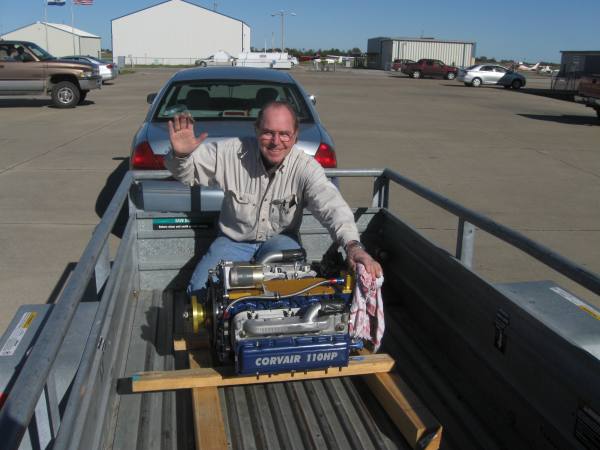
Above, Gary Burdett with the 2,850cc Dan bearing engine we built for his 750. It is rated at 110HP. He picked it up at the 2012 Zenith open house.  His firewall forward is made of our standard off the shelf components for Zenith installations. Gary decided that he was going to take full advantage of our 9 years of successful Corvair installations on Zeniths by sticking directly to our the step by step notes in our Zenith installation manual. This is the best way to insure an uneventful first flight just like Gary’s. On his first flight, Gary stayed aloft for 30 minutes. He said the OAT was a cool 60F, but the CHT on the engine never exceeded 300F. Not bad for a brand new motor, on a design with a factory 575F limit. In hot summer weather with a fully broken in engine Gary’s instalation should run 350F in climb and 325F in cruise, a very large cooling reserve on the 750. 

One of the reasons why Zenith aircraft are so popular is the amount of engine choices available to builders. Compare two well-known LSA aircraft the Van’s RV-12 and the Zenith 601/650 series. The only engine allowed on the RV-12 is the Rotax 912.  The Zenith can use a 912 also, but there are also seven other popular engines commonly installed. Zenith believes that if you are smart enough to build and fly a plane, you can probably select an engine that matches your needs. Sebastien Heintz, Zenith’s president, has demonstrated his commitment to this path by inviting many engine companies to his open houses and having a day at Oshkosh were there companies simultaneously met builders in the Zenith booth. To me, this fits with my perspective that homebuilding is about making educated decisions for yourself. The concept that a Homebuilder would be restricted to a single engine suggests both an inflexible airframe design and philosophy of post-sale control, neither of which are particularly appealing. Even the owners of certificated aircraft can select different engines through STC’s, homebuilts should have at least as much freedom.

At Sun N Fun this year, I had at least 100 people a day walk into our Flycorvair booth and ask the same two questions: What does it weigh? and How much does it cost? Any builder who has these as the primary two questions is not ready to choose an engine, period. Notice above, I said I am in favor of builders making educated choices. I told every one of the people with the two standard questions that they needed to do more homework, specifically evaluating what they wanted out of an engine, and which characteristics were important. To open their mind a bit, I pointed out that even if an engine weighed only 100 pounds and cost just $1000, it would do you no good if it wasn’t reliable. The first thing you need to know about any aircraft power plant is simply it’s reliability.

Many people think that this can be evaluated by simply asking the sales rep. What is the TBO? First, in the experimental world, companies often make up any number they like for TBO, particularly auto conversion companies. I have seen companies claim a 3,000 hour TBO on engines that had yet to have a single example fly more than 100 hours. If the engine made 100hp at 5000 rpm in a compact car, then the car would have done about 120mph at the power output that is used to fly a draggy plane. A 3,000 hr TBO says that you could take the same compact car and drive it at 120 mph for 360,000 miles without wearing it out or expecting it to break. Does that sound realistic? Think you could get a car to do 25 coast to coast trips at 120 mph /5,000 rpm? That is a pretty big goal, and it is only 500 hours.

Real reliability is a much more complex issue than a TBO number. First, reliability is about how long between a power plant breaking, not how long it is before it wears out. In WWII, a Rolls Royce Merlin was considered a very reliable engine, but the TBO was only about 250 hours. It was not an issue of how long it lasted, the vital question was would it break without warning? An engine getting tired over time is acceptable, and engine breaking is not. My perspective on how to achieve reliability is to lower the stress on the engine by running it at a fraction of the automotive rpm and HP, increase the strength of internal components by using parts like forged pistons, make the fuel and ignition systems as simple as possible, and then train the operators to really care for the engine by allowing each of them to become his own mechanic/engine expert. I would love to take credit for this as an original idea, but two other engine companies thought of it first. You may have heard of them, they had some pretty good success with the concept. Their names are Lycoming and Continental.

Beyond the basic engine, we offer several things for Zenith builders:

1) Conversion, installation and flight ops manuals.

2) The availability of every single installation component, flight proven over nine years and 70 flying aircraft.

3) We have a separate on-line peer-to-peer discussion group just for Corvair/Zenith flyers to directly and freely share information and data with each other in a civilized productive format.

4) We have free Colleges and I still make free house calls.

5) the Corvair is fully insurable from hour number one, at the best rates.

With all of the above and the Corvair’s 53 year flight history, you might think that the majority of Zeniths would be Corvair powered. In reality, the portion of  Zenith builders we are working with is about 20%. The Corvair isn’t for everyone. If I said it was, I would be no different from an airframe guy who told you there was just one engine for his design. Over the years the 20% number has largely remain unchanged. A business man would be focused on “market share”, but I am first and foremost a Homebuilder, and I recognize that the Corvairs greatest appeal is to ‘traditional’ homebuilders, the people who are in it to learn new skills and be the master of their creation, not just it owner. That attitude was once 100% of the EAA, but today, all kinds of people are attracted to homebuilding. Most of them don’t think like I do, (some are hardly thinking at all) but nor are they required to. I am just here to work with the builders who have carefully thought out and evaluated their needs, and have made a selection at a much higher level than What does it weigh? and How much does it cost? -ww

Mail Sack, 4/28/13, Various topics;

Builders;

Here is a sample of the mail:

.

On the topic of Carl Sagan and the value of individuality:

601XL builder/flyer Dr Gary Ray writes:

“If each Individual strives to be the best that they can be and follows their own course, then they are the primary beneficiary and all of society benefits as a secondary beneficiary. The Individual is free and society evolves in a positive direction. There are benefits not immediately obvious. Such as a huge increase in mentors and role models. I know now that I am only half as much as I could have been because there was not enough quality science exposure in my early education.
This mental malnurishment takes a toll. It burns time and we know now that a human brain will truncate pathways that are not used (use it or loose it). Each year another thousand doors of opportunity slam shut. So my advice to everybody is, start early and “Go for it”. Associate with those that know much more than you do if you want to learn and grow quickly.”

Pietenpol Builder/flyer, 2012 Cherry Grove trophy winner Kevin Purtee writes:

“I’ve mentioned that I can’t read the website at work anymore so I have to set aside time to get caught up at home. Read all the philosophy tonight. Good stuff. I’m not smart enough to understand a lot of it, but I get enough, I think. I really enjoyed the risk management series. I’ve been doing aviation safety professionally since 1989 and you continue to help me evolve with fresh insights. -Kevin”

601XL Builder w/running 2700/Dan engine William Dominguez writes:

“I’m also a big admirer of Carl Sagan and its work. I was in my early 20s when I watched Cosmos for the first time and it influenced heavily in the formation of the world view I have today.- William”

Builder Bruce Culver writes:

“You see, William, as Ronald Reagan would say, there you go again – enriching my literary understanding of the world. I read Orwell’s review of “Darkness at Noon” and it was everything you said, and so was the quote from Carl Sagan, disturbingly (and accurately, alas) prescient. Both are now safe on my computer for future reference and reflection. And I do reflect on things like this, as I consider what kind of society and culture we are leaving our kids. I am glad I grew up in the 1940s and 50s, when kids could and did ‘go out to play’, sometimes staying away from home for the whole day, exploring streets, neighborhoods, woods – all sorts of places – when we could express our curiosity without being labeled ‘hyperactive’ or ‘ADD’ and get pumped full of drugs, when we could be independent and learn on our own, when we weren’t scheduled to a fare-thee-well to make sure we would get into Harvard Medical School. We had it so good, even if we had no idea at the time just how good it was. Nero once championed ‘bread and circuses’ to keep the people distracted and content, and I see much of that in today’s culture, in “reality” TV and talk radio. The bride and I choose not to participate. You may be, in the truest sense of the term, one of the best-educated people I know and it is a pleasure to read and reflect on what you wrote here – it is so rare to have this kind of philosophy discussed, but it does lead us to consider at least the value of being our own person, pursuing our own dreams, making our own mark, refusing to be one of “those cold and timid souls who neither know victory nor defeat.” Bravo”

601XL Builder/Flyer Phil Maxson writes:

“While teaching another builder how to polish aluminum in my hangar last night, my friend lamented an $80 part he had ruined due to an error. After looking under my workbench at the many, many parts I had made and was not satisfied with, I responded, “If you stay with this project to completion two things will happen: 1) you will waste far more than $80, and 2) you will gain an education that is better than your college degree.” Sure, we are building airplanes, but in reality we are building men and women.-Phil”


On the topic of engine availability:

Merlin on floats Builder/flyer Jeff Moores of Newfoundland writes:

“Hi William, I’ve been trying to think of something clever to say all week but can’t think of anything, but I feel the need to send a small message of encouragement. I look forward to every evening after a long day at work, (sometimes followed by an evening flight if I’m lucky) when I read your blog. All of the positive things people are saying are right on. Keep up what you are doing and please don’t change! You are both informative and entertaining. I have said this before but again thank you for all of the help you have given me since I started my engine build.

I find it odd for someone to question the “availability” of Corvair parts, and the future thereof. I am probably the most out-in-the-sticks Corvair pilot around, yet I have managed to find a complete core engine locally as well as two spare blocks, a crank (currently at Moldex) and four spare heads. My engine is working so well that I don’t anticipate ever needing these spares but I’m building a QEC (quick engine change) just in case. I do not want any down time! I’m probably farther from Corvair parts than any builder in North America. With all the new stuff from Clark’s and Dan it’s a non issue. The ice on our lake has melted so now I’m back on the water and having tons of fun!!-Jeff, Corvair/Merlin”

Pietenpol builder Dave Aldrich writes:

“If you’d like a counterpart in the automotive community, look at the Ford Model A. Henry built 4.3 million of them (less than 3 times the Corvair total) and the last one was built over 80 years ago. Virtually every piece has been reproduced (in varying degrees of quality) so you can literally build a new Model A, except for maybe the engine block and one or two other castings. The point is that, if there is a demand, there WILL be a supply. People are still building racing parts for that engine, for heaven’s sake. I submit the same thing is true for the Corvair engine, even within the very small aviation community market.”

Builder Jackson Ordean writes:

“Great reality check, especially for us noobs at the bottom of the ‘hiking trail up the hill’. It’s notable that folks critical of even your very high level of ‘transformation’ (I like better than ‘conversion’) of the motor, don’t seem to do any research on O-200 part failures.

5th bearing, de-rating power, non-aerobatic rating, and propeller choice wisdom (and of course, airframe choice), are all parameters you have created that have highly reduced risk down to a non-issue in general. Therefore, specific follow up in craftsmanship and quality part choices falls to the builder.

Re your personality (at least the 2% that can be gleaned from a person’s writing and ‘public persona’) and philosophic bent and expression thereof: Don’t waste an erg more. Say what you want. Besides, we like it. If it’s ‘too real’ for some, that’s their problem. Finally, this post re tech issues is a pretty perfect balance of personal expression, truth, facts, and re-challenge to any questions doubtful or critical of your Corvair program. Thanks!-JO”

 Jackson also shared the thought: “A handy ‘ruler’ to measure the validity of our beliefs is whether it helps, encourages, builds up, validates, saves, touches others. Simple, really. The bumper sticker version of this is: “Stay stoked ’til you croak!” – usually covers all the above. {;^)”


Builder Dan Branstrom writes:

Amen!

.

On the Dragonfly flight report from “One Sky Dog”

Dragonfly builder Guy Bowen from TX writes:

“Congrats on 20hrs.OSD! I hope to learn a great deal from your experiences with this air frame and engine combo. I’ve been following your latest exchanges on engine baffling/temp and prop performance experimentation and it seems you are seeing some progress. Things are proceeding well on my 2850 and I hope to get the core finished before the end of the year. By that time you will probably have more issues worked out.”

.

Some parting shots on the topic of “Plain Speaking”

Builder Harold Bickford writes:

“Lots of good commentary here William, which took more than a few minutes to read and consider. I happen to appreciate the openness and honesty and am never put off. The idea is to learn and develop and that applies to more than just flying machinery. – Harold”

601XL Builder w/running 2700/Dan engine (CC#22), Becky Shipman writes:

“Hi William, I feel confident you will keep writing your mind, so no worries here. People worry about attracting new people to aviation, so one approach is to sugarcoat the risks. I think it’s better to encourage people with a healthy approach to risk management. As a smart but initially uninformed person, knowledge of the actual risks and ways to mitigate them is my way of overcoming fear. That’s what you lay out in your manual and website, and I think the stories just fit in w/ risk management. My recent injury is an example of letting my guard down after 23 years of attention to safety detail.

Ethically I don’t like the idea of making aviation seem easy, then letting mother nature sort out the worthy. I think we do the same thing w/ motorcycles, BTW. It’s the quick sale over the long-term customer. Unfortunately, I think the fact it takes a lot of money to get into aviation means the people who can afford it are not those who have the mindset to succeed at it. Take care, Becky”