Builders,
Several people have been discussing these types of cowls for their Corvair powered planes. Clearly they work on 65 hp Cubs, why not on a Corvair powered Piet? Well, they can and do, but there are subtile points to the design of these things that are just as critical as enclosed cowls. I am quite sure that Piper learned these by trial and error before standardizing the “J-3 Eyebrows” that people tend to use on 65 hp Continentals. As we go over this, keep in mind that when Piper went to 90 Hp engines in Cubs after the war, they switched to regular pressure cowls. Every Super Cub has one of these, and there is little argument against the proof that they work better, even on slow planes. However, if your heart is set on a J-3 style cowl, please read the following notes to avoid harming your engine.

Above, Frank Metcalfe’s plane at sun n fun. This installation works. Look at how large the eyebrows are in relation to other examples. If a 65 hp Piet and a 100 hp Piet are both climbing at 55 mph (They will have a very different rate of climb) it makes sense that the 100 hp plane will need more cooling air. Yet, I see too many Corvair powered planes with eyebrows that are smaller than the ones on a J-3. Think that over.

Above, our Pietenpol in 1999. This system worked great, but the two versions I made before it didn’t. TLAR (that looks about right) does not apply here, evaluation and testing does. In a phone call today, a Piet builder told me that a set of Corvair eyebrow scoop drawings are circulation on the net. What is the first question to ask? Have they ever flown and been proven on high hp Corvairs in hot weather? He was not so sure. If you want advice on down parkas, I am not your guy. If you need advice on cooling systems that work in hot weather, ask the guy in Florida.
Above, several details, some visible, some not. Notice that the scoops extend downward. They capture air that would run under the front cylinders at high angle of attack and ruin cooling. Notice the rounded nose bowl and spinner. If you want to have a flat plate as big as an end table, you will need to have much larger scoops to make up for this. Note also that the alternator is in the back. If you have a front one, it will work, but again the scoop must be bigger. (Dan Weseman has just finished testing his rear alternator, and it is the only one I endorse) The most critical part of this whole equation can not be seen: under the cowl there is a 3.5″ diameter hose connecting the two sides together. Without this, you are hurting the engine. You have a choice: connect the two sides, or use scoops 50% bigger. If you copy the size here, and then use a very blunt cowl and no transfer hose, than you are not doing anything positive for yourself, my reputation as an engine instructor, or the Corvair movement.
OK, now we get to the big quiz: Would you rather spend an hour reading something that requires a little thinking, or would you rather fry the heads on your engine, spend $1,000 or so, and loose half a seasons flying doing a rebuild? Right now you are thinking that 100% of the builders thinking of J-3 cowls are going to choose the first option, but you are not right……
goes straight to a 16 page story ( it has pictures, it is only about 5,000 words) about how I had to rebuild Gardiner Mason’s engine several years ago after he used TLAR to design a very blunt cowl. I like Gardiner, so he just bought the parts, I did the work, then wrote the story. KNOW THIS: I am not ever going to assist anyone for free to rebuild another engine that cooked it because: “I saw that story but I didn’t have time to read it because 1) It was sooo long 2) The big game was on 3) I didn’t think it applied to me because my plane is gray not red.” All future rebuilds will be done at the shop labor rate that Lockwood Aviation charges (the US importer of Rotax engines) Just read the story, learn something, save yourself a $1,000 in damage and preserve a little of my sanity. Please.

Above is Gardiner’s plane, the focus of the 16 page story. It does not look like it has a J-3 cowling, but it functions like one. This is a blunt cowl. This means you need bigger scoops. It isn’t hard to put some effort into making the front end smaller. It doesn’t just help cooling, the plane will be faster and look better. On a Pietenpol, a plane with a bad cowl and poor windshields actually has less elevator and rudder feel. If the entire fuselage is bathed in a foot thick boundary layer of very turbulent air, you can feel this when it gets back to the tail.
So, you were planning on reading the 16 page story after watching Dancing with the Stars and the Celine Dion concert? Keep in mind that this website has story tracking on it, and I will tell if 600 people read this but only 150 click on the link to the Gardiner story. Lucky for all the Celine Dion fans it doesn’t keep track of who didn’t read what. Just how many people didn’t. Don’t worry, I will still be able to tell who read it by reading the Pietenpol archives and seeing who writes in asking what to do after their engine severely overheats…….
Below is a sample from the 16 page story:
” Here is the major cooling issue of a propeller-driven aircraft that many builders don’t understand. When the plane is climbing at a 10 degree angle of attack, the blade roots near the cooling inlets have a 20 degree difference in their angle of attack between the effective angle of the ascending and the descending blades. They pump very different amounts of cooling air into each side of the engine. This is not theory, it is fact. Get into a light plane, fly to a safe altitude, slow it down to its best angle of climb speed and set it to full power. Notice how much rudder you have to put in to hold the aircraft heading. You may have been told that this was some swirling slipstream or “P” factor. Discard those ideas. A strand of yarn behind an engine on a test stand will show you the air even at zero airspeed doesn’t corkscrew much, and “P” factor does not apply to aircraft in steady flight like a continuous climb on one heading. What is going on is far more simple; the ascending and descending blades are making very different amounts of thrust. You feel it in the rudder pedals, the engine feels it in differential cooling.”

Above, the Pietenpol of Kurt Shipman. This plane won the Bronze Lindbergh trophy at Oshkosh. Before anyone starts saying how nice work Kurt does, keep in mind that there were 24,500 other planes at Oshkosh that year, and the judges were able to find four others that they thought were ‘better’ than Kurt’s. So he beat out 24,495 other planes…..that still isn’t first place. Nice try Kurt, maybe you can do better on your second home built.
Seriously, I flew in this plane and it is phenomenally well done. Look at the cowl. This is a typical pressure cowl. This is built off the nose bowl mold that Piet builder/flyer Shad Bell made. Rounded edges and reduced area like this make a huge difference. If you don’t have a committed feeling about cowling design, I highly encourage you to look at this set up. It works very well, and has a front alternator. Either system you choose, use all the available data that has been flight proven in hot weather, do a good job, and don’t alter the details without good reason.-ww
Builders,
In the last few days we have featured some stories on Carbs. Today I went to the mail box and picked up a package that happened to be my MA3 carb returning from overhaul. It was gone about two weeks.

Above is the MA3, freshly overhauled by D&G Suppy in Niles MI, (269)-684-4440. This is the FAA fuel system repair station that is run by Russ Romey. We have been sending builders there for 10 years. He is an excellent source of rebuilt MA3’s and Stromberg NAS-3s.
Several points here; It is hard to see, but the carb is sitting on my receipt from Russ. Although we are friends, note that the overhaul cost me the same price as he charges any other person, $650. Years ago, a handful of people on the web, led by Lon Wall of the Corvair Underground inc, frequently spread the lie that I made money and kick backs off the products I recommend to builders. This was Lon’s explanation why I suggested people shop with Clarks rather than him.
He didn’t understand that he lost the business solely because he wanted to sell builders cast pistons and old rod bolts. His claims went on the net for several years, mostly unchallenged or unmoderated. They sounded good to a handful of people who liked a good conspiracy theory or hated me since I first used the term “The Corvair authority”, (All of them missed that the acronym TCA at the time was a FAA airspace called a Terminal Control Area, and the letters stuck in aviators memories, and “WilliamTCA” my email address, predates our name “FlyCorvair” by several years.) Let the receipt be one more piece of evidence that my endorsements are not for sale.
My allegiance is only to the best interests of builders. In the last 10 years, lets conservatively say 1,000 people have built a complete corvair aircraft engine. On average, between cams, pistons, bearings cylinders, balancers, gaskets etc they spent $1,750 each on parts from a Corvair parts house. Thats $1,750,000 in shopping. The lion’s share of this went to Clarks. I did not make a single dime off any of this. If Lon or any other parts house wanted a part of it, all they had to do was sell the parts we recommend and not offer advice like using cast pistons in flight engines. Evidently, he couldn’t do this.
Second; An MA3 is a simple carb, I have been an A&P for 22 years, I am qualified to overhaul this myself, but parts are expensive, more than half the price of the complete job. In the end, I am glad to pay Russ a few hundred dollars to make it perfect. I have no problem paying another American aviation professional for his expertise. This is how the infrastructure of aviation as we know it in this country stays in place.
If someone chooses to buy a Rotax with their two German Bing motorcycle carbs, they are only fueling the trade deficit, and doing nothing to support American manufacturing and aircraft maintenance systems. And no, a person who took a 40 hour Rotax ‘mechanics’ class is not a trained aviation professional, they are just an extension of a foreign companies sales staff. For a reality check, my A&P training at Embry Riddle had the strict FAA requirement of 2,800 classroom hours.
If I had told the maintenance department chairman, Dick Ulm USMC ret. that I was ready to evaluate airworthyness on aircraft at the end of my first 40 hour week in the program, he would have laughed his ass off, and then punched my lights out. If I then complained to the University president, Kenneth Tallman, Maj. Gen. USAF, ret., I am pretty sure it would have had the same result. If anyone asks in 5 years why S-LSA”Light Sport category” failed live up to any of its potential to do positive lasting good for aviation, at least part of the blame will be on the fact the ASTM ‘certification’ standards on these planes are a bad joke, and the maintenance on them is done by woefully underqualified people.
Third; This carb is going on our own Wagabond, the plane that my wife will also fly, and we will bring the dog. The day it flies it will not have a radio, a transponder, a GPS, a Glass anything, an interior or a fancy paint job. Those things don’t make planes fly. It will however have this carb and it will have a 5th bearing, and a very well-built engine. Aviation is about good decision-making, and placing any of the first items ahead of the latter ones is an example of poor decision-making, and no one can offer a rational argument otherwise. Looks and tech toys come after airworthness items. If you have budget left over, add those things if you wish, but only after it is mechanically as good as you can make it.

It is a free world, and you can use any carb you like on your Corvair. Physics, Chemistry and Gravity also think it is a free world, and they fully support your right to make a poor choice, even one that will harm you if it doesn’t work within their system of laws. If you wanted to run a German motorcycle carb, don’t be mad at me if it doesn’t work. I didn’t make up the laws of the physical world. I am just the messenger here to remind people that Physics, Chemistry and Gravity are great allies if you play by their rules. They are also absolutely remorseless in dealing with people who feel like the rules don’t apply to them. Be advised, if they find you guilty, the penalty phase of the system moves much faster than our criminal courts, and does not have an appeals system.
It is no secret that I like aircraft carbs. Look at the photo above, the lettering cast into the body says “Marvel Schebler Aircraft”, the logo in the middle is a propeller. This was not designed for use on motorcycles. Look at the silver throttle arm. I could literally hang the entire weight if the engine off this arm. It is not fragile. In contrast the throttle cable on a Bing carb is a tiny bicycle cable, the exact same kind that you see on cheap bmx bikes at Wal-mart. A long time ago I flew ultralights with set ups like that, and justified it by the low landing speeds. Today, I am older and somewhat smarter, and I would not fly in any plane that used a bicycle cable as a primary engine control, especially not one where the carb is going to close if the cable breaks. If the cable falls off an aircraft carb, suction alone will generally make them run at full power.
In mechanical situations, I am a traditionalist. If we are going deer hunting, no one can argue that my choice to bring a .30-06 will not work. If we were going to sea in a storm, no one could argue that my choice of going in a USCG 44′ motor lifeboat would not work. If we needed a light truck engine, no one could argue that my choice of a 350 v-8 would not work. If the goal is to put a carb on a Corvair flight engine, no one can argue that my choice to use a MA3-spa will not work. They might say it was expensive, (valid, but not in the big picture) hard to find (not valid, just call Russ) or less efficient that EFI (not valid, see my testing), but no one can even begin to say that this carb is not reliable. It works and does this task with stone reliability, end of story.

Above, this side of the carb shows the accelerator pump, and the bronze mixture control arm. the orange plug it covering the threaded fuel inlet port which an AN fitting goes in. Just to beat a dead horse, let me point out that Bing carbs on Rotaxes just have barbed slip on fittings for rubber hose and hose clamps for fuel inlets.
The intake in the background is for our Wagabond. It is stainless, just like our others, but I elected to have it powder coated. It has a longer, one of a kind up pipe between the carb flange and the main pipe, on production manifolds this is about 1/2 that length. The small tube was for a primer line when the plane was equipped with a Stromberg carb. Going to an MA3, I have deleted the primer system. I will just have to find a plug to fill the hole….or maybe just screw a NOS nitrous fogger nozzle into it….-ww.
Builders;
I recently had some conversations with out neighbor Bob Woolley. He is building a Panther, and he is the second pilot who is working with Dan to fly the test program on the Panther prototype. You can read this link about Bob on the Panther website:
Bob is the F-4 Phantom pilot in this story I wrote last year about Marvel Shebler (MA) Carbs:

Above, three aircraft with carbs below the engine parked in our front yard. L to R, Louis’s 601XL – MA3-spa, Grace’s Taylorcraft – Stromberg, and Dan Weseman’s Cleanex-MA3-spa. The 601/650 is one of the few Corvair powered airframes that uses fuel pumps, almost all others are gravity feed. You might not guess this at first glance, but the Cleanex has no fuel pumps, it is only gravity feed, but it worked great, even during aerobatics. Do not accept complexity without good reason. The 601/650 have the fuel in the wings, which is a good trade-off for complexity. High wing planes can also have the fuel in the wings, but they don’t need pumps.
Bob is a outstanding pilot with a lot of experience both in building and flying, his professional approach rooted in his years in the USAF. Although his homebuilt experience runs from Pitts Specials to Glassair IIIs, almost all of the time is behind Lycomings. The panther was the first Corvair powered aircraft that he flew, and I wanted to catch his first impressions the same day he flew it. Came down to three points: It was the smoothest engine he could remember, It had more power than he expected, and it started easily.
Anyone who has been to a college and seen a Corvair that has never run before fire right up after 3 or 4 seconds of cranking will attest to Bob’s last point. When I put up the video of the test run on the 2,850 a few days ago, I intentionally showed how well the engine will repeatedly hot start. Between videos like this, colleges and flying planes, there are countless examples of how well the engine starts.
A second thing that came out of the conversations with Bob was that part of his Lycoming experience was different from Corvair procedure. With Lycomings, the major concern in starting operation is not flooding the engine, because if you do, it can be very hard to restart. For this reason, Lycoming pilots shut their engines off by pulling the mixture to idle cut off and starving the engine for fuel. When starting, they are very cautious not to get too much fuel in the engine by priming. The biggest factor on why Lycomings flood is their magneto ignition producing a low voltage, low energy spark, a plug gap of only .016″ and fairly low compression. If you get too much fuel in a Lycoming cylinder, the ignition can’t burn it off the plugs, and the lower compression will not vaporize the fuel just from the heat of compressing the air in the cylinder. It is a big issue, and if you are at an airport and you hear someone grinding away on a Lycoming starter, they probably flooded the engine.
The Corvair is a contrast to this. The 40,000 volt high energy ignition and .035″ plug gap is comparatively immune to flooding. The ignitions that we build have enough energy to fire plugs that are dripping with fuel, and when they do start, they will generally burn the carbon off the electrodes. The Corvair’s compression being one point higher doesn’t sound like much, but it gets it over the threshold of vaporizing fuel. If a corvair is cranked, it will vaporize excessive fuel and blow it out the exhaust, where a Lycoming will often leave wet drops of fuel in the cylinder even when it is cranked repeatedly.
When a piston comes to top dead center on the power stroke the air and fuel in the cylinder gets instantaneously hot. This is called adiabatic heating. The higher the compression, the hotter it gets. Our thermodynamics teachers loved pure textbook examples, where there was no heat transfer to the container, but those scenarios only exist in textbook land and unicorn world. Professors actually love things like “Carnot cycle engines” which we paid money to learn was perfect, albeit with the small flaw of just being theoretical and not possible to build. Thermo is the only branch of science that devotes time to studying and being fascinated with perpetual motion machines. Ah, but I digress…….

Above, an overhaulled NAS-3 that went on the Pietenpol of Dave Minsink. Read the story at: Stromberg Carbs
What you can take away from this is if you ever have a hard time cranking a Corvair, it is far more likely to be under primed than flooded. Dan provided Bob with a detailed procedure checklist to adapt his Lycoming experience to Corvairs. This included stopping the engine with the ignition switch rather than the mixture, priming the engine with the MA3’s accelerator pump one second before cranking, and starting the engine with the throttle cracked open slightly opposed to on the idle stop.
With these differences, the Corvair will start instantaneously. These procedures apply to MA3-SPA planes, but a variation on them also works well for Corvairs with other carbs. Our test stand has an old MA3-SPA on it, and it has done the first run on more than 150 engines. It has no primer, other than the accelerator pump in the carb, but I can generally get a brand new Corvair to fire off in 3 seconds at a College. Builders at these events in cold weather have seen me use the accelerator pump with as many a four shots before starting. This will make fuel drip out of the corers of the airbox. This leads people to think of the engine as potentially ‘flooded’, but in reality, excess fuel in the airbox doesn’t mean it got to the cylinder head.
With a warm engine or in warm weather, as seen in the video, the engine will start without any priming at all, unless the last operator shut it down by pulling the mixture. Again, other carbs will have slightly different procedures on a Corvair, but the concepts are the same, and I can think of many flying examples of Corvair powered planes for all of the popular carb choices that are capable of starting instantly. There is no reason to accept less than this on your own aircraft.
An entirely separate issue is engines that don’t crank well. Over the years I have had a handful of builders report to me that their Corvair powered plane had difficulty starting. One of the common things that these people said was that it could start easier on the points side of the ignition than it can on the electronic. More than one builder went to putting a very small second battery just to power the ignition during cranking or as some sort of back up. The fact this ‘worked’ seemed to validate their conclusion. In reality something else was likely at work. Read on;
First, let me say that several hundred running Corvairs use our E/P ignition. It completely dominates the flying Corvair community. Aircraft as diverse as Mark Langfords KR2S and Bernard Pietenpol’s “Last Original” have used our system. It is on the vast majority of all the Corvair powered planes you have ever heard of or seen pictures of flying. It works period. One of the things that any operator can tell you is that going from E to P, the ignition is on the other side instantly. Going from P to E, there is an audible delay of perhaps 1/4 of a second. Most people would not notice it without the comparison. From this, people with a starting issue often conclude that the two different sides should have different starting behavior. If they are just looking at one plane, this looks like reality. However, I have seen countless planes start easily on the Electronic side. Since we know that the modules, coils, and effectively the engines on these planes are the same, why are some people having an ‘issue’?
The most common answer is not the ignition, but the cranking end of the equation. Several things I have seen on planes have caused enough voltage drop on particular planes that the Electronic side had difficulty getting the voltage to start instantly.
Before we get to specifics, a quick test: If a plane is hard to start on the electronic side, hook a second, fully charged, 12 volt battery just to the E-coil with little jumper wires. If this ‘cures’ the problem, you almost certainly have one of the following going on:
-Low Main battery, or a dead cell in it.
-Missing or barely connected ground wire or strap causing high resistance and a system voltage drop.
-Starter shimmed too tight and binding, causing excessive current draw/voltage drop.
-undersized or poorly connected positive power cables.
-a separate ‘starter solenoid’ on the firewall (your starter has one, and if you put a second in, a-la the aeroconnection work book, you will cause yourself issues.)
radically advanced timing, incorrectly set.
Putting a second battery in is not the ideal way to correct the problem, the right way to do it is to fix the direct issue that is making the hard starting plane different from the others that function correctly.
The battery on the test stand is just a cheap one I borrowed from a garden tractor 9 years ago. It has less than 40% of the cranking power of a Oddessy 680. Yet it will go for a College and many months without being charged, happily starting Corvairs instantly. If an engine does this on my stand for its first fire up at a College, but is a hard starter when later installed in a plane, chances are, it has something to do with the airframe installation.
You might scoff at this, but last year, Dan and I had a series of phone calls with a Corvair pilot, a second owner who didn’t build his plane, who was having an ‘issue’ with a ‘bad’ starter. Dan specifically told him to get a set of jumper cables, and jump the starter off a car directly as a test. Pilot claimed to have done this, but didn’t actually try it. Instead he replaced the battery; borrowed a car and drove 100 miles and paid a guy to rebuild the starter in spite of the fact the rebuilder said there was nothing wrong with it; called me and asked if we could send him an entirely new starter: went on the internet and asked local experts for help; nothing worked. The issue? Of course his ground wire to the engine had fallen off. If he had followed the test of the jumpers, he could have saved several frustrating days and about $1,000. Experimental aviation is a very expensive hobby if you have trouble with following good advice.
Here are things that are not likely to be an issue:
-“stuck weights” in the distributor. I have had people claim this as a possibility on a hard start, but I can show anyone that the starter we use on the Corvair can crank the engine with 30 degrees of static advance.
-a variation in parts i.e. “My Crane E unit must have a different character than all the others” Mass produced electronic devices are not like this. There is far more variation in the quality of ground straps and battery connections made by homebuilders.
If any builder experiences anything other than quick starting, I encourage them to write me or call. There is no reason to tolerate sub-standard operation, and there is really no reason to follow sub-standard advice. ww.
Builders,
Below I have stripped down the new numbering system to just the group headings. Now it is forming something of a check list for a builder. Without the details drawing your attention, you can get a bigger picture of the build as a path.
In this segment I want to show builders where the primary sources are for people finishing most engines today. Again, this isn’t a detailed shopping list right now, It is just a big picture overview of the best route to success now days.
If the task of building still looks long even with all the details removed, first note this: Groups 3400 through 4300 are in this color brown. They are best understood as the airframe installation part of the engine build. If your goal is to get an engine running on the stand at a college, you will not need any of the parts from these groups yet. So lets stay focused on the groups through 3300.
Next, understand that you will not need to use all 34 of the other groups to have a running engine, There are 3 different 5th bearing choices listed, Dan’s is 3000 in blue, Roy’s is 3100 in green, and mine is 3200 in black. There are other choices on oil systems, charging systems, and other parts that mean a running engine is built out of roughly 28 groups.
Every group that most builders today get from Dan is coded in blue. Looking at Group 1000, it is blue because Dan is now processing the majority of cranks going into engines, and supplying a flow of new billet ones. He isn’t the only place, Moldex is still doing cranks, but I want this list to focus on what is popular now, not every possible path. Shortly, Rachel is going to have the same numbering system on their website as we use here to make processing easier to follow.
Parts from Roy are coded green and those from Mark at Falcon are coded red here. I left everything else in black. A little later I will introduce our own detailed parts list with new numbers, but for now, the majority of the remaining items in black are from us or through basic sources like Clarks.
While getting this overview, feel free to go back and look at the 20 parts I wrote in the last 60 days under the heading “Getting Started in 2013.” They provide an in-depth look at builder choices for the Groups 1000-1600. This is what the new numbering system is about; having the ability to have a good overview of the process by looking at the checklist below, then getting a more detailed look at each step and the required parts by studying the full list presented in the two previous parts, and finally, having each component numbered so that you can read and understand anything I share about my experience on that exact part, without loosing your place on where that specific part will be serving in your own engine build.
In the next segment, I am going to build up some typical engines and show exactly which groups they draw on, and in which order you work them to get to the finish line of a running engine this season.
.
(1000) Crank group
.
(1100) Cam group
.
(1200) Case group
.
(1300) Piston and rod group
.
(1400) Cylinder group
.
(1500) Head group
.
(1600) Valve train group
.
(1700) Head clamping hardware
.
(1800) Steel engine cooling baffles
.
(1900) Valve Cover Group
.
(2000) Rear oil case group
.
(2100) Oil pump and regulator group
.
(2200) Oil Pan Group
.
(2300) Front cover group
.
(2400) Starter group
.
(2500) Hub group
.
(2600) Top oil group
.
(2700) Oil cooler group
NOTE: If you opt for group 2700, then delete group 2800.
.
(2800) Heavy duty oil cooler group
NOTE: If you opt for group 2800, then delete group 2700.
.
(2900) Standard charging system group
NOTE: If you opt for group 2900, then delete group 2950.
.
(2950) Rear charging system group
NOTE: If you opt for group 2950, then delete group 2900.
.
(3000) Weseman 5th bearing group
NOTE: If you opt for group 3000, then delete the 2300 group. Contact FlyWithSPA.com for more information.
.
(3050) 5th bearing oil line group
.
(3100) RoysGarage.com 5th bearing group
NOTE: Typically, builders selecting this option will be fulfilling the following groups: 1000, 1100, 1200 and deleting 2300. Contact Roysgarage.com for detailed pricing.
.
(3200) William Wynne 5th bearing group
NOTE: This bearing takes the place of groups 1000, 1100, 1200 and deletes 2300. Bearing system is not in production at this time.
.
(3300) Ignition group
.
(3400) Airframe ignition group
.
(3500) Airframe charging group
.
(3600) Intakes and carburetors
.
(3700) EFI Electronic fuel injection
Note: included only for later discussion.
.
(3800) Mechanical fuel injection
Note: included only for later discussion.
.
(3900) Stainless exhaust systems
.
(4000) Propellers and spinners
.
(4100) Baffling and cowls
.
(4200) Motor mounts
.
(4300) Airframe fuel systems
Builders:
Here is the second half of the revised numbering system:
I revised the 2600 group at 8:30 pm est 3/21
I revised the 3300 group at 10:25 pm est 3/21
Starter group (2400)
2401- Starter
2402- Starter brackets w/hardware
2403- Tail bracket
2404- Fine gear
2405- Top cover
2406- Top cover gasket
2407- 5/16″ top cover hardware
2408- Ring gear
Hub group (2500)
2501(A)- Gold hub
2501(B)- Short gold hub
2501(C)- Black hub
2502- Hybrid studs and washers -6-
2503- Safety shaft, nut, washer and cotter pin
Top oil group (2600)
2601 (S)- Standard Gold Oil filter housing with 5/16″ hardware
2601 (R)- Reverse Gold Oil filter housing with 5/16″ hardware
2602- Oil filter housing gasket
.
Oil cooler group (2700)
2701- Stock oil cooler
2702- Oil cooler mount
2703- Oil cooler mount gasket
2704- Oil cooler O-rings
2705- Oil cooler mount bolts 5/16″
2706- 3/8″ oil cooler mount bolt
2707- GM oil cooler side baffling
2708- Outboard oil cooler mount bolt
2709- Oil filter nipple (20mm)
2710- Oil filter
Heavy duty oil cooler group (2800)
2801- Heavy duty aircraft oil cooler
2802- Gold sandwich adapter
2803- NPT to -6 fittings -4-
2804- AN-6 hoses to cooler
2805- Cooler block off plate and hardware
2810- Oil filter (same part as 2710 filter)
NOTE: If you opt for group 2800, then delete group 2700.
Standard charging system group (2900)
2901- Front alternator bracket set
2902- Mounting hardware
2903- Permanent magnet alternator
2904- Altermator mounting hardware
2905- Drive belt
NOTE: If you opt for group 2900, then delete group 2950.
Rear charging system group (2950)
2951- Rear alternator bracket
2952- Mounting hardware
2953- Permanent magnet alternator
2954- Alternator mounting hardware
2955- Drive coupling
NOTE: If you opt for group 2950, then delete group 2900.
Weseman 5th bearing group (3000)
3001- Bearing kit (designed for short gold hub 2501B)
3002- Alteration to standard gold hub (2501A)
3003- Alteration to black hub (2501C)
NOTES: Selecting this bearing option allows deleting the 2300 group. Contact Dan Weseman directly at FlyWithSPA.com for more information.
5th bearing oil line group (3050)
3051(A) – Oil feed line & fittings, Standard oil filter housing
3051(B) – Oil feed line & fittings, Reverse oil filter housing
RoysGarage.com 5th bearing group (3100)
3100- Bearing system assembly, Alteration to gold hub, oil feed line and fittings and modified starter brackets, etc. NOTE: Typically, builders selecting this option will be fulfilling the following groups: 1000, 1100, 1200 and deleting 2300. Contact Roysgarage.com for detailed pricing.
William Wynne 5th bearing group (3200)
3200- Bearing assembly system and sub components
NOTE: This bearing takes the place of groups 1000, 1100, 1200 and deletes 2300. Bearing system is not in production at this time.
Ignition group (3300)
3301 (E/P)- Electronic/points distributor with gasket
3301 (E/P/X)- E/P Deluxe w/ connector, studs, and gasket
3301 (D-P)- Dual points distributor assembly with gasket
3302- Hold down clamp, spring and nut
3303- Secondary wire set
3304- Sparkplug set -6-
Airframe ignition group (3400)
3401- Ignition coils -2-
3402- Condensors -1 or 2-
3403- HT switch unit (MSD)
3404- Coil to switch wires
3405- HT pass through
3406- Coil to pass through wire
3407- Pass through to distributor cap wire
3408- SPDT-DPDT switch
3409- Ignition fuse box
3410- Nason switch
3411- Tach pickup
Airframe charging group (3500)
3501- Voltage regulator
3502- PMOV
3503- Master solenoid
3504- Power bus/fuse box
3505- Main electrical pass through
3506- Battery
Intakes and carburetors (3600)
3601- Intake manifolds
3602(A)- Marvel MA3-SPA
3602(B)- Stromberg NAS-3
3602(C)- Ellison EFS-3A
3602(D)- Sonex AeroCarb – 38mm
3602(E)- Zenith 268
3602(F)- Rotec #3
3602(G)- 1 barrel Carter downdraft
3602(H)- Reserved
3602(I)- Reserved
3603- Carb heat
3604- Air filters
3605- Throttle cables
3606- Primers
EFI Electronic fuel injection (3700)
3701- FlyCorvair/Falcon
3702- RoysGarage
3703- Johnson/Holley
Mechanical fuel injection (3800)
3801- Airflow performance
3802- Precision systems
Stainless exhaust systems (3900)
3901(A)- Zenith 601/650/750/705 system
3901(B)- Universal #1 – KR-2, 2S, etc.
3901(C)- Universal #2 – Piet, Kitfox, Wagabond, etc.
3901(D)- Universal #3 – Tailwind, etc.
3901(E)- Reserved
3901(F)- Reserved
3902- Mufflers
3903- Y-pipes
Notes on turbo/321 pipes
Notes on iron manifold systems
Propellers and spinners (4000)
4001- Vans 13″ spinner assembly
4002- Front spinner bulkhead for Warp Drive props
4003- Warp Drive props
4004- Warp Drive mounting hardware
4005- Wood prop crushplate
4006- Sensenich props
4007- Tennessee props
4008- Reserved
4009- Reserved
4010- Reserved
Baffling and cowls (4100)
4101- Baffle kits
4102- Universal nosebowl with round inlets
4103- Zenith cowling
4104- Eyebrow cooling
4105- Rubber baffling seal
Motor mounts (4200)
4201(A)- Zenith 601/650 mount, all models
4201(B)- Zenith 750/705 mount
4201(C)- Pietenpol mount, high thrust line
4201(D)- KR2/2S mount, conventional gear
4201(E)- KR2/2S mount, tricycle gear
4201(F)- Custom mounts
4202- Tray and spools
4203- Bushings
4204- Bolts, nuts, clips, tubes
Notes on weight and balance
Notes on Cleanex mount, Panther mount
Airframe fuel systems (4300)
4301- Firewall pass through
Notes on gascolators, valves, braided lines
Note, group 1000 was revised at 6:15 pm est 3/21
Note, group 2200 was revised at 8:50 pm est 3/21
Builders:
Here is the first half of the revised numbering system. I will have the second half out later today. After that we will have a builder check list, sample build options based on the ‘Alan Able- Eddie easy’ models we discussed last month, I will introduce boxed ‘kits’ that will cover whole groups, and we will revise our parts catalog to reflect these new numbers. All on target to get done this week. Good thing I broke my new years resolution to drink less coffee. Everyone should print out copies of the posts in this series for their own shop build note-book. If you are heading to CC#25 or to sun n fun, having these in your hand will allow us to cover a lot of ground and take notes for your particular plan of progress. When I am standing at Sun n Fun, and guy has a notebook in his hand, and right beside him is a guy who claims to have followed our webpages but has no idea about this numbering system, I am going to be polite to both of them, but who do you think is going to get the bulk of my time? Which guy gets a regular answer, and which guy gets me to dig out the rear oil case and show him the flow pattern in detail?….. Correct, the guy who brought me another coffee……Just kidding.
Crank group (1000)
1001 (A)- Crank (8409 mark, GM)
1001 (B)- Billet Crank (Fly5th Bearing)
1002- Crank gear
1003- Crank gear key
1004- Crank gear gasket
1005- Rear keys -2-
1006- Fuel pump eccentric
1007- Spacer
1008- Bronze distributor drive gear
1009- Oil slinger
1010- Main bearings
1011- Connecting rod bearings
.
Cam group (1100)
1101- Cam
1102- Thrust washer
1103- Key
1104- Cam gear
1105- Hydraulic lifter set -12 total-
1106- Cam lubricant
1107- ZDDP oil additive
.
Case group (1200)
1201- Case -2 halves with studs-
1202- Main case bolts -8-
1203- Main case nuts -8-
.
Piston and rod group (1300)
1301- Piston set with wrist pins
1302- Ring set
1303- Connecting rods -6-
.
Cylinder group (1400)
1401- Cylinders -6-
1402- Base gaskets -6-
1403- Head gasket set
Head group (1500)
1501- Pair of heads with seats and guides
1502- Valve spring set
1503- Retainer set for intakes and keepers
1504- Exhaust valve rotators and keepers
1505- Intake valves -6-
1506- Valve seals
1507- Exhaust valves -6-
1508- Exhaust stacks -6-
1509- Welded on intake pipes
.
Valve train group (1600)
1601- Pushrods -12-
1602- Pushrod tubes -12-
1603- Pushrod O-rings -24-
1604- Rocker arm set -12-
1605- Rocker balls -12-
1606- Nuts -12-
1607- Lock nuts -12-
.
Head clamping hardware (1700)
1701- Guide plates -6-
1702- Stud O-rings -12-
1703- Rocker studs -12-
1704- Upper head nuts -12-
1705- Upper head washers -12-
.
Steel engine cooling baffles (1800)
1801- Under cylinder cooling baffles -2-
1802- Clips to retain engine cooling baffles -4-
1803- Baffle between #1 cylinder and distributor
1804- Baffle between #2 cylinder and oil cooler
.
Valve Cover Group (1900)
1901- Valve covers -1 pair-
1902- Hold down clamps -8-
1903- Hold down hardware 1/4″-20 -8-
1904- Valve cover gaskets -2-
1905- Oil fill cap
.
Rear oil case group (2000)
2001- Rear oil case casting
2002- Rear oil seal
2003- 5/16 hold down hardware
2004- 3/8 hold down hardware
2005- Case to block gasket
2006- Harmonic balancer
2007- Balancer bolt and washer
.
Oil pump and regulator group (2100)
2101- Oil pump assembly
2102- Oil pump gaskets
2103- Oil pressure regulator piston
2104- Oil pressure regulator spring
2105- Oil pressure regulator plug
2106- Plug washer
.
Oil Pan Group (2200)
2201 (B)- Gold billet Oil pan
2201 (W) – Fly weight welded Oil pan
2202- Oil pickup
2203- 1/4″-20 hardware -19-
2204- Drainplug
2205- Oil pan gasket
2206- Dipstick
2207- Dipstick bracket
.
Front cover group (2300)
2301- Front cover
2302- Cover to case gasket
2303- Front oil seal
2304- 3/8″ hardware -9-
Builders:
Below is a sample of the 1100 group of the new numbering system. We saw this earlier, in the ‘Getting Started in 2013’ series I wrote last month. I am going to slightly change the system of numbering to make engine building easier to organize. It is a subtile change, but an important one. I pick this simple group to show the before and after, and to explain why. Very shortly I am going to come back with the final revised numbering system, and print it all out here. We are going to change our own parts numbering system on our catalog page on our main website to match the new system, and we will have a vastly better organized system for builders to work with that will provide a very orderly path to a running engine.
Below is the original numbering system from last month. Note how the group is 1100 and also the camshaft itself is part number 1100.
.
Cam group (1100)
1100- Cam
1101- Thrust washer
1102- Key
1103- Cam gear
1104- Hydraulic lifter set -12 total-
1105- Cam lubricant
1106- ZDDP oil additive
.
Ok, here is the change: Notice the group stays the same, 1100, but everything moves down one number. below this I will explain the why of it.
.
Cam group (1100)
1101- Cam
1102- Thrust washer
1103- Key
1104- Cam gear
1105- Hydraulic lifter set -12 total-
1106- Cam lubricant
1107- ZDDP oil additive
.
Now, picture yourself building an engine with the new numbering system. As I will show everyone shortly, there are 40 different groups, each with their sub component numbers. We are going to have a checklist for builders with the 40 groups on it, so a guy heading to a college to close his case will know that he needs to have all the sub components so he can ‘check off’ groups 1000, 1100 and 1200 from his list.
The new change eliminates confusion between a builders speaking of ‘having part 1100’ which was just the cam, and ‘having group 1100’ which are all the items listed above. The simple number change above fixes this.
Second, we are moving toward a system where we will be able to offer an entire group in one box, instead of just some parts of the group. for example, Lets look at the Oil Pan Group (2200).
.
Oil Pan Group (2200)
2201- Oil pan
2202- Oil pickup
2203- 1/4″-20 hardware -19-
2204- Drainplug
2205- Oil pan gasket
2206- Dipstick
2207- Dipstick bracket
.
Traditionally, a builder bought a pan and an install kit from us, and ended up with all the things listed except for 2205, 2206, 2207. respectively, his gasket was from a gasket set like the clarks 120ww set, but we are moving toward getting builders to look at the gasket as a part of the group, because big sets often have things like front seals that 5th bearing builders don’t use. In this case I want builders to just have a clarks c-199 gasket. We have long told builders to get the Ford 302 dipstick and cut it down. This hasnt been a problem, but I could just get a giant stack of them and cut them all down to the correct length in 30 minutes. The tab is a small bracket the stabilize the top of the dipstick to one of the 5/16″ top cover bolts. Easily hand-made if the builder wishes, but I want to have laser cut ones available because they are cheap enough and I want builders to focus on the big things, not a detail like fabricating this small part, especially at settings like Colleges.
Thus, we are shortly going to revise our catalog page to have something called a “Complete 2200 group”, which will have all of the parts of this group in one box. We will have clearly explained letter code suffixes, so a builder can directly order a 2200B, which will be the whole group with a Gold Billet pan, and we will also have a 2200W, which is the whole group with one of our welded pans. Of course, we will still have the Gold Billet pan by itself, and it will have part number 2201B.
You don’t have to memorize any of this, we will spell it all out in detail, but I just wanted to give builders a look ahead and a specific sample so that we can understand the system and where we are headed with it. I personally think that it will make a big difference on the accessibility of engine building.
Now, follow this next part closely, because it is the whole reason why I have spent a year developing this new system. I want more builders to get more focused on developing their fundamental understanding of the Corvair engine, and become much better operators and mechanics on them. Right now, we are doing good, the average Corvair builder is a Motorhead/genius when his engine is done, if we compare him to the average guy that just bought a buy-it-in-a-box imported engine. But I am setting my educational standards higher than that. I want every guy to get the most out of building his engine in terms of a learning opportunity.
Here is how the new system serves this: right now, too many builders view the engine building task as collecting the parts, assembling them, and getting it done. Thats fine, but I am not after improving builders shopping/scrounging skills, nor am I interested in having builders focus much thought on making a dip stick tube bracket. I want builders to really know things like how to install and time distributors, how to set valves once, how to use a differential compression tester, how to do a valid 100 hour inspection, when to preheat in cold weather and why. These things are the type of things that really good A&P mechanics all know about the types of engines they master, and there is no reason why any person in homebuilding for the right reason should accept knowing less. Having the parts system better organized and group parts more accessible gets more people away from the parts perspective, and get them to a mindset where they are focused on improving their real skills at being the true master of the engine they fly.
That may not be the goal of 90% of the people wandering around in experimental aviation, but let me tell you this with 25 years of hindsight of doing this stuff every day: The people who get something out of experimental aviation, really know it’s rewards, are the people who came here to learn. To really learn, not just know the answers on the quiz, or to sound smart in hangar BS sessions, but to be able to walk out to their airplane to preflight it and know that they are not taking a random chance, nor hoping some one else knew what they were doing. To walk out to your own plane with confidence because you are the master of it, and you are the only person you will be counting on today, and you are calm because you know that you invested the time and effort to really learn something, and you have made your plane right with this knowledge. That is getting something out of experimental aviation that is worth all the time in your shop, all the money you spent, all the things you sacrificed to do it.
And the other 90%? I hope God looks after them, or at least their families. Sound harsh? Try this: go to your airport today, find the oldest aviator there, a guy so old he flew radials commercially, the guy who is likely to have seen just about everything in flying, and ask him just one thing. Ask him if he ever saw a single person hurt in aviation because they knew too much about the machine they were operating, that their mastery was too high for their own good, that a person with less skills would not have been hurt. I don’t care who you speak to, no one has ever seen this. Today, somewhere in print, some moron will say that buying a new Lycoming or Rotax is the path to safety. What a joke; there have certainly been ignorant users, thinking they could buy their way to ‘safety’, who were shortly thereafter harmed by their allegedly ‘safe’ item. Anyone with a brain and a speck of honesty will tell you that the only path to safety is Understanding, Skill ,Knowledge and the Judgment to apply them. Anyone who says that you can buy some product and not have to be so concerned about U-S-K-J is a dangerous fool.
Ernest Gann may have been aviations greatest writer. In “Fate is The Hunter,” preface states that flying is a kind of war story, where “the designated adversary always remains inhuman, frequently marches in mystery, and rarely takes prisoners.” He wasn’t kidding or stretching the analogy. The book has several pages of abbreviations in small print, which you only understand later are a list of all the people he knew who were killed flying. Gann and his contemporaries where doing far more dangerous flying than we are, but it is fair to say that they were also professionals who were vastly more talented that average pilots today. I can tell people the risk typical GA pilots face today is a small fraction of what Air Transport pilots faced then. What is your response? 90% of EAA pilots take this to mean that they can get by aspiring to a lot less than those early aviators knew. If you are part of the 10% that understands that your risk will only be far lower than theirs if you work to develop the same Understanding, Skill ,Knowledge those men had, then welcome, I have things I can share with you. You will not need God to look after you, you can do it with the brain you received.
I think Gann’s analogy holds. You are headed to a combat of sorts. My goal is to really teach you how your weapon works. To take it all apart, be able to clean and maintain it, spot trouble before it happens, put it back together, and how to fine tune it and operate it with great skill that only comes with intimate knowledge of a machine. Even though the task ahead is serious, you will be prepared, and harm will not come to you because you didn’t know your weapon in the conflict. Contrast this with the prevalent mentality of 90% of the people in the EAA. Just like everyone else, they are headed to a conflict, but they don’t like thinking about it, “it will be all right” is their common motto. They think they can buy a new weapon, and this will make it reliable, even if they don’t know how to clean it, far less understand it. They think high-tech is some sort of magic armor, a replacement for understanding. They are not the master of their arm, they are just the person holding it. Deep inside they know this, and they suppress that thought every time they meet a well prepared master by blurting out “mine is new, I don’t have to know what you do.” Who do you think is more at risk? In the hours before conflict who do you think will be frightened and who will be confident?
They will never feel what you do when they walk out to preflight their plane. You will be confidently checking your workmanship. A preflight to them a some sort of ritualistic pagan dance they were taught the moves of, by an equally ignorant ‘instructor’, a dance that they desperately hope will appease the gods of luck and chance and keep evil at bay by a method that is unknowable. The real gods of flight, Physics, Chemistry and Gravity, look down from above, unmoved by the little dance. They only respect people who follow their rule book. To Aviators, the book is on the shelf and written in plain language. Dancers who never took the time to learn to read view bad events that happen to the dancers in their troupe as running afoul of luck and chance, fake gods they themselves made. Each of these events looks very different to any aviator who knows who the real gods of flight are, and understand that these gods are just, but never understanding nor merciful.
Are you a person who spends money and hopes for the best, or are you a person who actually likes knowing that your fate is in your own hands, and no one elses’s? This answer matters more than any other in your experimental aircraft experience. Any commentary on risk management, be it in print, in person, or broadcast isn’t worth paying any attention to unless the focal point of it is developing the Understanding, Skill ,Knowledge of the Aviator. -ww
Builders:
Below is a picture of the latest running corvair, mounted on the front of A Zenith 750 built in the bay area of northern CA by Coenraad Van Der Merwe. The engine is a 2700 cc Gen #1 Dan bearing power plant with all of our Gold system parts and all of our Zenith installation components.

Above, Coenraad at the controls. In spite of a busy personal schedule, he has made great progress building his engine and airframe. Although they are not on in the picture, the wings have been completed. For the first start, Coenraad called in our West Coast man Woody Harris, who flew his own Corvair powered Zenith 601XL to supervise. It all worked out great, Woody said he had done a very good job on the airframe and engine. I am looking forward to seeing this aircraft on the flight line by the end of this season. Hats Off to Coenraad, the newest Corvair builder to reach the running engine milestone.-ww
Builders,
We ran Dan’s 3,000 cc Corvair in our yard the other day to test the static rpm of the Tennessee prop a (62 x 54) he is thinking of using for his first flights. At the bottom here we have a short video clip of the engine running.

Above, engine running on stand. It was about 40 degrees outside. The engine started with just the MA3-SPA accelerator pump for priming. Oil pressure on start and high idle (1,000 rpm) was about 65 pounds. Within 4 or 5 minutes the oil was warm enough for the pressure to come down to 50 pounds. I revved it slowly to make sure it didn’t creep back up at rpm, which it didn’t. The full static runs were about 2,525 rpm. It made excellent thrust, but Dan is in search of more rpm, as his experience with years of flying his Wicked Cleanex taught him first hand that a Corvair builds HP much faster than prop efficiency falls off, resulting in a net increase in thrust when you allow the engine to rev up. The Panther is aimed at being LSA legal, but it has a very wide potential speed envelope, and homing in on the optimal prop may take two or three tries.
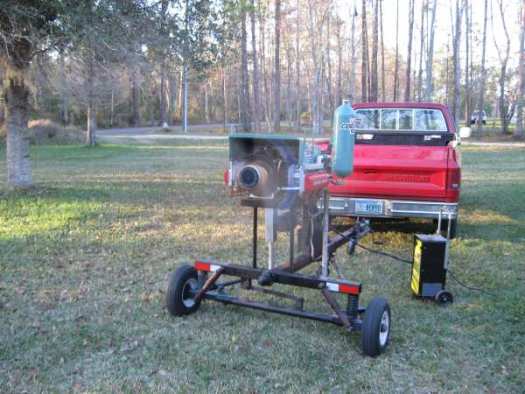
Above, a slightly different angle. I hooked the battery charger to the stand because we had not charged the stands battery since CC#24 and it cranked slowly in the cold weather. I installed a NV-4500 5 speed in the red truck last month. It logged 14.4 mpg at 75 mph on the round trip to South Carolina last week. Not bad for a 3/4 ton truck with the aerodynamics of a brick, a 4 barrel carb and zero electronic controls.
My personal philosophy of unwavering allegiance to mechanical simplicity extends well beyond airplane building. Out in my hangar I have a slip roll, a bolt action .30-06 and box and pan brake that are 110, 85, and 75 years old respectively. They are all great tools, made in the US, better than you can commonly buy today. They out lived their original owners, and will likely out live me. Conversely, the computer I am typing this on, the cell phone the tv, microwave and all other electronic goods in the house, all made overseas by poor souls working in conditions I would not want for my nieces and nephews, are destined for the landfill, and I am certainly going to live long enough to drive them there myself. No consumer electronic good has ever made me as happy as a good piece of machinery. Keep this thought in mind when you are building your airplane and answer the question for yourself.
Even if your personal answer is not as polarized as mine, take comfort in the concept that your Corvair engine information comes from a source that worships reliability and simplicity. This is a far better position than taking your engine advice from a person who is fascinated with ‘high-tech’ and ‘new’, and has no understanding for nor appreciation of things long proven to work. Low tech aviation machines that will outlive you are eminently preferable to ‘new and exciting’ high tech aviation appliances that stand a good chance of dying 30 seconds before you do.
Below is a link to the film of the engine running. Notice it blew the hearing protection off my head during the run. Keep in mind that this prop is well below the level of thrust Dan is looking for.
Right now, somewhere on-line, a guy who has never built an engine, doesn’t own a plane and probably has never soloed one is writing a post that says: “Any prop less than 72″ in diameter doesn’t make any thrust at all, it is just a flywheel.” Having just stood behind such a ‘flywheel’, I beg to differ.-ww
Builders.
There has recently been some discussion on the net about people flying Corvairs in cold weather. Specifically some builders were concerned that you have to warm up the engine for an extended period, and people were wondering if this could be shortened by having a thermostat of some sort. Some of the tone of the conversation suggested that these were conditions that might never have been encountered before of something I was never involved in testing. Neither of these assumptions are true. I have long known every detail of the Corvairs oil system, and it application to flight engines in great detail. Anyone who would like to learn more on this can write me with any question, review the sample of data taken off our website, or they can come to any college. Asking questions on the internet and sorting through various replies is not as efficient use of time if your goal is to build, finish and fly your plane. If you would like to hear a variety of opinions from people whose data is derived from zero to one Corvair engines, ask the net. If you would like to learn facts from years of testing, ask me. It’s your time and your engine, you decide how to spend it.
First of all, the Corvair has an outstanding oil system. Think of how few core engines ever seen have any kind of damage inside, in spite of having 100,000 miles on 1960s quality oil and few changes in the last years of automotive operation. The work we have done to develop flight oil systems in evolutionary on top of this foundation. If you would like an overview of oil systems, read the link just below. Note it is from our website nearly six years ago. Still think there is an aspect of the oil system I don’t know? You are probably going to change your mind by the end of this story.
When you start a Corvair below freezing, you want to make sure that it is getting oil to the bearings. This is accomplished by having an oil cooler bypass and having thin enough oil for the bearing clearance. The issue that some people are concerned with is that it takes a Corvair or a lycoming for that matter, 6-9 minutes at an outside temp of 25F to get the oil up to 140F. How fast the temp comes up is not a real issue to the engine, but having circulation is vital to not hurting your engine.
Oil clearance; An engine that has .002″ main bearing clearance at room temp will have less at 25F. Why? Because the case is aluminum and it contracts more than the steel crank. This is a function of diameter. The bigger the diameter, the more starting clearance is required for very cold weather operations. This has been long known and understood in aviation. If you were told that German Aircraft engines didn’t start at -20F on the eastern front because of paraffin based oil, you were largely told a myth. A much bigger factor was bearing clearance. The Russians understood reliability in the field. The German fascination with precision clearances worked against them. This isn’t an internet story, one of the first people I ever worked for was named Verner Haberman, and he knew the story from personal experience in 1943.

Above, My 5th bearing running in our front yard in 2008. This is the same design that flew 450 hours on Mark Langford’s KR-2s. Just like a Lycoming thrust bearing, there is no ‘bearing’ in my design. The crank rides directly on the case material. The bore diameter is 3.375″. This makes it more susceptible to temp. growth/contraction issues, but any combination of Aluminum case, steel crank is going to face this in proportion to its size. Lycoming works with a lot of room temp clearance, but at a certain OAT, you have to pre heat the engine to prevent it from having no clearance on start up.
.
To explain why testing is important, let me relate a 2009 story: At this point Mark Langford is flight testing our 5th bearing. We don’t sell things that are not tested, and Mark offered to do this work for us. We set up the bearing housing and the crank at a very tight clearance, with a nod toward seeing if we could keep it tight after the system was at operating temps. The target was .001 to .0015″ clearance. (I chose this number, not Mark.) I had neglected to consider the lesson of Mr. Haberman. One morning when Mark had about 75 hours on the bearing he went outside to start his engine at 25F with no pre-heat. It ran for 30 seconds or so and came to a halt, locked up tight. The engine had 20w-50 oil in it, but I don’t think that was the main issue, it was the clearance. The engine had done fine through the fall, but it reached it’s limit at 25F.
OK, Why will a Corvair car with .0015″ main bearing clearance start at 25F without issue? Because the mains on the engine are 2.0″ in diameter, and my 3.375″ 5th bearing was subjected to different amount of expansion and contraction. On any Corvair flight engine, the 5th bearing is going to be the clearance issue. Roy’s bearing is 3.0″ diameter and Dan’s is 3.25″. It isn’t just the size that matters, it is the starting clearance also. Dan shoots for .0007 to .001″ clearance per inch of diameter. This is why Dan’s bearings require a High Volume pump. When they are hot, the extra clearance will drop the idling oil pressure with a stock pump. Dan didn’t make up this idea himself, he is following the bearing manufacturers specs. You could probably start Dan’s set up down to zero F without issue.
Roy tends to run his bearing tighter than Dan’s. This is why few of Roy’s bearings need a high volume pump to maintain 20 psi as a hot idling oil pressure. The opposite side of this is that people using that design need to ask Roy about the minimum OAT for a cold start without a pre-heat.
On round two with my bearing on Mark’s plane, we polished the crank, and then rebored the bearing for .002-.0025″ clearance. This was the final number after the bearing was ceramic coated. Mark went on to fly the design 350 more hours through several seasons without issue. Again, no bearing design is immune to this, it is a consideration on all of them. You can lower the range by using thinner oil, but all the tight clearance bearings need to be preheated at some point. If you would like to read both Lycoming and Contenintal’s info on why the both require hours of pre-heat below 20F, read the articles at this link: http://www.reiffpreheat.com/Articles.htm
These Articles discuss the relationship to the oil pressure indicating if the engine is ready to be operated. On a Contenintal, you can use full power with oil at 100F, But, the engine must not have excessive oil pressure, caused by the relief valve not being able to bypass cold oil fast enough. If you have a High volume housing and pump from us, I have machined this port larger for you. This is in the photo below, indicated by the drill bit.
Lets’ say its 35 degrees out and you start your Corvair. If your normal oil pressure regulates at 45 psi, then you will undoubtedly see the oil pressure exceed this, even with an enlarged bypass. You may see as much as 75 psi. Do not rev the engine up, let it idle. In a few minutes the engine will warm up the oil enough to bring the oil pressure down. What you are watching for is the point where you can do the run up on the aircraft and have the oil pressure regulate normally, at no more than 10psi above its normal regulated pressure. This will likely happen when the engine oil reaches 140-150F. If this takes a long time with 15w40 Rotella, you are fully invited to switch to 5W-30 Amsoil, and it will happen a lot faster. With Rotella, this may take 6-8 minutes. If this isn’t fast enough for you, let me ask what is the hurry?
The Corvairs requirements are no different from Lycoming nor Contenintal’s. Go to your FBO and tell them that you are going to rent one of their planes, but you are unwilling to warm the plane up for 10 minutes if required, because you’re a busy guy, and your time is so important. Watch how fast they slam the door in your face. They own that engine, they don’t want it damaged, and they don’t want people who disregard manufacturers instructions near them. Your Corvair is your own masterpiece, treat it at least as well as student pilots at the FBO treat the rental equipment.
Why not get a thermostat? This will allow me to take off in 3 minutes instead of six, right? OK, for some background, go to google and search the words “Lycoming Flyer Operations” and get a look at pages 66-69. This gives a beginning description of systems that have a bypass like the Corvair and half of Lycomings, and systems that have a ‘Vernatherm’ (Lycomings term for an oil thermostat.) If anyone wants to debate that an oil bypass system allows the engine to warm up faster, realize that I have Lycoming and all their official publications on my side of the discussion. It does some of the same task as a thermostat in a simpler, smaller more reliable way. Second, know that many Lycomings run 50 weight oil, and they need this system more than a Corvair with thinner oil. A thermostat is something that is only going to operate on your plane for the few minutes until the oil reaches 180F on a cold day. For 98 out of 100 hours a year, it is going to be open and doing nothing more than what the bypass does. Does this justify the added complexity and fittings? Should you just have the oil system set up for how it is going to run 98% of the time, with the most simple system that can accomplish this?
OK, let’s get this point fixed in everyone’s mind: They made 1.8 million Corvairs If they made on 70,000 miles each and drove this at a 35 mph average, then each car made 2,000 hours on average, which means the fleet made it to 3.6 Billion hours of operation. If only 5% of the operation was done below 32 degrees as a starting temp, I would be stunned, but lets use that as a conservative number. That means 180 Million hours of operations we done under these conditions. Was every one of these engines carefully pre-heated? Was every start up held for 10 minutes until the oil was at 140 degrees? Was any of these hours logged with quality oil? Of course not.
The system we use on Corvairs is identical to the system used in cars. There is going to be a car guy who writes me to say that cars had thermostatic damper doors on the bottom of the car, and that they did something to regulate the speed that the car warmed up the oil. To this, I am going to point out that I firmly believe that most car owners waited less than 15 seconds after the car started to put it in gear as a habit. No system, damper doors or not, was having an effect at that point. Today the only people who own Corvair cars are people who love and respect them, and warm them up slowly. Trust me, the last guy to drive your core engine in the winter of 1979, didn’t treat it according to the owner’s manual in the glove box, and the damper doors were long since gone on your core engine. Below are some samples of stories from our webpage. The captions are the original ones with the year added in front. I put them in blue italics to show what we were speaking of at the time. The black notes are my comments today. If you still think that someone this week on the net is going to ‘discover’ something about the engines oil system I have not considered, read on and note the years.

(2007) The Corvair has an outstanding oil system. Builders are disassembling hundreds of core motors a year. These come from cars that have been sitting for many years. Most of these cars never received an oil change the last two or three years of their lives. They were continuously run low on oil and beaten like dogs. Yet just about every builder is rewarded with a crank that can be polished, or have a simple .010/.010 regrind. This is all the evidence you need to appreciate the quality of the GM design. Just like the Doctor’s Oath, your first vow is to do no harm. Many modifications that inexperienced builders propose are a serious reduction on the Corvair’s reliable oil system. Until I understood the operation of the system, I too took detours. My Pietenpol was the first Corvair to fly with a rear starter. It used a 3-hose oil system, an arrangement I now consider a mistake. Read the information here carefully, and you’ll avoid repeating missteps people have already paid for.
All Corvair engines need an oil filter, oil cooler, filter bypass and cooler bypass. The above photo shows two pencils pointing at the Corvair’s stock bypasses. The one in the rear case is the cooler bypass, and the one in the top cover is the filter bypass. They’re both set to open at 7 psi (they’re the same part). You can read all about my testing of oil accessory cases and the specific rig we built to do this on our Web site. Systems without bypasses, particularly cooler bypasses, will starve the engine for oil. Five years ago, we tested filters and coolers by packing them in ice to simulate a start at 32F. The cooler bypassed for more than 10 minutes, whereas a filter packed in ice only developed a 2 psi differential. Coolers without bypasses can cause massive restrictions in oil flow. If your pressure sending unit occurs before the cooler, you’ll have no idea that the pressure to the bearings is dropping on every start.

(2008) Above are two views of the optional Gold HP Oil Cooler Bypass. It is often referred to as a Sandwich Adapter because when installed, it’s sandwiched between the Gold Oil Filter Housing and the oil filter. It’s held in place by a very accurately machined, hollow mounting bolt. It can be installed on the Gold Oil Filter Housing in literally one minute. It includes a square o-ring gasket, held in place in a deep recess. The AN-6 fittings for the lines to and from the cooler can be clocked in any position. It contains an all metal cooler bypass featuring a precision spring manufactured by the nation’s foremost supplier of aerospace springs. On a normal start cycle, the cool oil in the cooler will produce a pressure drop in excess of 7 psi. Any time this is so, this bypass valve senses the pressure differential and allows the oil to bypass the cooler, greatly speeding up the elapsed time until the oil reaches 150F.

The drill bit is pointing to the pressure regulator bypass hole. It has to be opened up when you install a high volume pump. Otherwise the pressure will be very high until the oil temp is thoroughly warmed up. The enlarged hole allows the bypass to work with cold thick oil. Without enlarging this hole it might take 15 minutes of running on the ground on a 40 F day before the oil settled down to its normal regulated pressure. Before this, an increase in rpm will raise the oil pressure. On very cold start ups you want to watch this, because even with the hole enlarged it is possible to have the oil pressure exceed 80 pounds by carelessly revving the engine to taxi it while the oil is still cold. Give the engine a chance to warm up, don’t be in a rush. Oil pressure spikes are very rough on the drive system running the pump. This is true of almost all engines, not just Corvairs. People don’t talk about ideas like this with the buy-it-in–a-box imported engines because they just wanted to buy something and use it. Since the primary motivation with Corvair builders is to learn while creating, we talk about things. Most people are happy to just have things, people attracted to the Corvair were the ones who took apart the toaster at age 10, because for some of us, we need to know why.
Below is a series of photos of oil testing. This is on our website. It is 10 years old this month. Get a good look, no one notices this but there are beers cooling in the bucket next to the oil cooler. Testing is a tough job, but I was willing to do it.

I am bigger fan of Mich than Becks Dark. Oil cooler is in bucket. Bypass stayed open with a 7psi differential or more until the water in the bucket hit more than 130F. Beer as long gone before then. If somebody would like to differ with me on oil systems, that’s fine, but unless they have 10-year-old test photos, it’s going to be their guess vs my test.

Above, look at the instrumentation, were we have probes on both inlet and outlet lines to compare the differential. The engine in the photo is the original Skycoupe 2,700 cc power plant. Note that the stock oil filter is being cold soaked to measure the differential pressure with 32 degree oil. It was only 2 psi.

Above, the gauge pack and the digital tack on the idling engine. If you would like to read the whole report, it is on flycorvair.com, search “2003 oil system test” in the search block on the bottom of the main page. It has been there for a decade, for any one with an open mind who wants to learn. For those that like their theory more, and would like to suggest that I don’t know what I am speaking about, have a good time. When I first wrote the report, I had people say the same things at the time. In the last 10 years we have done a tremendous amount of work, helped countless builders, held 24 colleges and had many great adventures. without exception, the critics of 2003 did nothing. They are still out there, telling people what they will do some day. 2013, is no different, some people will listen to the internet critics of today and be dissuaded from doing anything this year. Decide tonight if your place will be with the builders or the critics. Decide carefully, one path leads to a flying plane and great adventures in the company of people of good people. The other leads to reading about an endless series of ‘problems’ which will be ‘discovered’ without fail by internet critics on 2 week intervals for the rest of your life.-ww


