Builders, Here is a sample of the mail on aircraft finishes and how professional builders and magazine editors distorted the perception of traditional craftsmanship:
Cleanex builder and flyer Dale Williams of SC writes:
“William, You are singing my song here about aircraft finishes! I’m currently painting my “Cleanex” with a very experimental method that many would run from i.e. aluminum boat paint put on using a series of rollers. The paint itself is a three-part Acrylic Urethane Enamel. After applying the paint I’m doing a bit of sanding and using some 3M rubbing compound to turn my 20′ paint job into a 10′ paint job. The swirls and final polish will be done with Meguiars #9 Swirl Remover. This paint goes on extremely thin so the weight of the applied paint verses the finish is easy to control. I do not yet have mine finished as I’m awaiting the trim colors from the supplier before I can apply the numbers, striping, and graphics. Here is a photo of the Cleanex belonging to Clarence Dunkerley that used the same paint and application method:
I’m sure you remember Clarence from CC # 21 at Barnwell, SC:
These are indeed “industrial” paint jobs but also are “experimental” and the money saved goes under the cowling where it belongs. Besides, I learned something by doing it this way! Thanks for a great story and having the courage to write it. Dale N319WF a.k.a. Myunn- daughter of cleanex”
701/Corvair builder, CC#20 graduate Terry Samsa writes:
“Very interesting and quite compelling. I like you even better after that than I did already. Thank you for becoming part of the solution rather than remaining part of the problem.”
Terry, I wrote the second half so that no builder working in his own shop looking at the results of his efforts ever mistakenly compares his work to that of a paid professional who has spent a career getting very good at the skill, and who’s budget puts any tool, material or process in their hands. The magazines had countless stories that implied that you were looking at the work of other regular builders, and I think thousands of builders at home were discouraged by their own results in the unfair comparison. I wanted rank and file traditional homebuilders to have actual confirmation from a former insider that what the may have suspected was actually more true than they knew. I don’t need to be thanked for it, it doesn’t risk my work nor business relationships, my involvement with that side of experimental aviation is long over. -ww
Pietenpol Builder/ATP Terry Hand writes:
“What happens to a business/association that supports and even rewards such dishonesty in “builders”? Fifteen years later they have a CEO who thinks flying a Stearman and a T-6 is staying in touch with the common man, and building huge chalets to rent to Corporate America while spoiling the view at Airventure for the little people is a good idea. And once he is fired his replacement is a guy that bought his degrees from a diploma mill, and everyone thinks he is a great guy. Maybe he is a great guy, but I sure can’t Google and find anywhere that he has owned up to his mistakes the way you did in 2,500 words. That’s where all of this has taken us. Thank you for all that you do- not just for Corvair builders but for all of experimental aviation. -Terry.”
Builder Bruce Culver writes:
“Another timely and revealing essay on the basics of homebuilding, and the ‘dark side’….. Long ago (I joined EAA in 1982) I had a small library of homebuilding books, and I am now replacing those. I just acquired all of Tony Bingelis’s books off eBay, and I remember how much I learned from them many years ago. As for my paint, I was looking at a paint supplier’s website, and marveling at how much money would go into enough paint to do an airplane. I figured it would take as much money as building one of your Corvair engines (or close to it). Since I am doing a “warbird”, I will go for a satin sprayed finish, and it won’t be using paint that costs $335 a gallon….. Echoing others, we owe you a debt of gratitude for helping to make aviation affordable for those of us really bad at picking winning lottery tickets.It was frankly sad and disturbing to see EAA engage in such fraud, but it is obvious they have “moved on”.And 95% of the people going to Airventure won’t have any idea any of this is happening. I have two framed copies of “The Man in the Arena”; one will go into my office, the other into the workshop, a reminder to me that nothing worthwhile comes without struggle and sacrifice. And that is as it should be……”
Builders,
Here is a sample of what friends wrote in about the story of my Fathers 87th birthday and the importance of Fathers and people of courage in this world. The story also brought a number of private emails where people shared thoughts on their relationship with their Father that I found very moving. In many ways I think my Father is very typical of men of his generation, and for this reason the story about him brings people my age to think about their own dads and the role they have played in our lives. Our family had a very good day together in NJ, and I hope that most of you had a chance to spend some time with your fathers over the holidays. -ww
New England builder, CC#14 Grad, and USN Seabee Dave Simon writes:
“Always glad to hear about your father, William. I fondly recall a few hours visiting with him about the Navy and the Seabees at CC in Massachusetts. Happy Holidays! Dave”
NJ 601XL Builder/flyer Phil Maxson writes:
“I honor your father, a true American hero. Your note describes his accomplishments, but I always remember him as a delightful, humble man with a broom in his hands cleaning up the hangar in preparation for a college in your hangar in Edgewater. I am very glad to have met him.But I honor you as well. you have dedicated your life to making flying, safe, achievable and affordable for many people. You have taught me more than anyone else about how aircraft and engines work. I am in your debt. We members of the Corvair movement are in your debt.”
DC-3 owner and man of adventure Tom Graziano writes:
“William, Thanks from one of the 3%…Tom”
Builder Jackson Ordean writes:
“Right on.-JO”
Builder Dan Branstrom writes:
“Amen, and best wishes to all, especially Grace Ellen and your families.”
Builders, Here is some of the mail on the topic of what will we accomplish in 2013:
Newfoundland Merlin on Floats Builder/pilot Jeff Moores writes:
“Hi William; great to see you back “on line.” It is quite cold here now and I am anxiously waiting for our pond to freeze enough to try flying my Merlin on floats from the ice. During my Christmas break I rigged up a preheat system for my engine and tested it. Very simple; just a 1500W heat gun, some scat tubing, and a snowmobile cover tied over the cowling to keep the heat in. At -6 deg. C after 1 hour it was warm enough to try. I was very surprised when, after four shots of prime, it started instantly.
I am now working on a method to be able to easily move the plane in and out of the hangar. One cannot move it backwards in the snow because the step diggs in, so I have to be able to get it out moving forward and get it back in also moving forward and be able to turn it around in the hangar. I’ve flown skis off ice before but not Full Lotus floats, so this is all a learning process. I’m taking my time and proceeding cautiously. – Jeff”
Florida 750 builder Tom Griesemer writes:
“Glad your back. Haven’t had anything to read for almost a month. 1 flaperon done and deburring the right wing skeleton on the CH750. Most importantly was the hot tanking of the Corvair case. Full speed ahead…”
Midwest 2850 cc 750 builder Gary Burdett writes:
“I am close and I plan to spend…..wait a minute…. I’ll get back to you, Honey Boo Boo is on.”
Very funny Gary…-ww
Builders: Here is a sample of what came in the mail.
Builder Earl Brown writes:
“Thanks for the “Pietenpol Week”! Always great to have extra inspiration while working on mine”
Builder Harold Bickford writes:
“Hello William, The Booth Piet and the ch.1279 example are great examples of persistent effort. Excellent workmanship from plans built efforts are evident in the pictures. The owner built Corvair engines follow the Pietenpol formula via the WW approach. It is inspiring to see the results of other’s efforts. It will be fun to see how much can be accomplished this year with the Piet Edi and I are working on. Thanks for posting. – Harold”
Builder Randy Cary writes:
“Great comments William. Welcome back. I’m glad there are people left in this world who have the heart of a servant!-Randy Cary“
Builder Dan Branstrom writes:
“Using Google Earth, Bernie’s old shop is at Latitude 43°35’16.99″N, Longitude 92°17’19.75″W If you go to street view on County Highway 5, and face east, you can see the shop at ground level from 2 shots. The views of his shop aren’t as good as your picture. The aerial view of the small collection of houses gives a good idea of exactly how small Cherry Grove is. It really is just an intersection with a collection of houses and a church. William, your writing has a quality of Richard Bach, in the sense of “Nothing by Chance.” It gives me a deep appreciation for flight and life. -Dan”
On the Cherry Grove story, Ch-750 Builder Dan Glaze writes:
“you wanna know what I think William? I think you and Grace are great people and thanks for the ” rest of the story” good day, Dan-o”
On the Cherry Grove story, Builder Bruce Culver writes:
“This is a beautiful and thought-provoking piece. It has always been too easy for us to be distracted, or attracted to the shiny things in life, the things that are glitter and often not real. Like crows who collect bits of metal and shiny plastic, we look for someone else to supply the means to find fulfillment and happiness. In the final analysis though, all it really takes is a flat open field and a man with a dream….. Well said.”
Builders;
I received a thoughtful letter from a builder with a lot of positive comments, but they did mention the fact that their own personal aircraft was not likely to look as nice as Gary Boothe’s or Mike Groah’s. They mentioned that in a small way, this was a little discouraging. I gave this some thought last night and wanted to share some perspective on the subject.
While I tend to be very fussy about the engine compartment, anyone who has seen any of our personal Corvair powered airframes could tell you that their finish was well below the level seen in the story about Gary’s and Mike’s Pietenpols. While I am personally content with an ‘industrial’ level of finish on my own airframe, I still have great respect for builders who go the extra distance to make things to their own standard of excellence. There is a very wide space between 100% airworthy and 100% airworthy and esthetically perfect. It is for each builder to decide for himself what level of finish he wants on his plane. You are not competing with anyone. Homebuilding is all about doing it for the right reasons. Just ask yourself how you would build it if no one else on earth was ever going to see it, and as long as the answer falls between the two limits above, build it that way.

Above, a photo of my Pietenpol circa 1999. While the plane was 100% airworthy, and appealing from 25 feet, it was not esthetically high quality. It had a level of finish I call ‘industrial.’ If an I.A. went over the plane he would not find a single nut or safety wire out-of-place. The weight and Ballance was perfect, it could stay in the envelope with any pilot between 135 and 290 pounds. If a welding inspector went over it, he would not find a single rough bead. If Ray Stitts examined the fabric he would find it correctly applied and the tapes razor straight. I regularly loaned the plane to friends for flights to other states without the least concern that it might break or that any system on it needed special care.
Yet the finish was matte and it had plenty of scrapes in the paint; The nosebowl was rough finish; The tops of the eyebrow scoops have a slight back angle because the corner was cut off the sheet of .025″ I used, so I cut the other three corners off to match. If you look on the leading edge just above the prop blade, there is a silver patch over some hangar rash. The patch is shiny because it was made from Duct tape. I cut the tape with pinking shears and few people noticed it. The plane would not have earned a workmanship award, but it met my personal standards of finish. I would build it a little bit better today, but it still would not look like Mike or Gary’s planes. In our hangar our Wagabond is approaching completion. I just spent $200 to replace the wheel bearings and races because they had some corrosion from sitting. I bought new tires and tubes for $249 because the others looked slightly cracked. These parts might have passed an annual inspection on a certified plane, but they were below my standard of being right. Yet the plane has a dent in the boot cowl the size of the palm of your hand that I have no intention of fixing before I fly it. I find nothing wrong with a builder spending many hours to have a much higher level of finish on his own plane, just as long as he covers 100% airworthy first.
Follow this connection: Things in the EAA went off track in the finish department about 20 years ago. I speak from first hand experience here, as I was part of the problem. Back then the EAA started putting the Oshkosh grand champion aircraft on the cover of Sport Aviation with a lavish article by the then editor, Jack Cox inside. Starting innocently with a Glassair III built by a good guy, very rapidly the system became broken. People with money saw that these airplanes were often sold for an astronomical amount after the article came out. They also noted that apparently no one cared if the guy claiming to have built it solo actually ever got his hands dirty.
Suddenly an arms race of professional building was unleashed. Lets say a guy bank rolled the building of a Glassair or a Lancair to the tune of $175K; It wins grand champion, it is on the cover of SA, and then he sells it for $200K. It isn’t a very good return on investment until the guy then hires cheap labor and builds 5 or 6 clones of it. And that was just how it worked in the beginning, before the real money arrived……

Above, this is what a real hot crew of ‘hired gun’ builders looked like in 1995. Yours truly is on the left. The owner of the Lancair IVP is in the middle. I ran this all Embry-Riddle crew for 3 years to build N420HP, the first V-8 Lancair. It had more than 8,500 man hours of work in it. It is the cover plane on the July 1997 Sport Aviation. In the article by Jack Cox, it is clearly stated that the ower built the whole plane solo. He extensively wined and dined Jack Cox to get this story written that way. It made the plane eligible for Grand Champion judging.
Here is economic irony; In 1993, after 5 years and $100,000, I graduate with a 3.85 gpa from Riddle, but I can’t find a job; The Cold war has ended, defence isn’t buying, and the market is flooded with highly experienced former military guys. Airlines are in a slump. Yet, people at the top of the ladder now have cubic dollars from the market expanding and the general economy doing great. There is something new called a ‘dot com millonare’ and evidently they will buy any kind of ‘toy’ sold. This leads to the guys in the photo above working for less than $10/hr on a plane that was worth most of a million bucks.
While it isn’t right, keep in mind that there is absolutely nothing illegal about professionally building planes or paying magazine editors to write lies about them. The only actual crime in the system was the owners signing the FAA airworthyness application and claiming it wasn’t built for hire. The form said the fine was up to $10K for making a false statement. When you understand what a trivial amount of money that was to these people you understand why they all signed it. Plus, in all the years of thousands of people lying through their teeth to DARs, no one ever got turned in. Part of the reason for this was the DARs made so much money, they of all people were never going to blow the whistle on anyone. The only thing that ever slowed the system down was Mooney, who couldn’t sell planes, started making a lot of noise about the FAA not enforcing the rules. The got an advisory circular published, but all Mooney had on their side was being right, they didn’t bring any pay off money, and that was what the system operated on.
Lancair IV’s were the commodity that made the system take off. Skilled labor to build them was very cheap, the planes sold for $550-$850K when they were done, and there was a seemingly unlimited number of newly wealthy people who wanted one. The key to getting known as a supplier was to do what ever it took to be known as a “Sport Aviation cover/ Grand Champion” shop. (By whatever, I mean, but I am not limiting it to, bribing magazine people.) On round one, I was a pawn in this system. After the above plane was finished, I went back to regular small GA work and welding. Work was sparse, I made about $12K gross in 1996.
Christmas Day 1996, I found myself with $25 in the bank and a week away from turning 34 years old. My girlfriend, also a Riddle engineering graduate, said “I don’t want to live this way anymore.” I did what I knew I shouldn’t, made a number of calls, and started a professional building shop with a partner. On January 10th the first kit arrived. I had a practiced speech for the owner justifying why we needed a $5,000 deposit to work from. Two sentences in to it he stopped me, opened an envelope with a $60,000 certified check, and simply said “Call my secretary when you need more.” Our shop was in Edgewater FL, where we leased a 140′ x 120′ hangar. By the end of 1997 we had 11 Lancair IV’s in the shop, and I had hired 30 Riddle students as my own cheap labor. I was no longer a pawn in the game, I was now part of the problem. in 1997 I made about ten times as much money as 1996. That buys a lot of rationalization.
Here was the negative side; Every magazine now got flooded with pictures of professionally built planes and the stories all said the owners built them. I am going to say half of the coveted Oshkosh workmanship awards to individuals were at least partially fraudulent. The people with money all filled out the FAA form saying that 51% was built by amatures. The hired guns encouraged this because if the plane crashed, technically they were not the builders. People who had no idea how their plane was built insisted on getting repairmans certificates. DAR’s, who were largely retired FAA guys, charged $500 for an inspection, but they also frequently acted as “progress inspectors” on behalf of the owners, collecting a number of $500 for 30 minutes paydays, a real conflict of interest.
In our shop, to survive, we paid direct bribes to many people. First, we paid the Lancair chief field inspector $1,000 for every plane that came to our shop because he ‘recommended us’ to the kit purchaser. If we didn’t pay, he would tell every kit buyer to avoid us. We paid magazine people, from many different publications, to write positive stories. We picked up large ‘entertainment’ tabs. It was a long list, but it was easily funded because the going rate to build a Lancair IVP was $120,000 for just the labor, and this did not include the painting. The average IVP that left our shop cost the owner over $500,000. They didn’t care. One of the first ones finished was for a guy who was one of the first 25 employees of Intel. Money didn’t mean much to him. Neither did honesty, he told everyone, the FAA, the judges and the magazine editors, he built it himself. No one was incentivized to speak up. The major companies were selling kits as fast as they could make them. Go back and look at the Magazines and see how many full-page, full color ads they bought. In 97 or 98, that page in Kitplanes was $5,000 a month. When a magazine guy came to a factory, he was treated like royalty, and his whole tab, down to the dollar bills in the strip clubs was picked up.
Most of the Champion aircraft of this era were actually built by hired guns. We only worked on the most expensive stuff, but the system worked all the way down to small-scale guys who built RV-4s and 6s. Rank and file builders who read industry publications and went to major shows had a hard time understanding how a guy who is a hedge fund manager who never built a single thing in his life got a workmanship award for an SX-300 or a Questair Venture or a Legend, may have suspected, but they had no idea how corrupt the process was.
I’d like to say I invested the money wisely, but I didn’t. I lived in a great beach house on 6 acres Ponce Inlet, threw lavish parties and traveled a lot. The only smart thing I did was funnel a ton of money into Corvair R&D. Custom cams, props, testing, everything I wanted was done quickly. I was making up for years of having good ideas but no budget. I paid for my sins shortly. In less than 3 years my partner figured out how to fire me from a company I started; I found out how few friends you have when you’re not picking up the tab, My girlfriend left and took my cat. Christmas 1999, I was about to turn 37, and I had $25 in the bank. Fortunately, I had My Pietenpol, my tools and a rented T hanger, and every week I went to the old mail box in Port Orange and found an ever-increasing amount of mail from real builders who wanted to know more about Corvair engines.
I am all for people painting their own planes. I am more interested in a mediocre job done by a first time guy, than a fantastic one done by a pro in a down draft booth. You can learn something useful from the guy who is using the same tools you have access to. I have no problem with people who want their plane to look nice, and pay others to make it look nice. My only issue is people who claim to have done the work themselves to win some trophy, inevitably taking it from some deserving guy who actually did his own work. I say this knowing that I made it possible for such things happen in the past.
The internet changed a lot of things, people were not so attached to organizations anymore, they could get to read about any kind of plane the wanted, and the magazine editors lost all their power. What never came back was rank and file guys having respect for the organizations, the trophies or the awards. I want to be real careful here and make sure that no one thinks that all of the awards were bogus. There were a great number of people who did fantastic work on their own planes, and you never want to be in a position of falsely accusing one of those guys. To real champion builders, I apologize for having a part in messing up the system. In the “Cherry Grove Part 2” story below I talk about how hurt I was that people at Oshkosh 2002 had so little faith in the message of homebuilding when I needed them to believe. I deserved this. I had knowingly been part of a system that had harmed the integrity of homebuilding. It was a bitter harvest when I was hungry, but I had a hand in making it so.
Earlier tonight I was reading a 1963 Sport Aviation with a basic Tailwind on the cover, kind of industrial finish plane. A very basic Ozzie and Harriet couple stands in front of their pride. Their clothing and body language says they are salt of the earth, working class Americans. 1963 was an era where every person who joined the EAA was going to be in the arena, not a spectator. Hired gun builders have a lot to apologize for, but we were not the ones who decided that regular looking people and the planes they built were not cool enough to be on the cover of their own membership magazine. That one is on the Editors and the management of the EAA…maybe thats too harsh, maybe part of the fault lies with people who were too willing to become spectators in the very branch of aviation that was founded on the principle that no one should be a spectator. .-ww
Builders,
Below is another piece I wrote about Cherry Grove and the spirit of homebuilding just after Oshkosh 2008. It was in our Oshkosh coverage that year. In the photo with me is Pietenpol builder Dave Mensink, one of the brothers pictured in the previous Cherry Grove story.
Here is the important part of the story I left out, something I was reluctant to say a the time because I was concerned about what potential customers reading it might think, something I have moved beyond now ( I still care what builders think but not ‘potential’ customers); Oshkosh 2002 was the worst week I have ever had in aviation. It was the first airshow I had been to since my Pietenpol crash 12 months before. On the surface, I had every reason to be down while heading to the show. I was broke from medical bills; my body was a mess and would never be the same; my AME said I would not get a medical for two years (It turned out to be five); my plane was burned to a cinder. But inside I felt very good; I had cheated a very close brush with death; Grace was with me; We had many friends and we were headed to Oshkosh. I felt I had some insight to what was important when other things were stripped away. In an odd way, I felt a little blessed.
When we were at the show, all of this evaporated. More than 50% of our customers said they were quitting Corvairs; Few people listened to what I had to say; I found out that 90% of what I had done in the previous 12 years had been throughly slandered on the internet in the previous year, almost without retort; The only person willing to accept a single magazine article from me was Mick Myal. I thought I was returning to my temple with an important revelation learned from a year in the wilderness. Instead I found that our church was really a giant commercial enterprise and most of the people I thought of as fellow airmen were really consumers shopping for material distractions. After my last forum, which was attended by 1/10th the number of people who had been there in 2000, I actually went out to the parking lot, sat in the truck and wept.
Grace in her wisdom decided we needed to go to a more fundamental aviation place. She had briefly met Dave and he had casually invited us over to Cherry Grove. We drove there, essentially going back in time to a very different era in experimental aviation. The silence of the three of us being the only people in Cherry Grove that day was an absolute contrast to the crowds and mindless noise of Oshkosh the day before. Standing there, I had a very powerful moment of awareness that the fundamental elements of aviation, the timeless things, its real value, was right there on the surface at Cherry Grove, and that it was folly to expect to find them in a parade of consumerism like Oshkosh. I knelt down and put the soil from Bernard’s airstrip in the coffee can because I wanted to take some of the magic of the day with me. It worked, I drove away with a pound of dirt and a lifetime of understanding.-ww

“The man in the photo with me is Dave Mensink from Preston,Minnesota. He built a fantastically beautiful Corvair powered Pietenpol several years ago. He invited Grace and I to make a house call after Oshkosh 2002 to inspect it. His home is just a few miles from Cherry Grove, the tiny town Bernard Pietenpol called home most of his life. Dave took the time to bring us all the way out to the original flying field and shared his memories of being a small child around Bernie’s airstrip. It was a surreal, quiet day. We stood on the field and didn’t talk much for a long time. We had just come from the crowds at Oshkosh, and the contrast couldn’t have been more dramatic. Standing there, I honestly felt that there was a timeless truth in flying that you could discover if you spent enough time in Cherry Grove. I have never had this sensation on the ground anywhere else. We took a little coffee can of soil, which has since lived on top of our refrigerator. Once every great while, when I am having one of those days where you question the value of your path in life, I take the can down and look inside.
If you look at their lives close enough, all of the greats offer something to guide us in pursuit of the timeless truth of flying. Pietenpol teaches that we are more likely to find it in the simplest of planes; Lindbergh knew that you started your search inside yourself; Gann said that we will not see the truth directly, but you can watch it at work in the actions of airmen; and Wittman showed that if you flew fast enough, for long enough, you just might catch it. These men, and many others, spent the better part of their lives looking for this very illusive ghost. Some of them paid a high price, but you get the impression they all thought it was worth it.
While it is possible that someone who rents a 172 or even a person who reads Fate is the Hunter has some access, I honestly think that the homebuilder who dreams, plans, builds and eventually flys his own plane is infinitely more likely to experience the timeless truth of man’s quest for flight. All of the aviators who had some insight to guide you found it while they were in action, in the arena. If you inherently feel that you want to build a plane, you feel just like Pietenpol did. When you’re building it, you will find out how determined you are and what kind of perseverance you have. Lindbergh evaluated these qualities in himself every day. As you finish and prepare to fly, you will find others of enormous qualities and flaws, and you will learn to sort them and their counsel, as Gann always did. And when you fly your plane, and come to trust it because it is your creation, and you cut no corners, you will never want to stop, the way Wittman never did.” -ww-(2008)
Builders;
In 2010, I took some time the week after Oshkosh to travel to Cherry Grove, Bernard Pietenpols home town in Minnesota. I went there with Mark Petz, our Corvair cylinder head expert from Madison WI. After getting back to Florida I wrote the story reprinted below. Since this has been a week of Pietenpol thoughts, I wanted to bring this back out for people who may not have seen it.
I consider BHP to be the Patron Saint of Homebuilding. I don’t say that lightly. Before him, it was just accepted that aviation was for rich people to do and working people to watch. The battle on this point didn’t end with BHP striking a blow for affordable aviation with his model A powered Aircamper. It still goes on today, and there are plenty of magazine editors, FBO operators and even people on the EAA board who think that if you work for a living your place is watching from the outside of the chain link fence. I am from NJ, and we have a three word phrase to express unwillingness to go along with someones idea for you. It is “F- – – That S – – -.” I consider myself a foot soldier in the conflict to keep aviation affordable. BHP is my George Washington (Our first Commander-in-Chief.)
BHP was truly a genius. He knew how to repair Color televisions in the vacuum tube era of electronics, no small feat. The best lesson in life I ever learned from the man is that simplicity has made far more people happy than complexity. Many of the things I do, from live in a rural area, to not having a cell phone can be directly traced back to understanding that BHP knew a secret; The best things in life and flying are often the most simple in the most peaceful setting. It is hard to explain how much I respect the man’s legacy. Try this: I keep a Coffee can of soil that I picked up from the Cherry Grove runway in 2002 on top of my refrigerator. Once a year or so, when I am having a bad day, I take it down and stare into the soil in it and think about how the guy who walked on that ground knew how to live with peace of mind in a trying world.
‘The Long Way Home’
After Oshkosh I took a few days to regroup at Mark’s shop. We decided to make a field trip out to see Piet builders Dave and Will Mensink, and make a trip over to Bernie Pietenpol’s home town, Cherry Grove, Minn. We made a couple of stops in Wisconsin, Minnesota and Iowa. Because our 450 mile loop was intended to go visit things that live in the past, it seemed appropriate to take Mark’s 1963 Corvair van.
H.L. Menken is one of my favorite writers. In the 1920s and ’30s, he and George Nathan would take long car trips in rural America without a time or destination, just a goal of “taking in the national mood.” Menken was one of the best known newspaper men of the day, a halfway point between Mark Twain and Walter Cronkite. Today, journalists think that news comes from NYC, DC or LA. Despite being nationally prominent and a lifelong lover of all things Baltimore, Menken knew that the story was “out there.” With this spirit in mind, Mark and I drove west to visit some places from long ago.

Mark displays his motorhead credentials. The pistons and rods are 350 Chevy. His 1963 Corvair van in the background is affectionately referred to as The Groovy Cruiser. It looks terrible but runs great.

Mark and I stopped to see this Stratofreighter on static display in the middle of Wisconsin. It had been flown into a tiny airstrip decades ago

Above is the cockpit of the Boeing C-97. It is powered by four 4,360 cid radials. A placard in front of the co-pilot lists the minimum weight, full flap stall speed as a stunningly low 69 knots. With their reversing propellers, these aircraft can land on short strips.

Third stop for The Groovy Cruiser was to visit the brothers Mensink and their Pietenpol project. Will, seated in the plane, is a worldwide cargo pilot for UPS. Dave runs a huge and successful family farm about 10 miles from Cherry Grove, Minn.

Above, an overhead shot of the Mensink Pietenpol during its weight and balance. Although a Piet is a very basic aircraft, it still is a good match for All of our Gold Components. Dave’s 2,700 cc engine has a Weseman 5th bearing, and was assembled by Mark at Falcon. It will be a potent, smooth performer on their aircraft.

Will Mensink’s hangar used to belong to Andrew Pietenpol, Bernie’s grandson. Inside this hangar is an exact full-size replica of Bernie’s Cherry Grove shop (his shop in Cherry Grove was in town, separate from the hangar). This door is the original from Bernie’s shop.

Bernie Pietenpol was a multi-faceted guy, and he did a lot of other things besides build airplanes and convert Corvairs. In his shop, he also repaired the most sophisticated piece of consumer electronics of his day: color televisions. This row of light switches is an exact replica of the ones in his original shop. They’re mounted overhead as you walk into the shop, and could all be thrown with one motion of the hand.

Will and Dave gave Mark and I a guided tour of Cherry Grove. I had been there only once before, with Grace eight years ago when Dave took the time out to show us this tiny hamlet. Years ago, it was very quiet, almost deserted. Today, there are a dozen or so people there. Bernie Pietenpol’s old airstrip is about a mile from town. Out in the fields, it would be impossible to find from the ground if you didn’t know where it was. In the above photo, Mark and I with The Groovy Cruiser at one end of the airstrip. It is private and still owned by the family. It looks a lot bigger in the photo than it is in reality. I would sincerely discourage anyone from flying there without first contacting the family.

Cherry Grove is the intersection of two streets. There might be two dozen buildings there. The above photo is Bernie Pietenpol’s old shop. I consider the location a very special place, perhaps the most sacred spot in the entire history of homebuilding as a passion for the working man. Being something of a historian and extremely passionate about this subject, I do consider taking two days out of my life and driving across the upper Midwest in a 46-year-old van as time well spent. However, I do want to caution people reading this that the shop no longer belongs to the family, and the owners are private people who are somewhat perplexed and not entertained by the concept that they own something that’s seen as a national treasure by others. Drive by if you wish, but don’t count on a friendly welcome. Cherry Grove has been around more than 100 years. Perhaps it’s just in a private era right now, and time will likely change this. Keep in mind that the spirit of Bernie Pietenpol and his ideals live more in the workshops of Piet builders around the world than a small shop in Minnesota. The ideals of George Washington are not restricted to the things that physically exist at Mount Vernon.

Fans of wooden aircraft will appreciate this detail. When we visited the shop in 2002, I noticed the awning frame out front, which had no roof on it at that time, was made from a Piper wing spar. You have to appreciate the values of a man who ended up with an apparently straight aluminum Piper spar and thought that its best use was an awning frame. If you look closely at the photo above, you can see the diagonal bolt holes where the lift strut used to be attached.

If you’re building a Pietenpol, take out the plans and look at the title block. When you see the name Hoopman, you will be looking at the same identity as noted in the quiet cemetery of Cherry Grove. If you look closely, you will see a Sky Scout engraved on the marker above. This is about 100 yards from Bernie Pietenpol’s shop. Yet the efforts of both these men do not reside in a shop or in a cemetery. Eighty-one years later, builders around the world enjoy the legacy left by these two men in their dogged pursuit of flying for every man.-ww
Builders:
In addition to the four ships highlighted earlier in the week, here are a few more selected Corvair Powered Piets. I drew these photos from our regular website Flycorvair.com. We have a lot of others, this is just a sample. There are a number of other well-known Corvair powered Pietenpols like Virl Deal’s 1,000 hour bird that I am saving for a second post. If you have a Corvair powered plane and have not sent us a photo in a while, please do, we would like to have it in a follow on album.

Above, P.F. Beck getting ready to take off. Photo Taken at Corvair College #12. PF was the host of Colleges 19,21 and 24. His aircraft has flow more than 200 passengers. It has electric start and a very quiet exhaust system. PF was awarded the Cherry Grove trophy in 2011 as ‘Corvair aviator of the year.’

Above, Shad and Gary Bell’s Piet in flight. Aircraft is based in Ohio. It has made a number of appearances at Brodhead. Gary and Shad came to CC#7 to get started on their engine. It is a modern 100 hp Corvair with electric start. The plane has a very nice finish on it, accomplished with industrial latex enamel. If you ever hear a fool say something like “latex paints make planes look like houses” ignore them. There have been Oshkosh grand champion aircraft painted with latex systems.

Above, Tom Brown’s pietenpol, flying since 1982. Although it has spent its life in a cold climate, and it has competed with all the other beautiful aircraft that Tom owns and has access to, he has still managed to put nearly 1,500 hours on it. By my count, it is the highest time Corvair powered aircraft in the fleet. We did a weight and balance on this aircraft and it came in at a feathery light 624 pounds. This is 125 pounds lighter than one of the A-65 Continental hand prop aircraft at Brodhead. It is a very effective demonstration that it is a myth that Corvair engines are inherently heavy. Good aircraft building technique is far more important than which engine you choose when shooting for a lightweight plans built homebuilt. The engine is a BHP conversion without any modern updates, yet Tom has never put a wrench on the inside of it in the last 30 years.

Above, a photo of Kevin Purtee’s Pietenpol airborne. This plane flew 340 hours in a few short years before being heavily damaged in an accident in 2012. The rebuild is well underway. The engine ran with mild updates at CC#24, where Kevin and Shelley were awarded the Cherry Grove trophy for 2012. Kevin credits his wife Shelley Tumino with much of his success. They hosted CC#22 in their home state of Texas. His engine is a modern electric start 100 hp and a Dan 5th bearing.
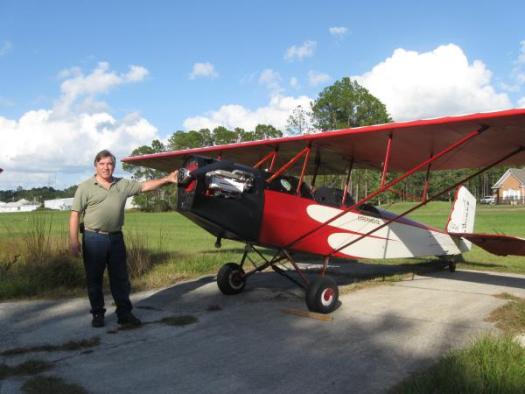
Above, Bob Lester of FL with his aircraft. It was powered by a 65 hp Lycoming, now a 100 hp Corvair. This is a radically different aircraft than it was a few months ago. It when from barely having a positive rate of climb with two people on a hot day to being able to climb 800 feet per minute at the same load and conditions. It now has safe and smart-looking gear that works correctly. The Mount, spring gear and intake were built at our shop. The plane is 25 mph faster now on the top end. The engine is equipped with electric start and a Dan 5th Bearing. It was built at CC#17.

Above, Harold Johnson’s ‘Big Piet’ at Brodhead.This aircraft won Best Auto Engine Conversion at Sun ‘N Fun in 2010. The Big Piet builders completed and flew 5 of the 6 planes started, a record in group project success. Their first visit to our hangar was back in 2003. The planes met with great reviews for both their operation and their attention to detail. They have 28″ wide steel tube fuselages. They all have modern 100 hp engines with electric start and MA-3 carbs.

Above, Frank Metcalfe’s plane at sun n fun the day before the tornado. This plane and her sister ships, the ‘big piets’, exhibit extraordinarily high craftsmanship. As many people know this aircraft was extensively damaged by the tornado. The plane is currently being rebuilt.

Above the plane of Bruce Laird who is also one of the big Piet builders from Carrollton. If you look closely you can see Frank’s airplane in the background. Like Frank’s, Bruce’s aircraft was extensively damaged. If these were factory built aircraft, they would have been considered totaled. But these aircraft are different. They represent years of hand work and care. They will not be written off as the majority of damaged aircraft at Lakeland were. The same hands that created these aircraft are back at work, making them right again. I look forward to seeing these planes again in 2013.

Above is Gardiner Mason’s Pietenpol, photographed before it was damaged in the tornado. The plane is now repaired and flying again. The plane had made its public debut at CC#19. Debugging his aircraft was the subject of an 18 page set of notes on cooling systems that we wrote. After working with us, the plane flew beautifully. After the tornado I spent some time with Gardiner at the show, and he was stoic about it. Everyone wanted to say they were sorry when they spoke with him and buy him a beer. It made me think about A.E.Houseman saying, “Ale does more that Milton can to justify God’s ways with man.” The plane has a 100hp Corvair with a Dan 5th Bearing and electric start. If you have an hour to learn, read the 18 page report here: http://www.flycorvair.com/pietengineissue.html On the internet there are a small number of critics that take every opportunity to say negative things about Corvairs and my work with them. Read the report and understand that while negative internet vermin type their bull, I am doing things like rebuilding Gardiners engine for free, running the Weight and Balance project and hosting Corvair Colleges. Take your pick on who benefits Pietenpol builders more. I don’t need to be thanked for doing things I want to, but I take a dim view of being criticized for it.

Above,Randy Bush of TN. at Brodhead with Miss Le’Bec (it is a combination of his girls’ names coined by his wife). His aircraft was seven years in the making. A consistent work of craftsmanship, the plane’s creation spanned both easy and hard years in Randy’s life. Many people new to homebuilding think that it is something you do if life is treating you great and you’re rolling in dough. Here is reality: The most successful builders I know understand that hours spent in your own shop, creating things with your own hands, is a vital part of a worthwhile life, and that this reality will be most evident at the hardest of times. Learning to make things is a crucial investment in your own sanity. Does it surprise anyone that really happy people always have a way of being creative? The plane has more than 400 hours on it. It has a 100 hp Corvair with electric start and a Roy 5th bearing.

Above, Kurt Shipman of Illinois with his Pietenpol at Brodhead 2009. His super clean installation features one of our Electric Start setups, Falcon heads and a standard rebuild straight out of our Conversion Manual. Kurt is a 39-year-old ATP who flys for the airlines. A prolific ‘internet personality’ made the claim that Corvair Powered Piets all have ugly cowls. Kurts cowl housing his starter is so ugly that when he flew it to Oshkosh for the first time the plane won the Bronze Lindbergh trophy, as the 5th best homebuilt at Airventure. So much for critics.

Above is a photo of Texan Hans van der Voort’s Corvair powered Air Camper at the Southwestern Regional EAA Fly In. His NX15KV won the Tony Bingelis Memorial Award for Best of Show there recently. Tony Bingelis was the greatest how-to writer homebuilding ever had, and Texas was his home turf. I’ve yet to see it in person, but everyone who has says Hans’ airplane is outstanding. How do planes with such ‘ugly cowls’ keep winning trophies? Hans’s plane utilizes a Zenith carb and one of out stainless exhaust systems.

Above, the Jim Ballew of OK, lands his Piet. It is a traditional BHP conversion. What is notable about Jim is that he also has a Corvair powered Davis DA-2 and a Corvair powered 601XL that he has built and flown. When a man has 3 Corvair powered planes you can be assured that there is a lot to like about the powerplant.

Above, BHP’s last original. This plane has 800 hours on it today, it lives at Brodhead and belongs to our friend Bill Knight. We did the weight and Ballance on this plane two years ago and overhauled the engine last year. On the outside it looks just like BHP made it, but inside it has a nitrided crank, Arp bolts forged pistons and one of our Black prop hubs and hybrid studs. Look closely and understand that BHP kept the thrust line low because he had the stock automotive blower fan on the engine, which sticks up higher than our electric starter set up. BHP’s Corvair Thrust line was very near the location of the Ford’s thrust line. It was a familiar location, but if you look at most classic planes, the thrust line is closer to the top longeron. Note that the last original has the main axles far forward and it has die spring in a tube gear like we made for Bob lester’s Piet.

Above, the Pietenpol of Duane Duea of Minn., at right, (and Kurt Shipman’s at left). The photo was taken at Oshkosh 2009. Duane’s aircraft was completed in 1972 and is so true to Bernie’s plans that I initially mistook his aircraft for Bernie’s first Corvair-powered ship, which resides at Oshkosh in the Pioneer Airport. This aircraft has approximately 1,000 hours on the clock. We spent some time with Duane at our booth, where he reflected on the privilege of knowing Bernie Pietenpol in person. This aircraft is nicely complemented by Kurt’s, which was completed in 2008, 36 years later. Although Kurt’s aircraft retains a very classy, pure look, it takes advantage of all of our research and development.
If you’re a Piet builder or just a fan of Corvair powered planes, I hope you have enjoyed ‘Pietenpol week.’ We have a lot of shop work over the next 72 hours, but I am going to get in a mail sack update this weekend and also get an engine building series started for next week. Stay tuned-ww.
Builders,
In keeping with the developing “Pietenpol Week” theme, today Vern and I drove about 2 hours to the northern edge of Florida to make a house call on a Corvair powered Pietenpol that has been flying since 1977. The plane is the handiwork and pride of a builder named Pat Green. Even though I have known him for 15 years and we live in the same state, Pat and I don’t often have a chance to get together.

Above, Pat’s Pietenpol. It has more than 1,000 hours on Corvair power. The installation has always been very close to BHP’s plans externally, but internally Pat went to forged pistons and an OT-10 cam more than 10 years ago. He was flying long before I started working with Corvairs, but he was never reluctant to adopt any improvement that my testing revealed. His original conversion manual from us was one of the first 50 I had printed, I have known him that long.
Many years ago he flew the plane to Corvair College #9, where he was much appreciated by Piet builders in attendance. In the years since, we have been very busy and Pat was deeply involved in the hour by hour care of his late wife. After beating a few health issues of his own, Pat paid a visit to our hangar where he explained that his personal plan was to get back into flying full-time and really enjoy all the elements of it that he used to before greater responsiblity took priority. A key element of this was switching from a traditional Bernard Pietenpol hand prop/blower fan engine to one of our electric start systems. He had been hand starting the plane for 35 years, but being 77 and having had back problems, he thought going with key starting was a safety issue, and made the prospect of operating the plane solo a lot more appealing. From that point we made a plan for a house call and to get him a running start on a conversion to electronics doing the starting.

Above, a shot of the original BHP/blower fan conversion from an angle that illustrates why an engine set up this way doesn’t fit well with a high thrust line engine mount. engines with starters and J-3 eyebrow scoops can utilize a higher thrust line and still fit inside the shape of the fire wall. The Prop hub is an original BHP model. It is mounted by the original short flywheel bolt in very deep wells. I developed Hybrid studs 15 years ago to improve the mounting of the prop hub for engine with more output than traditional BHP conversions. A BHP hub can not be used with any of our starter set ups.
Pat actually traveled to Cherry Grove and spent time with the man himself. Pat stuck with the project and finished it after 10 years of on and off building. The plane was not the only aircraft in his life, there were many. But as he gets to the other end of his flying years, he is very clear that his Pietenpol is the centerpiece of his aviation life, and without question the best thing he ever did in planes. The Sport Pilot rule will allow Pat to fly the plane for many years to come, so it is inevitable that it will be the last plane in the stable of planes he has kept, but he says that all medical factors aside, if he were to have had only one plane, the Pietenpol would have made him the most happy. He will be very glad to finish out his flying hours in the plane, and he will log a lot more of them with a starter.

Above are the blower fan parts that came off the engine when putting the Front starter on. There are people who have suggested that this stuff weighs a ton, but it doesn’t the fan is magnesium ( we put a story up last year about burning them in a bonfire at one of our airport parties) and weighs less than a pound. All in all, an electric start system is going to add about 20 pounds to the airplane after you take into account things like the larger battery. It isn’t shown in the photos, but Pat is going with a John Deer style front alternator driven off the Gold hub.

Above is a look at the engine being test fitted with the starter and the gold hub. The parts, including the starter kit, a new hub, hybrid studs, the alternator , brackets, regulator and a belt cost Pat about $1,400. It is going to take a bit of time to re-configure the cowl and wire the electrical stuff, but overall, it isn’t a lot of money or time to get the plane set up to layout that is a much better match for Pat’s next few years of flying.
Below: Blast from the past, Pat and I stand with his Pietenpol at Corvair College #9, seven years ago. The caption in blue italics below is the original words from the 2006 College. note to fashion critics: I haven’t always had long gray hair, but I have always dressed like a refugee, even long before it was stylish.

“Above, I stand with Pat Green of Jacksonville, Fla. Pat started his plane in 1967, and first flew it in 1977. Since then he’s logged about a thousand hours in it. Again, the Golden Rule in action. In my hand I’m holding a photo of Pat and I standing in exactly the same positions in my old hangar eight years earlier. We had a laugh, because I pointed out Pat was wearing the same hat, and he commented that it looked like I was wearing the same shirt. Pat is good company, and a sharp observer of human behavior. When he talks, I listen because he’s a man of many experiences in life. Among them is having known Bernie Pietenpol personally.”
A few words about house calls and service to builders: The trip up to Hillard, a few hours of work and back took seven hours today. I charged Pat my standard rate for a house call: Zero dollars. If you get a look at the years of such house calls documented on our websites, keep in mind that I have never charged any builder, wether we were old friends or not, for a house call. Some have been fairly close like todays, many have been on the way to or from airshows, but there have been others that involved getting on an airliner to go help a builder solve an issue. All of this was done at no cost. Our business makes fair profit on the items we provide, but I don’t view every interaction with builders as a opertunity to generate revenue. That is how a corporation or a LLC might think, but not me.
There are plenty of things we do just because I am a home builder and I like builders. People who have yet to meet me often incorrectly assume that things like house calls are just for friends. In reality, the recipient has little to do with my motivation. I know a lot about homebuilts, and a great part of this was taught to me by experts, mostly gone now. Those men didn’t charge me for their time. My willingness to pay attention and take their message seriously was enough. I also suspect that they were paying back a previous generation of aviators also. I have many flaws as a person, but being an ingrate isn’t one of them.-ww
Builders;
Continuing on the Pietenpol theme, we present round three of California Corvair powered Pietenpols. This magnificent bird is the work of Mike Groah and his father Vic. It has been flying a little less than 6 months. Get a good look at the workmanship in the photos, it is outstanding.

Above, the side view of a first class aircraft. Note the high deck angle provided by the full length gear legs. We flew our Piet with both short and very log legs. The additional angle of attack available with longer legs lets the aircraft land substantially slower in the three-point position. It also allows for a shorter take off technique. I personally like the look better.

Photo from the front. A very nice choice of colors.

Mike and his Dad Vic. Mike has said that one of the greatest things about the four-year build was that it gave him and his father a chance to spend a lot of time together than they would have otherwise. It is interesting that Fathers in their 40’s all want to get their sons involved in their building; Sons in their 40’s want to get their Fathers involved. Hats off to Mike for actually doing what a lot of us would like to.

Above, a very clean and well-organized engine bay. The engine has a front starter, but the alternator is a rear belt drive unit where the stock oil cooler was. Moving the alternator to the back does tend to clean up the front of a Corvair powered plane that is using J-3 style ‘eyebrow’ cooling ducts. While a gold hub, oil filter housing, starter brackets, E/P distributor and sandwich are visible, the parts that really set this installation apart are the things that were carefully had fabricated for this specific plane. I spent a lot of time looking at this photo and the one below. There is a lot of attention to detail that you may not notice until you have installed your own Corvair.

Above, the side view. A few months back I wrote a story about Pietenpol thrust lines. Mike’s mount has the traditional height as designed by the master himself, BHP. The two screws on the left, on the boot cowl, are the height of the longeron. The traditional mount has the thrust line about 3.5″ below this. Original Corvair installations with blower fans needed the engine to ride this low for clearance. We flew our Piet with mounts of this thrust line and also with the engine moved up 3″ in the airframe. Both locations work; go back and look at the earlier article to compare the side views of the aircraft. The carb is the photo is an MA-3, the exhaust is stock iron manifolds. The intake is a custom unit that Mike made. Although there is a lot of stuff in the photo, it is well-organized. The top photo shows that the plane has a large header tank in the cowl. If a piet has just a wing tank it has a lot less fuel, but the space behind the firewall can be used to house the battery and ignition system components. The two blue items are Bosch 0012 ignition coils, the ones I prefer for the Corvair.

Above, a good look at “the office.” certainly some very nice workmanship here also. Years ago, aircraft with other automotive conversion engines were very often some of the poorest looking examples of each particular airframe. Many of the people attracted to alternative engines seemed to care very little about quality and appearance of their airframe, almost as if it was some kind of inconsequential stand that followed their engine around.
Many of these aircraft, especially ones with belt drives, or liquid cooled engines or radiator installations that were an after thought or reworked many times, had particularly ugly cowls. Oddly, many engine guru’s themselves also had slipshod and disorganized engine on their own aircraft. (Mikes engine compartment is nicer than 95% of the Subaru installations owned by ‘gurus’ of that brand in the 1990s) I attributed this to many of these people really being ground based engine guys who cared little about traditional aircraft quality and organization, and even less about flight performance. If you listened to them speak at the time, a common thread was a naive disrespect for certified engines (calling them Lycosaurus, etc) and a level of venom for regular aircraft mechanics and the skills they exercised. These people were often vehemently opposed to learning anything from traditional aviation, even if ignoring it directly endangered them or people who followed them. It was Ego before Safety, and I can think of several of them that paid with their lives for this attitude.
fortunately, the Corvair movement has been spared these ills. The fact that the engine is air-cooled, narrow, free of a blunt belt drive and shaped like traditional aircraft engine gives us all a great running start of good-looking cowls that function well and clean engine installations. As the most outspoken person in the land of Corvairs, I took every opportunity to explain that philosophically we were going to emulate every single successful thing we could from Lycoming and Continental, (with the exception of their price structure.) If this alienated or excluded a fringe element who had a rabid desire to demonstrate “how stupid Lycosaurus engines are”, I am not the least bit sorry. People like that were bound to give alternative engines a black eye, at least I could discourage them from using a Corvair to do it.
The positive corollary is that we also made sure that the Corvair was well-known as the alternative engine of choice among people who practiced and respected traditional craftsmanship. This brought in countless builders who believe the original motto of the EAA, “learn, build and fly.” Trust me, this is one of the greatest personnel trades in the history of team building. The good people we attracted by highlighting the work and efforts of builders who valued a mixture of tradition an innovation are infinitely more valuable fellow builders than the handful of ‘special’ people who moved on the other unfortunate engines.
If you would like a clear picture of the reward of having a movement that champions genuine craftsmanship, get a good look at Mike’s plane. Any aviator who sees this aircraft in person will have an increased respect of Corvair building in general; Builders like Mike give all of us a better standing when we say “I’m building a Corvair” in any aviation setting. His workmanship is a direct example for other Piet builders. In addition all this, I like the fact he built the plane with his dad best of all. Hats off to Mike and Vic Groah, Father and son Pietenpol builders and flyers. – ww.


