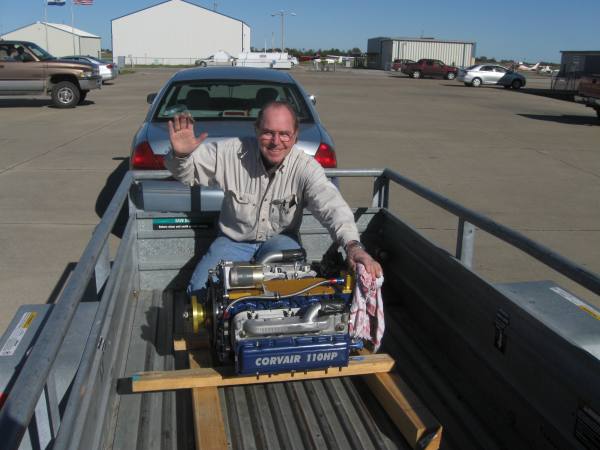
3,000cc/Billet Crank Shortblock, Destination: Waiex
Builders,
Below is another look at a high quality Corvair. This particular engine is in my shop right now, but is soon headed to its owner. The engine is something of a ‘kit’, and it is a clone of the engine in Dan Weseman’s Panther. After some planning with the owner, we decided that it made the most sense for me to find a core for him in Florida and perform all the modifications to it before sending it. The owner is a skilled mechanic, but opted to have us assemble the case and install the Weseman Billet crank and Gen 2 5th bearing. We are shipping the rest of the parts, the 3,000cc Piston/rod/cylinder kit and a set of Falcon heads, along with the gold components to finish the engine. The total isn’t cheap, but it is a good value. Keep in mind the Builders goal is to have an absolutely first class engine for his Waiex. The Corvair covers many builders needs, this particular engine is a good representation of the upper end of the spectrum of options. Although this engine was planned as a ‘cost is not a consideration’ build, it is worth nothing that the engine is almost entirely made of made in the USA parts, and it still costs only 40 to 60% of an imported engine. Corvairs are not for everyone, but there are good reasons why they make sense to the builders who choose them.

Above, the engine in a case assembly stand on my work bench. If you look closely, the Weseman Billet crank is visible. In our numbering system, this is part 1001(B). This engine has a new OT-10 and a California Corvairs Billet cam gear. The 5th bearing is a Gen 2 Weseman bearing. The tape over the Hybrid studs is part of the vastly simplified installation procedures of the Gen 2 design. This Case has already been bored for the 3,000 cc Cylinders. This engine uses aftermarket rods with floating pins, also sold by the Weseman’s. Although many people think of Corvairs as “rebuilt” or automotive engines, The only parts that came from the car that remain in this particular engine are the case, the bare head castings, the rear oil case casting and some miscellaneous small hardware. Everything else is new, and the great majority of it, like the crank, pistons, cylinders, oil system etc, was all specifically designed for flight engines. I have never shied away from the term “automotive conversion engine” because it is an accurate description of the Corvair. We have converted this engine internally to meet the demands of being an actual aircraft power plant.
Throughout much of the history of experimental aviation there have been advocates of taking a an engine straight out of a wrecked car and putting some external systems on it and running it in a plane. Sounds attractive to people looking for a ‘bargain’, but these engines typically have a very poor track record. Flying in a plane is a demanding and specific task that automotive engines in their pure form are not designed for. You can get away with it when you shoot for 50hp out of 200 cubic inches (model A) or even 75HP out of 164 cid (original Bernard Pietenpol Corvair Conversion). In recent years there have been many people who claimed that you could get 100 or 115hp out of a 110 cid Subaru pulled straight from a car. Today there are car engines aiming for 100hp out of 79 cubic inches. There have never been a shortage of bargain hunters to buy into this ‘free lunch’ mentality. I have long said that I am in aviation to tell builders what they need to know, and this is often very different that what people want to hear. Reasonable people understand that driving up the HP/cubing inch and raising the RPM to 5000 or 6,000 rpm, at the same time as trying to get away with basic car parts inside is not a formula for longevity nor cooling.
Philosophically, the Corvair is in the same line of thought as the Jabaru 3300 (201cid/120hp/3,300rpm) and the UL-350 (215cid/130HP/3,200rpm). Neither of these two engines is a “Car” engine. they have internal components designed for the stress of flight duty, Just like the Corvair. If you consider the examples of Lycoming and Continental, The Corvair is using the same basic layout and philosophy of the majority of successful engines.
There will always be people who point to rotax 912s and say they are 100hp from 80 cubic inches. I respond by saying that they really are purpose-built engines, and they have a lifespan and a cost per hour that I don’t find to be a good value. Everyone thinks that 912’s are an incredibly prolific engine, but consider that they have made 40,000 of them total in several decades. Continental has made far more O-200s than that, and GM made more than 40,000 Corvairs a month in 1964 alone. Another issue to consider is that I have worked on O-200’s that have been overhauled several times and had more than 6,000 hours on the basic components, parts that were designed to be rebuilt several times (just like a Corvair). I have heard very few stories of people ‘rebuilding’ a 912. It isn’t that kind of engine, it is much more akin to a disposable appliance. This doesn’t bother most people, but it isn’t the kind of engine I want on my plane. Think it over and come up with your own answer that makes sense to you. Its your project, your choice. -ww.
Jim Waters 601XL-B project, “In The Arena,” Memorial Day 2013.
Builders:
We had a visit from well-known and liked Corvair builder Jim Waters. He is from Pennsylvania, but he drove down to Florida with a trailer to pick up a nearly done 601XL-B that he found for sale on Barnstormers.com. Jim has a Fisher Horizon project in his shop, but he has been reading about the adventures of 601/Corvair pilots like Lynn Dingfelder, Ron Lendon and Phil Maxson, and he decided to change gears a bit and put his complete, test run 2700/Weseman bearing engine on the more versatile 601 airframe. When this one came up for sale, he saw his chance, made the move and got his own aviation adventure into high gear.

Above: Jim, his girlfriend Suzi-Q, Grace and Scoob E do the “looking skyward” pose in our back yard. The airframe is a Zenith quick build kit, with a panel in it, instrumented by the original owner for a Corvair. Jim and Suzi spent the night at our place and picked up most of the parts to install Jim’s Corvair on the front of this plane, including a powdercoated motor mount. This plane could easily be flyable by the end of the summer with just part-time work. Getting an aircraft this complete does not present any 51% rule issues. As long as 51% of the work in the plane was done by non-paid builders, it does not matter how many of them worked on it. A plane can have 11 different owners who each do 5% of it, and it will not have any issue qualifying as a homebuilt. Note that Jim has a copy of Stick and Rudder in his hand. It is a good luck present from Grace and I at the beginning of his new adventure.
In looking at our Web site, I was reminded how many Colleges and airshows Jim has made it to, and how he has always been a positive force of fun at each of these. I found photos of him at CC #9, #14, #16, #17, #20 and Oshkosh. He completed his engine at #14, and test ran it with a 5th bearing at #16. At the other events he just came to help out and enjoy the company.
At these events Jim saw the increasing amount of guys who were finishing 601s and flying them back to the Colleges, guys who had completed engines at Colleges right beside Jim. At some point he decided that time was getting past him a little too quickly, and it was time to switch gears and get in on the group of people who are out crisscrossing the country in Zenith 601s and 650s. I am not sure how long ago he started thinking about it, but from making up his mind to having his new plane sitting on the trailer at our place was about 21 days. He decided that he was not going to let another season get by without a serious change in strategy to make progress happen faster.
Although Jim has picked up this airframe largely done, it is only 25% of his “project.” As we sat around our dining room table, we spoke of how his project is four parts: Building the engine, building the airframe, putting the two together and getting them operational, and in Jim’s case, learning how to fly.
Although he has wanted to build and fly for a long time, he had other responsibilities. He is a man of action, ridden motorcycles all over the country, and experienced a lot of things. Building and flying is a just new chapter in his book. As I reminded Jim last night, learning to fly a plane with a good instructor is not a difficult task; people do it every day. Continuing to improve and hone your flight skills is what sets good pilots apart, not the initial license. I like the fact that he dove into The Arena, built the engine and got the plane, all with the confidence that he would later learn any skill he needed, including flying. There is a good lesson here for people just getting started.
By my measure, picking up the airframe saved him 25% on his four-part task. Smart move in my book because the goal is to build and fly. If a purist builds every single part, he may have satisfaction, but if his goal was to fly it and the depth of detail vs. available time equation means it never gets done, then that builder didn’t get his goal. Conversely, I think Jim has a plan of action, and the accomplishment of his four-part plan is now on the horizon and getting closer. There will always be purists who claim (often from the safety of an Internet connection and a mystery email name) that it isn’t really homebuilding unless it is plans built and you grew the trees for the spar yourself or smelted the aluminum. I don’t think like that.
To my perspective, “homebuilding” isn’t a competition over building aircraft, and I don’t think it is really about planes at all. I think that the real project is how the accomplishment changes the builder. How much more he knows, how much more he can make, and how he sees himself on the other end of this major challenge. The only person you’re competing with is the lesser side of your personality that would settle for you doing less with your life. That is the real enemy that you are confronting, and that is who you will defeat when you reach your goals. I look forward to hearing of Jim reaching each of his new milestones as he met the ones he has achieved already. Of the thousands of builders we have met in the past 20 years, Jim is one of the really special ones, and on the future day that I hear he has flown his plane, I will take an hour out to just simply be glad for him.

Video of Running 2850cc engine.
Builders,
If you would like to see a two-minute video of this 2,850cc engine running, including idle, repeated hot starts, and a short full power run,

Then click on this link, it goes directly to our new YouTube channel:
http://youtu.be/TQqlRFS1Qfk
2850 Engine Ready To Fly
Builders,
Below are pictures of a complete 2,850 from our shop. We assembled it as a serious upgrade to a pre-existing 2700 that was built a long time ago. The engine has a standard size, factory nitrided GM 8409 crank and a Gen 1 Weseman bearing. The engine now has one of our P/N 2850CC Piston/rod/cylinder sets.

Engine from the front quarter view. Gen 1 Weseman bearings have the same billet housing as the Gen #2s. We selected the Gen 1 because it was a “bolt on” installation to the factory nitrided crank. Visible are all the parts of the starter system (P/N 2400), the Short gold prop hub (P/N 2501B), powdercoated valve covers (P/N 1900PCBK) and the electronic/points distributor (P/N 3301E/P).

Above, a good view of a really simple oil system. This is a basic Group 2700 Oil system built around a 12-plate GM cooler. The gold oil filter housing (P/N2601S) has the oil filter mounted on it with a nipple (P/N 2601). Because it has a Weseman bearing, this engine has one of our High Volume oil pumps (visible on the case in the photo). We sell this pump assembled on a remanufactured case, exchange, as P/N 2000HV. Years ago, many builders were interested in engines with rear starters. What those engines required was complicated oil systems with remote mounted filters and often remote coolers. Such a system would have 5 hoses compared to this engine having one. The Wicked Cleanex, Dan’s plane before the Panther, flew for many years on an engine just like the one above. (The only difference was it having a 2601R Reverse oil housing.) It is very had to argue against simplicity, especially when it is flight proven.
Above is the engine during its break-in run in our front yard. It fired up in 4 seconds of cranking and ran perfectly smooth through an initial 45 minute break in. Tomorrow, another hour or so of running before an oil change and inspection. -ww
Dick Otto in California, S.R.B. (Senior Ranking Builder)
Builders:
Our man on the West Coast, Zenith 601XL Builder/flyer Woody Harris made another house call last weekend, to Dick Otto’s place to be on hand for the first run of Dick’s 2700/Dan bearing engine. Woody reported that it fired right up and ran very well. He snapped the photo below to capture the first run of the engine, while it was bolted to Dick’s plans-built 601XL.

If you have not met Dick yet, I highly suggest that you read this story I wrote about him a while back: Mail Sack – Letter of the month – Dick Otto, 601XL Calif. I refer to Dick as our “SRB ” because he is 92 years old!
The story above gives you a glimpse into the life of a member of “The Greatest Generation.” I have enjoyed every hour I have spent in the man’s company. Hats off to Dick for getting his engine up and running, and many thanks to Woody for investing the time to assist West Coast builders.
Because Dick now has a running engine, I have submitted him as a new member for our Zenith/Corvair private discussion group, moderated by Zenith 601XL builder/flyer Phil Maxson. The group is fairly active, and has already generated several hundred posts in its technical archive. As a direct peer-to-peer group, the members can work directly with each other to exchange information. The ‘invatational” nature of the membership (it is open to anyone with a flying ww conversion on a Zenith, and to Zenith builders with a running Corvair.) allows the flyers on in the group to share their information with builders advanced enough to appreciate it, and the flyers are also insulated from ‘peanut gallery’ comments by internet trolls and ‘experts’ who can not resist criticizing the flying work of others, even though they will never do anything themselves.
We are now less than three months from Brodhead and Oshkosh, where we look forward to seeing many builders, friends old and new. Spring is now on hand, even in the northern parts of the country, and it is a good time to put your ‘plan for progress’ in action. Do not let the time pass without getting things done. The big aviation events this summer will be a lot more satisfying to attend if you do so knowing that you have significantly advanced your project since last year.-ww
Panther Engine Is Alive … ALIVE
Friends,
As I type this, the sun is setting in Florida. 30 minutes ago the 120 hp, 3,000cc Corvair for the The Weseman Panther was completing a 1 hour break in run in our front yard. It started after 3 seconds of cranking and ran flawlessly for a 65 minute progressive break in run. This is the first engine with Dan’s American made billet crankshaft.

Above, Dan and I stand next to the running engine and cover important technical topics like the fact that Rachel made pot roast and said we could all eat dinner over at their place after the engine run as done. I would like to say there was some drama involved, but in reality the engine cranked right up, ran steady, we monitored all the temps and the oil pressure, which hardly fluctuated during the hour. It all went just as good engineering is supposed to: No surprises. At the end of the run Dan did give in a little and say that he was pleased with the turn out. We have a very full week of work heading into College #24, so there will be no pause to celebrate. We will be going back to the shop after dinner to prep more parts for the College.-ww
Here is a video of the Panther engine on the test stand:
New “Zenvair-750”, Jeff Cochran, 2,850cc engine, N750ZV
Friends,
Jeff Cochran of Alabama has been flying his Zenith 750 on Corvair power for the last few weeks. Below is a quick look at the plane and Jeff with his running 2850cc Corvair at CC#19. I spoke with him recently and he is planning on flying the plane to Corvair College #24 if he can get the test time flown off.

Above, Jeff on the left on the day he passed his airworthyness inspection. The plane displays outstanding finish and appearance. In working with Jeff I can attest to his methodical and professional approach to aircraft construction. He asked very specific questions that reveal a lot of thought and reasearch.

Jeff supervises the run-in of his 2850cc Corvair at Corvair College #19. Jeff chose to have us build the engine for him. We delivered it at the College #19. The engine features a RoysGarage.com bearing, the 2850 cc dished pistons, all of our Gold Systems, and Falcon heads equipped with Inconel valves and exhaust rotators. This is a seriously robust engine. The Zenith 750 is a large airplane capable of climbing at very low airspeeds. This combination makes it brutally unforgiving on engines with inadequate cooling or light duty construction. The Corvair’s outstanding cooling and high quality components make it impervious to installations that are the undoing of lighter engines.
Although we assembled the engine for him, Jeff has invested the time to attend Colleges #16, #17,#19, and #21. Because of this, he knows his engine far better than builders who opt for a ‘Buy-it-in-a-box’ imported engine. I wouldn’t characterize Jeff’s Corvair college experiences as purely educational, if you look at the photos from these colleges there was a lot of fun mixed in with it. Jeff’s path to success high lights the Corvair’s flexibility to adapt to the needs, budgets and time lines of individual builders. With other engines, builders have to accept the power plant the way that it is offered, and pay for it all at once. No such condition exists in the Corvair movement. You can tailor it to fit your individual goals.
Thinking of getting started? Haven’t made enough progress this year? The most common thread in the stories of successful Corvair builders is attending a College. We are 33 days from the last College of 2012. Make your plans now, decide to head for Corvair College #24.
Hats off to Jeff Cochran on the completion and first flights of his Zenith 750.-ww
Shop perspective: Mastery or ?
Friends,
Here are a few photos to give builders some insight to a day in our shop. They were taken the week before we left for the Zenith open house. Perhaps the most important aspect of our work with builders is that I am essentially a homebuilder myself. In our industry, there are countless companies staffed by people who have never turned a wrench on a homebuilt aircraft. These people have little or no understanding of the needs and capabilities of rank and file homebuilders. Many of these sales people have no exposure to real builders beyond handing our brochures at Oshkosh. Very few of them have ever made a single house call to a builders shop, and consequently have little real connection to traditional homebuilders.
We are on the other end of the scale. Over the last 20 years I have held 23 major colleges and made something like 400 house calls. This is a lot of opportunity to listen to builders and really get to know them. Until you do this, I can make a good argument that you are not really in a good position to be an asset to builders. Yes you can sell them things, but until you know them, you don’t even know if builders are installing the stuff correctly, far less learning anything nor improving their own personal capabilities.
Look at the photos below and notice that my shop and hangar may be a little messier, or have more old school tools, but it is still a homebuilders shop. A product producer who has a spotless CNC shop, but never works on aircraft directly, will have a distorted view that technology rules the day in homebuilding. It doesn’t. Craftsmanship will always be paramount. No matter how the part is made, a human, (an amature not a professional in homebuilding) will have to bolt this part on and operate it. Unless you understand these builders, and are willing to invest effort in assisting them in the development of their personal craftsmanship, you are not going to make a difference. technology is an important tool in the process, but it isn’t the focal point. It’s called homebuilding for a reason….if every part was made exclusively in a high-tech factory and came pre-installed, you could drop the name Homebuilding and replace it with the term Factory-buying.
At Zenith I met a guy who was having a different brand of aircraft built for him. He was dropping some big checks to have his airframe built, have a buy-it-in-a-box engine installed, and another guy paint it. Almost everything the guy had to say was a frustrated complaint. Little surprise, he had gone to great expense to remove every satisfying element from homebuilding and replace it with a consumer experience, had attempted to negotiate a leveraged exchange rate for the craftsmanship of others for his dollars. In direct comparison, I had a number of corvair builders share pictures of things they were very proud to have created with their own hands. There is an obvious truth that people who make things are happier than people who buy them.

Above Grace is sealing parts, hardware and instruction sheets into sealed bags. This is in one end of our 20x 30 shop. It is disorganized because we were packing up the trailer to head out to Zenith. The shop is usually full, but neater. For the most part, Just Vern and I work in the shop, so it’s small size is not a problem. It is well lit and has central heat and air. (It is attached to our 40×50 hangar, but the hangar is truly ‘climate controlled’, in the sense it is hot in the summer and cold in the winter.) Look Closely and you will see the Scoob E. is lying on the chair behind Grace. He tends to spend 23 hours a day within 10 feet of her.
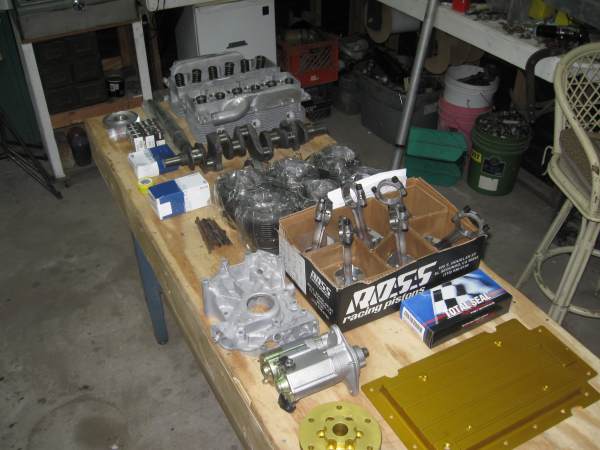
Above, parts laid out that were assembled into Gary Burdett’s 2850cc engine. Gary is well along in the construction of his Zenith 750, and elected to have us assemble his engine. Even though he purchased it complete and test run, he has taken advantage of all of our educational material and the type of learning we offer at colleges. He is far more knowledgeable on the building, operation and maintenance of this engine than almost any person who buys an engine from a company that places little effort or focus into builder education
Note the high-end parts that went into Gary’s engine. The Falcon Heads are vastly better than any Corvair head that every left the factory; The pistons are Forged, CNC machined and made in the US; The crank is fully stress relieved and deep nitrided. The engine components are far better than the ones GM used. Corvairs were rated up to 180hp in the car, redlined at 5,500 rpm. Not only do we use far better components, bet we simultaneously flat rate the engine to 55% of this power output 58% of this rpm limit. This is the root of all the success of the Corvair engine as an aircraft power plant. It is truly an automotive Conversion engine, because we have converted in the form of substantial internal improvements while flat-rating its output. This is the only rational way to expect a car engine to reliably do the job of an aircraft engine.
Over the years, there have been countless companies that tried to promote the concept that a car engine rated at say 100 hp at 6,000 rpm can have a reduction bolted to it and be put directly into a plane, and then asked to reliably produce 100hp and turn 6,000 rpm. Everyone understands that if you drove your car like that it would have a short life span, but many people bought into this idea because they wanted to believe it. These engines were called auto conversions, but in reality they were not….they were just auto engines, being asked to continuously develop power at high rpm. Most of these engine came out of cars that were wrecked, many were out of designs marketed to 18-24 year olds, most of whom have no concept of auto motive maintenance like oil changes. When asked what they would do if their stressed engine broke, almost all of these people said, “I will just go get another from a junk yard” as if every aircraft engine conveniently breaks on the ground in front of a snap on tool box.
You can’t teach people who don’t want to learn nor consider any thought that would challenge something they have a big emotional investment in believing. I don’t try, I am just here to work with people who wish to learn more about how they can become their own engine builder, and maintenance department. Some people would gladly take the word of a junk yard operator that the engine he is selling is read to fly. Corvair builders are the kind of people who would much rather count on an engine based on a 52 year track record of steady improvement on an excellent design, that they built with skilled hands, with conversion parts specifically designed to make the engine reliable. Which engine you gravitate toward depends entirely on what kind of person you are.
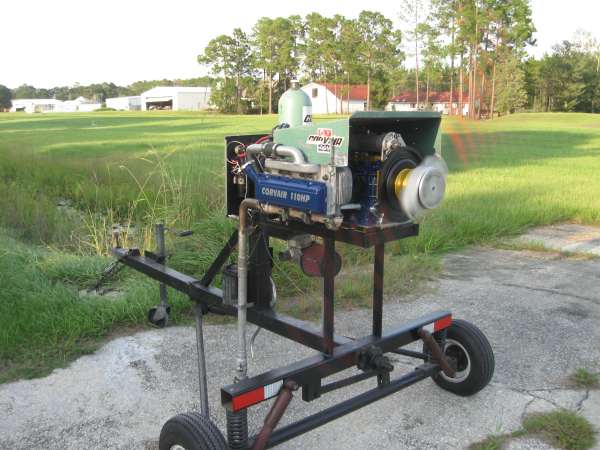
Above, Gary’s 2850cc engine at power on the break in stand. A fundamentally simple engine, that we have a long track record of expertise with. Safety in aircraft is all about understanding and having mastery of the machine you are operating. You can not show me a single person who was ever hurt in a plane because he understood too much about it, but I can show you countless statistics that used to be humans who got caught operating a machine with pass-able skills when the moment required better.
I do not have an instrument rating nor a multi rating. If I wanted either, I am sure I could write a check to a ratings mill and have enough skill in 10 days to do a passable job on the check ride. People who actually have mastery of muti and instrument flight understand that neither of these are forgiving of “pass-able” skills when it counts. I can make a good case that this extends to every skill set in aviation, that safety lies in mastery. My personal concept of what I want to do in aviation is mastery of the stick and rudder VFR planes that I like. Because I am a homebuilder, I am also speaking of mastering the building of this plane, and it only makes sense to me to know the power plant, and I mean really know it, as well.
Plenty of people demonstrate that you can get away with very little understanding of aircraft, flight, powerplants and weather, and still get back to the airport. Maybe they don’t care, maybe they are not bothered by trying to cut a few corners or get away with stuff, But this isn’t me, and it isn’t why I am in aviation. I am here to really know things, and to be the master of the equipment I am counting on. The inherent simplicity of the Corvair and the educational nature of the movement makes this possible. I honestly don’t understand people who would be comfortable pushing the throttle in on the take off roll, comfortable with the idea that the guy at the junkyard said “the engine was only driven on Sundays and had low mileage.” Ronald Reagan popularized the phrase “trust with verification.” After 24 years in experimental aviation, let me suggest you will be better off if you just skip to the last word and just “Verify.”-ww
Zenith Aircraft Open House
Friends,
Here are a few photos and thoughts from last week’s Zenith open house celebrating 20 years of operation in Mexico, MO. (Zenith has been in operation more than 30 years, but was based in Canada for the first years.) After I took them, I realized that almost all of them were shots of people. This is fair enough, because in the real measure, homebuilding is about people and their hard work to achieve something extraordinary in their lives, people un willing to settle for what others will accept.
This month marks 9 years since Grace and myself bought our 601XL kit from the factory. When it flew several months later, we started the era of ‘Zeniths powered by Corvairs’, something we shortened to “Zen-Vair.” The years since have seen almost 60 more Zeniths take to the air with Corvair power. We now have another 50-60 aircraft that could fly in a year, and a completion rate that is close to one every 12 days. It is a success story make possible by Zenith providing outstanding designs that are well supported. Choosing an airframe is something of a marriage between the builder and the factory. In the case of Zenith, they have a long track record of successfully working with builders of all experience levels. They are one of the longest lasting and most stable companies in our industry, and as one of their builders, I will gladly say that they are first class people to work with.

Some people show up everywhere. Albert and Dan Glaze have been to the last half-dozen Corvair Colleges, a number of airshows and several Zenith open houses. Dan’s engine ran at Corvair College #20 in Michigan last year. Yet he and Albert return to events to give back a little more than they received, a common thread in the Corvair movement. These two long time friends have an ongoing comedy routine like Bing Crosby and Bob Hope. Dan’s aircraft is a 750. he is now past the 75% mark, and having the engine done and running is a lot better feeling than having a big expense looming in the future.
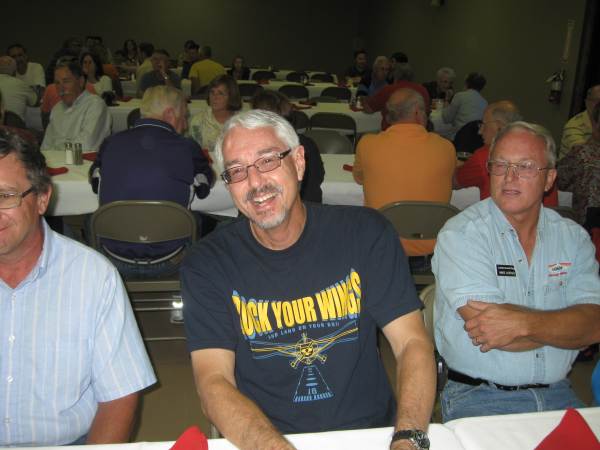
650 builder and pilot Dave Gardiea. His aircraft was the polished one with the red nosebowl. Dave’s plane has also been seen at Oshkosh, and is another outstanding example of the breed. Although I like pretty much anyone into homebuilts, Dave is a good example of the self-reliant, thinking kind of builder that we attract to Corvairs, easy people to admire and get along with. At first glance, builders considering engine choices often compare weights and prices. truthfully, finding the best match for your plane is much more about your personal goals in homebuilding. For people who want to know everything about their aircraft, on both sides of the firewall, we have the Corvair.

Delton Perry and his better half. He is closing in on finishing his Zenith. Last year, at College #21, Delton ran his magnificent engine. A life long mechanic, his powerplant displayed a very high level of detail and gave a very smooth test run.
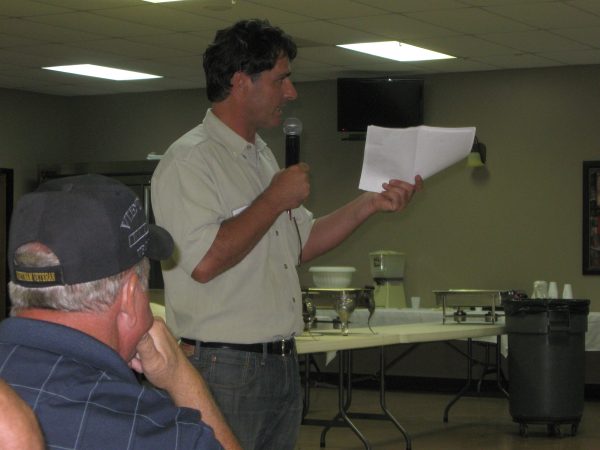
Sebastien speaking at friday night’s dinner. He made sure to personally thank his staff for the success of the factory. When he recounted how long each of the people had worked there, it stood in contrast to many other aviation companies that go through employees like water, unable to generate stability nor loyalty required to attract and keep a first class staff like Zenith’s.
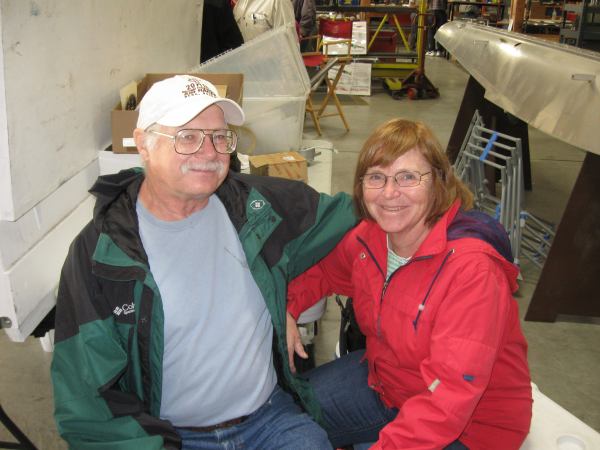
Craig and Valerie Westedt. The both came to Corvair College #22 in Texas and CC#23 in Florida earlier this year. Craig is quick to point out that the project is actually Valerie’s build, he is playing the support role. At the Zenith dinner Valerie won a deluxe VIP Oshkosh Package from the EAA’s president, Rod Hightower. It included an up close parking pass. All the Corvair builders who have met Valerie understood she isn’t going to need the parking pass, as she is determined to fly into Airventure.

Lynn Dingfelder’s 601XL(B). This is the first time I have seen his plane since he flew it into Corvair College#20. The engine is a 2700cc power plant with a Dan bearing and an Elison EFS-3A carb.

Shane and Phyllis McDaniel stand in front of their 650, which was the first amature built 650 in the country. They brought it to Oshkosh to great praise, it is a outstanding example. They recently finished a 601XL, also Corvair powered, for a his and hers combination. They are both skilled builders and pilots. Both of their aircraft have 2700cc engine with Dan bearings and MA3-spa carbs.

Dr, Steve Minart, of Iowa, stands beside his 2700cc Corvair powered 601XL(B). His aircraft was the 4th Corvair powered Zenith to arrive at this years event. Over the years we have had a steady stream of builders bring their Zeniths to Mexico, Colleges, Oshkosh and Sun n Fun. This is the best measure of success. Sales numbers mean little, I am in the game to get people flying. Our Corvair program for Zeniths has been around a long time. On our 2005 Midwest Night School tour, one of the stops was Dr. Minarts home. Here today, gone tomorrow companies in experimental aviation have stolen more builders dreams than most people first guess. Few people understand that less than 10% of the firms in our industry 20 years ago are left. Even many of the familiar names went through ownership changes and bankruptcies, often at builder expense. Zenith’s record is a complete standout in our industry.

Above, Mark Petinunas of Falcon machine speaks with Lynn Dingfelder about Lynn’s 601. Mark ‘Petz’ is one of our Corvair All-stars. He came down to the open house to meet with builders and Deliver a 3,000cc Corvair that is destined to power Clark Taylor’s 601XL. Because we are primarily in the business of teaching people how to build their own engines, the Corvair All-Stars are all mechanics and builders, not sales people.

Above I stand beside Ray Huffman from Lexexa Kansas. who has a long personal history with aviation. I noticed his hat and asked him about it. I listened closely while he spoke of Flying Hellcats and Corsairs in WWII, and Banshees in Korea, including ditching in the sea of Japan and being rescued by a helicopter. He is 88 today. About 10 years ago he built and flew a 601. It says a lot to me about the experience of homebuilding that a man who had flown the front line of aircraft in combat in his youth still found homebuilding a vital part of the panorama aviation, something he was unwilling to miss.
Listening to this man will likely turn out to be the best hour I spent in aviation in 2012. In another decade, we will still honor the courage of aviators of the greatest generation, but they will be gone, and you will never again be able to listen to one of them while standing in the sun on the ramp at an airport. You will always be able to see a F4U or a F6F at Airventure, or read about the history, but these are just machines and books, and are not comparable to meeting the man. 99% of us will never see nor do the things this man has, but as fellow homebuilders you have some common ground with him, a connection that can give you slightly better perspective on his experience. I have casually wasted many hours in my life, but from 3 to 4 pm CST September 22, 2012, I spent one of my hours doing something very worthwhile.