Zenith 750 / Corvair reference page, October 2013

Builders,

Here is a single location page that has a great number of links to information specific to the Zenith 750 / William Wynne-Corvair Combination.  It is a particularly good match, we have a number of different ways to approach it that serve the needs of many different builders, and it is a success story that builds on our 10 year history of working with Zenith builders, starting with our own personal 601XL in 2003. Since then we have assisted more than 80 builders to complete and fly their Corvair powered Zeniths. In the coming years these will be accompanied by an ever increasing number of 750’s.

If you already are working on your Corvair, this page will have information you have seen already on our websites, but I have included it so that this page can function as a ‘stand alone’ guide for 750 builders who have just heard about our work with the Corvair. Our approach to serving builders is different than typical businesses geared only to sell things to consumers. Our goal is to assist you on your path to becoming a more skilled aviator. The products we sell support this, but simply getting you to buy things is not what I am in aviation to accomplish. If you would like to start with a simple three page spec sheet on the engine, read this link first: Basic Corvair information

This page is broken into the following sections:

1) Introduction

2) Engine and build options

3) installation components

4) Support for builders

5) Flying 750’s

6) Builders in process

7) 750 flight data and safety notes

8) who is WW?

9) Comments on dangerous trash.

At the end of each section there are links to supporting stories that have expanded information on concepts discussed in the section. Take your time and study it carefully.

I will be glad to answer further questions just email WilliamTCA@aol.com or call 904-529-0006. You can also check our two websites, http://flycorvair.net/ , http://flycorvair.com/ . The first is our ‘newspaper’ the second is our ‘library’ and ‘store.’ The links below are stories that already appear on these two sites, they are just arranged here to support this introduction to Corvair power for 750 builders.

blogburdett050813

Above, the flying 2850cc Zenith 750 built by Gary Burdett of Illinois.  It has our full complement of Zenith installation components and one of our production engines.

.

1) Introduction:

The Corvair has been flying since 1960, and I have been working with them as flight engines since 1989. It is a story of careful development and testing, a slow evolution to the engines we have today. It is ‘old and proven’ rather than ‘new and exciting.’  If that approach appeals to you, read on. There is a lot of material here, and it isn’t something you are going to absorb in one quick scan. Frankly, your engine selection deserves careful consideration, and it isn’t the kind of decision you should make based on a 4 page sales brochure.

Corvairs have proven themselves to serve a very broad variety of builders. Many alternative engine options for the Zenith are offered only as a “buy it in a box” import, more of an appliance than a machine, with little or no consideration of the builders, skills goals, needs, budget or time line. The Corvair has options to address these valid considerations, because your power plant should conform to you, not the other way around.

This said, Corvairs are not for everyone.  In the 25 years I have been in the EAA and working with builders, the Corvair has always been very popular with ‘traditional homebuilders’, the people who have come to experimental aviation to discover how much they can learn, understand and master.  The expansion of the EAA has brought more of these builders, but it has also brought a great number of people incapable of distinguishing between mastery of an aircraft or an engine and just merely being its buyer and owner.  People who’s consumer mentality and short attention spans are better suited to toy ownership than mastery of skills and tools in aviation. Corvairs, and perhaps experimental aviation, are a poor match for such people. Many salesmen in our field will gladly sell anything to anyone with green money. I am an aviator, not a salesman, and the gravity of the subject requires more frank discussion and ethics than many salesmen bring to the table.

If you came to experimental aviation to find out how much you can master, not how little, then you are among the aviators who follow Lindbergh’s timeless 1927 quote: “Science, freedom, beauty, adventure: what more could you ask of life? Aviation combined all the elements I loved.”  Even if you are brand new to aviation, I am glad to work with you. I have a long history of working with builders of all skill levels. We have a number of successful builders out flying their Zeniths who are the masters of both their airframes and engines, who had never changed the oil in a car before building their plane.  If you got into experimental aviation just to buy stuff, then any salesman will do just fine for you. If you got into experimental aviation to learn, develop your own skills and craftsmanship and make things with your own hands, then who you work with really matters. You can’t become and old school homebuilder / motor head by buying things from salesmen. They have nothing to teach you. What you will do in experimental aviation is not limited by what you already know. It is only limited by what you are willing to learn, and selecting experienced people to learn from.  If you are here to learn, I am here to teach. It is that simple.

.

—————————————————————————-

a) – Complete Lindbergh quote is here: The Quote, 1927, C.A.L.

b) – Explanation of machines vs appliances : Machines vs Appliances Part #2

c) – Story of real engines vs ‘ideal’ ones: Unicorns vs Ponies.

d) – An example of our ling standing working relationship with Zenith: Friday out of shop until 4pm.

e) – A direct explanation of what makes my work different than typical LLC’s : 2011 Outlook & Philosophy

f) – A moving statement of philosophy: Sterling Hayden – Philosophy

.

Above, the 3,000 cc Corvair, configured for a Zenith 750. An inherently simple engine, It’s opposed six configuration makes it the smoothest of available power plants. It has outstanding cooling because GM put a tremendous amount of cooling fins on it and  gave it a factory CHT redline of 575F. All of our engine parts are made in the United States.

.

2) Engine and build options:

.

If you are new to Corvairs, lets quickly cover some ground: General  Motors made 1.8 million Corvairs. brand new parts, including billet cranks, forged pistons, valves bearings,  virtually every single part inside is currently made and readily available, and will remain so. Rebuildable Corvair engines are plentiful, and much easier to find that Lycomings or Continentals. We have been working with Corvairs for 25 years, and there is no shortage of core engines or parts. If you doubt this for a second, Google “Corvair engine parts.”

The Corvair makes an outstanding aircraft engine because it is a simple, compact, direct drive, horizontally opposed six cylinder, air cooled engine. It is robust, and ‘flat rated ‘ from it’s automotive output. The engine runs equally well on automotive fuel and 100LL, and it does not care about ethanol. In its 53 year flight history, more than 500 experimental aircraft have flown on Corvair power.

The engine can be built in three dispacements with three respective power outputs. They are 2,700cc / 100HP, 2,850cc / 110HP and 3,000cc / 120HP. The two smaller displacements weigh 230 pounds, the larger actually weighs 8 pounds less because it uses lighter cylinders. All engines are completely rebuilt from very high quality parts before flight. They are not just removed from cars. The parts we use are specifically selected to convert the engine for the rigors of flight use. Forged pistons, Inconel valves, chrome rings, ARP rod bolts and many other components are upgraded in the rebuild.

To absorb the propeller and flight loads a “5th bearing” is added. It is a billet housing with a very large bearing from a V-8, bolted on the end of the case.The ignition is redundant and utilizes two 40,000 volt systems, one driven by digital electronics the size of a match book, the other by a traditional set of points. The engine is direct drive, it has no complex reduction unit. It makes good thrust because it has more than twice the cubic inches of a Rotax 912. All of the systems on the engine are intentionally patterned after those on Lycomings and Continentals, because they are the  model of success in proven aircraft power plants. People who do not acknowledge certified engines as excellent models of success are often just zealots.  To succeed in experimental aviation you need dispassionate information not emotional opinion.

One of the unique features of the Corvair is that it can be built at home, from our information and parts and a locally acquired rebuildable engine, or it can be purchased from us, test run with logs. 90% of current builders are building their own engine at home. Only 10% of the builders opt to have us build their engine. We have happy to serve both builders. In either case, Corvairs are the best match for builders who want to understand and be the master of their engine.

Because of the plans built vs production engine nature of the Corvair, there are large variations in how much builders budgets run. Below is a quick look at the differences. Keep in mind, these budgets are for first class, completely overhauled, zero timed engines with 5th bearings, starting, ignition and charging systems. We have clever builders who have built and flown engines for less than $3,000, but this not representative of main line builders. The numbers below are much better for Zenith builders to budget on.

.

2,700cc / 100HP typical homebuilders budget: $6,500- Same engine assembled and run from us $9,750

2,850cc / 110HP typical homebuilders budget: $7,500- Same engine assembled and run from us $10,750

3,000cc / 120HP typical homebuilders budget: $8,500- Same engine assembled and run from us $11,750

.

If you are attracted to the concept of building your own engine, but have not built motors before, Good.  About half of our builders have never built any kind of an engine before. Our main work is teaching people what we know and providing the parts to work with. Our system does not require anyone to be a machinist nor to have previous engine experience.

The procedure of building an engine in your shop follows this format:

1) Get a conversion manual and DVD’s from us, use them to find a rebuild able core engine locally. Disassemble this engine following the steps in the DVD.

2) Send the crank and heads to our approved facilities for rebuilding and modification. They come back ready to ‘bolt on.’ Other parts of the engine are cleaned and inspected. The parts to convert the engine are ordered from us, many of the standard rebuild parts like lifters and gaskets are available from local auto parts stores. We do not ‘middle man’ anything you can directly buy.

3) Assemble these parts according to the manual and DVDs. There is no machine work required, only basic tools are needed, and a few specialty tools like a torque wrench. Many builders attend our free Corvair Colleges and directly learn hands on skills. You can even bring your parts and assemble them under our supervision, and test run your engine on our equipment. College attendance is a plus, but not required. Our methods work without direct training; a good number of engines are built and flown each year by builders who have never met me in person.

4) The test run serves several purposes. We teach people to build one of  three specific models, and we teach them to use specific parts. Not only are these proven, but it also allows me to verify from a remote location that the engine was assembled correctly. A builder can report his static rpm, CHT, oil temp during the test run with his Warp Drive prop at the specified setting, and I can confirm the output and assembly of the engine without seeing it personally.

If you would like a sample of the information on working your way through the above four steps, get a look at this: Getting Started in 2013, part #1, Crankshaft process options.

I have broken down building a Corvair and installing it on your airframe into 42 “groups”. The previous link is about  ‘Group 1000’ the crankshaft. If you would like to look at every part that goes into a Corvair, along with the conversion parts we sell, look at Groups 1000 -3300 at this link to our catalog: http://www.flycorvair.com/products.html

All builders get started with a conversion manual. The first part of the above link is about manuals and DVD’s.  The direct link to the manual is: http://www.flycorvair.com/manual.html. almost all builders looking for a rebuild able engine also order the Disassembly  DVD, which covers core engine selection visually. The direct link to it is: http://www.flycorvair.com/videov.html We encourage everyone to get started with information, even if you are pretty sure you would like to purchase a production engine from us. If you eventually buy an engine from us, we directly reduce the price to rebate all the money you spent on manuals and DVD’s.

.

———————————————–

a) – Corvair Weight story: Corvair vs O-200…. weight comparison

b) –  Samples of our production engines:  2012 Corvair Engines For Sale: 100, 110 and 120 HP

c) – For an explanation of ‘flat rating’ and a 750 engine build : Shop perspective: Mastery or ?

d) – A story about engines running on our hangar Dyno: http://www.flycorvair.com/thrust.html

e) Engine of builder now working on 750 airframe: World’s Strongest 3,000cc Corvair, built by Greg Crouchley

f)  3,000cc engine we built for 750 builder Larry Hatfield: 3,000cc Engine Running

g) A story about the evolution on 120HP Corvairs: 3,000 vs 3,100 cc Corvair engines.

.
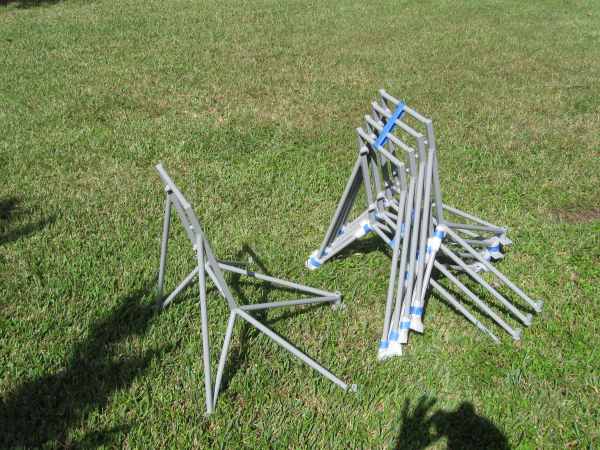
Headed to the 2012 Zenith open house, six of our powder coated 750 mounts. All of our mounts are welded in house, all of our parts are made in the United States.

.

3) Installation Components for the 750:

We provide every single part it takes to install a Corvair in your 750.  You can buy them one at a time, or all at once. Ninety percent of these parts are common to our Zenith 601/650 installation, which has been successfully flying for a decade. Only the mount, the diameter of the prop, and the size of the air inlets is different. Our Zenith installation manual detail how and why each of the installation components are installed on your airframe.

The installation does not require any modification to the airframe fuel system like most EFI engines do.  Being air cooled and carbureted, it is one of the easiest engines to install. Many companies that are good at selling things are poor at teaching things, like how to install their products. Teaching is the very cornerstone of my work, I am a skilled writer, we run Corvair Colleges, and we have a simple engine. All this adds up to a comparitively easy engine to install. There is no need to rush it, but I can do it working in one long day.

 Installation part numbers are Groups 3400 through 4300 in the second half of our numbering system. Get a look at this link: http://www.flycorvair.com/products.html From that list, you can see that the major installation parts for a 750 are: #3601(S) intake manifold, #3901(A) Stainless exhaust, #4002 spinner bulkhead, #4003 Warp Drive prop, #4101 baffle kit, #4102 nose bowl, #4103 cowl kit and a #4201(B) mount. The other smaller items listed are detail in our Zenith installation manual. All of the above parts have links to stories through the products page, but just for an overview of a single part, look at this link: Zenith 750/Cruiser Mounts. P/N 4201(B)

Many people new to building initially think that very economical engines like the Corvair must also be inexpensine to install. In reality, the cost of items like motor mounts and cowls are not affected by the cost of the engine they mount and house.  A mount for a $30K UL-350 and a $7K Corvair have about the same amount to tubing and welding time in them, and thus cost about the same. Most engines for Zeniths have installation kits that run from $4,000 to $6,000. The Corvair is near the bottom of this range, but the savings of using the Corvair is in the engine, not the cost of installing it. Builders can save a significant amount of money by fabricating many of the parts like #4103, but most people are near the finish line at that point and opt to buy it and save the time. Exact cost on the installation parts varies a bit, I will be glad to review it with builders after they study the installation manual.

—————————————–

a) – For an example of 74 years of aircraft welding talent: Zenith 601/650 Motor mounts, P/N 4201(A)

b) – To learn about the Stainless exhausts we make: Stainless Steel Exhaust Systems

c) – A 2008 look at how we developed the 750 installation on one of the first kits:

  http://www.flycorvair.com/750.html

d) You tube video of an engine we built running on a 750 fuselage, 2009: http://www.youtube.com/watch?v=y_1ov0DAbe8&feature=plcp

.

An overhead photo of a CH-750 installation we did in 2009.

.

Above, 2004 at Oshkosh: Next to our personal Zenith N-1777W, I explain our dual ignition arrangement two executives from Falcon insurance, The EAA’s provider. To offer real support, an alternative engine provider must be an effective advocate for his builders on many fronts, including meeting the requirements of underwriters. Just being an engine guru is not nearly enough. Corvair engines that follow our design,  including to ones assembled by builders, are fully insurable at the lowest rates, right from the first flight, because they have an outstanding safety record. Having good effective hands on support is a critical element in this outstanding record.

.

4) Support for Builders:

Beyond the basic engine and installation components, we offer many forms of support to Zenith builders:

.

a) We have a very detailed Installation manual for all Zeniths: http://www.flycorvair.com/601im.html We also have a flight operations manual with specific test flight plans and procedures: http://www.flycorvair.com/ops09.html

.

 b) we hold 4 free hands on technical seminars called “Corvair Colleges” every year. This includes an annual College held in Mexico MO at the Zenith Factory timed to coincide with the factory open house in September. For an introduction to Colleges, read this link: http://www.flycorvair.com/cc21.html  An overview of upcoming colleges is at this link:  Upcoming events, Airshows and Colleges #26-28. If you would like to see video of a College, here is a link to Corvair College #17 http://www.youtube.com/watch?v=wfa85e3ibI4&playnext=1&list=PL1D40A102EC2A194D&feature=results_video

.

c) The “Zenvair” group is a separate on-line peer-to-peer discussion group just for Corvair/Zenith flyers to directly and freely share information and data with each other in a civilized productive format. The link is : ‘Zenvair’ Information board formed  This is very effectively moderated by Zenith/Corvair builder and flyer Phil Maxson.

.

d) Woody Harris, subject of this story:  Zenith 601XL-2,850cc, Woody Harris Is our west coast representative. Although we have held 5 Corvair Colleges in California, including 2 at Zeniths west coast facility Quality sport planes,  we only make one trip to the west per year. Woody covers all the shows and events from Arlington to Copper State when we can’t be there.

.

e) I am the last guy in aviation who still makes free house calls. Over the years I have made more than 400 in person visits builders projects. I travel extensively, and go out of my way to include builders workshops on these trips.  These stops and the colleges allow me to really understand the needs, strengths and dreams of rank and file builders that no one can read in email or at an airshow. for a sample, read this story: Corvair House Call, Range: 335 miles.

.

f)  By my continued advocacy and industry relations, Corvairs have full insurance, at the lowest rates, available from a number of sources. If you would like to find out more Contact Bob Mackey, VP of Falcon insurance, The EAA’s designated provider, seen on the left in the photo above.

.

g) Over the years, we have built a very tight knit community of like minded builders. If you read this story about fools at our county airport: A visit to the insane asylum, and it sounds like your airport, and if your local EAA chapter is devoid of homebuilders and filled with negative people, you will find the Corvair movement to be a powerful antidote. Many Corvair builders catch several colleges a year, there they find positive, outgoing, energetic builders, effectively making the Colleges their “local EAA chapter” We have worked very hard to attract outstanding people interested in accomplishing their goals. I  go out of my way to encourage new builders but I am intolerant of people who are compulsively negative. I am willing to be a cheerleader, but not a therapist.

.

——————————————

blog050213stevenson

Doug Stevenson’s 750, powered by a 3,000 cc Corvair engine in California. This was the first Corvair powered 750 to fly.

.

5) Examples of flying Corvair Powered Zenith 750s:

Doug Stevenson : Flying Zenith 750 w/3000cc Corvair, Doug Stevenson, California

Jeff Cochran: New “Zenvair-750″, Jeff Cochran, 2,850cc engine, N750ZV

Gary Burdett: Zenith 750 Flying on Corvair Power, Gary Burdett, Illinois

first story: Gary Burdett, 2,850cc Zenith 750, now flying. (engine selection)

Tom Siminski : Flying Zenith 750, Tom Siminski, 2700cc, PA.

———————————————–

blogvdm030613

Above, Coenraad Van Der Merwe at the controls of his 750 during the first run of the 2,700cc Corvair he built for it. In spite of a busy work and personal schedule, he completed the airframe and built his engine in 18 months. Electing to build your own engine need not significantly increase the length of your build.  In many cases, the vastly lower cost of this option compared to other engines allows the aircraft to be completed years earlier. Money, not time, is the limiting agent in most aircraft builds.

.

6) Examples of Builders working on this Combination:

Coenraad’s 2,700cc: Running Zenith 750, Coenraad Van Der Merwe, CA

Blain Schwartz’s 2,850cc: Zenith 750 Builder Blaine Schwartz video on you tube http://www.youtube.com/watch?v=B4HwntCo2-I

Rodger Grable’s 2,850cc Corvair College #23 – 2850cc Engine, Roger Grable, CH-750 Builder

———————————————-

.

7) Operational Data for this combination:

If you would like to read a story about detailed flight data collection on a 2,850cc 750, check out this link: CHT part #5, flight data from Zenith 750 . It is an example of the type of information exchanged on our ‘Zenvair’ group.  If you are attracted to a builders group that is made of intelligent thinking people, you will fit right in with Corvair builders.

If you would like a single example to effectively demonstrate that I am an aviator not a salesman, it is the type of data that I discuss with builders. No salesmen will acknowledge accidents nor difficulties that involved their products, even circumstantially.

Conversely, I am here to teach people what they need to know. I have a long history of writing about subjects that salesmen wouldn’t touch with a 10 foot pole. I write about accidents and friends I have lost, honest mistakes people made and things you can learn from them.  Just about everything know in aviation cost someone dearly to learn. If you are unwilling to talk about these things in plain language, people are doomed to repeat them.

For an example of  plain speaking, I conducted an in person investigation of an accident on Doug Stevenson’s 750. It had an off airport landing on it’s third flight, and was damaged. It was caused by fuel exhaustion. You can read the whole story at this link: http://www.flycorvair.com/stevenson.html . Doug made a simple mistake., but he was man enough to admit it, and he wanted others to learn from it. As the leader of the Corvair movement I long ago set the ethic that we don’t demonize men for honest mistakes, we work with them to investigate and teach others. Doug repaired the airframe and we tore the engine down and internally inspected it. His aircraft is back flying and a proven performer now. As you read the report, keep in mind that I am a graduate of the same Embry Riddle degree program that most NTSB accident investigators. The data I collected, including the video, was taken into the official report.

.

——————————————-

Above, A photo taken at Sun n Fun 2006. My wife Grace Ellen and myself, in front of the first Corvair powered Zenith, our own N-1777W. The plane was the first XL model with conventional gear.  Grace is a skilled pilot in her own right. She has been a pilot longer than I have, holds more advanced ratings and owns two aircraft. As a point of ethics, we do not promote, advocate nor sell things we have not personally flown behind.

.

8) Who is William Wynne?

Modern consumer sales logic dictates that that business should ‘de-personalize’ themselves so consumers find nothing objectionable about the provider while they are spending money.  That model may work elsewhere, and even have advocates experimental aviation, but I don’t buy it.  I contend that Aviation is a different arena, and who you are dealing with, and their ethics, experience and perspective matters.

Building a plane or an engine is a marriage of sorts between the builder and his airframe or engine company. I believe that it is best if everyone goes into it well informed with their eyes wide open. I am always surprised how few people even Google the name of a person they are thinking of working with. You don’t need to see eye to eye with them on every point nor even love them, but the relationship must absolutely have trust and respect operating in both directions. In 25 years I have seen many builders try to justify buying a product from a provider they didn’t really trust. It never works out. It doesn’t matter how good it looks, what it costs or how great it is supposed to work, if it is from a bad guy, it isn’t worth buying.

I could write a quick paragraph about how I am a pilot, a 22 year A&P mechanic, and that I hold both an AS degree in Maintenance and a BS in Professional Aeronautics (accident investigation) From the worlds #1 aeronautical university, Embry-Riddle , but I don’t think that any of that explains my commitment to builders nearly as well as the flying planes of our builders and things we have accomplished. Henry Ford said “A man can not base his reputation on what he says he will do; only what he has done.”

I am plain spoken. to understand why, read the ‘Effective Risk Management’ story below. I have many friends who are experienced aviators who value plain talk. This type of speech also tends to offend people who dabble in aviation and would rather read polite things that align with their pet opinions. I am in aviation to share experience builders need to know, not say things people want to hear. Below are a selection of stories, some humorous, but all with a point, that give people a better understanding of who I am. From there you can decide if you choose to work with me as your engine mentor.

a) Fixing America is going to cost each of us $1.69

b) Greatest Book on Flying Ever Written, (Is your life worth $16?)

c) In defense of plain speaking……

d) Turtles and Cell Phones, 6/24/13.

e) A thought on Easter….

f) Happy Father’s Day William E. Wynne Sr.

g) Effective Risk Management – 2,903 words

.

—————————————————————————————.

9) Notes on trash from Bankrupt LLC’s:

Not all things called a Corvair represent my work or designs. Over the years, our success and willingness to share information has brought out a number of short lived LLC’s that were run by rip off artists, and mentally ill people. Particularly, there have been four businesses that made poor copies of our parts or untested garbage. All of these are bankrupt today. Because they were LLC’s they could take peoples money without any liability to repay it. Today, I have just heard that another is coming back with a new name. The story will never end as long as people don’t do their home work or believe that they are getting a bargain. You can read about one of these companies at this link: Cloudn’t have happened to a nicer guy……

I warn people all the time not to buy things from these people, or to buy this stuff at the flymart. For examples of things no one should have bought, look at this story: Built by William Wynne? Built according to The Manual?

Let me be absolutely clear, that I will be polite to people, but I will not work on, offer advice on, or help with products made by bankrupt people that I considered vermin. If you have one of the engines from these LLC’s you are out of luck. I will not allow you to join our ‘Zenvair’ group nor will I allow you to attend any of the Colleges. This isn’t out of spite, it is to protect these builders lives. They all want to put a band aid on their bad purchase and make it “good enough to fly.” A band aid isn’t going to do it, an amputation is in order. People who blew $12K on Junk don’t want to hear this, they are still looking for a cheap out that doesn’t exist.  I will not assist them in the delusion that they have found one.

The Zenith Builders and flyers website has a small number of old posts from people who bought trash like this for their projects. If you look closely, these people offered great testimonials, but later abandoned their builds. On the same sites, I have builders like Larry Winger and Rich Whittington sharing that the same people took their money and delivered trash. Some people still don’t do their home work.

Below is a photo of a heavily damaged Zenith 750 with a Corvair in it.  At first glace you might think it was the work of one of our builders, but it is not. The photo was sent to me by the insurance agent who wanted to know who much it would cost to repair. I told him I wouldn’t touch it for any price.

The problem with the plane is that the owner bought from the wrong people, and later wanted a ‘band aid’ fix, and tried to alter his engine to look more like the ones we teach people to build. Looks don’t count, function does. This plane had a rear starter that deleted the harmonic balancer. This required a goofy motor mount to clar the ring gear in the back. After the builder had a number of failures with the original starter, the builder bought another crank from another LLC in Georgia and tried to set up the plane with front starter parts bought second hand. On one of the first flights after the band aid was applied, the entire prop hub assembly and the prop came off the plane in flight and it crashed. The reason for this was probably something as simple as having the wrong flange on the replacement crank. The owner didn’t tell the insurance company that he had applied the band aid, but they found out anyway, and when they did they started talking about voiding the coverage. All of this could have been avoided by doing some homework before the original purchase, or just starting over when he realized his mistake. This is why I don’t help people put band aids on things that need to be amputated.

Just one thing to look at: The two down tubes in the mount that support the cabin structure. Note that they are actually broken. Look closely and see that they had a direction change and a butt weld right in the middle of the tube to clear the original rear starter set up. That is pure trash put out by people with no education and purchased by people looking for a bargain.  I am not here to serve such people. I believe that people have a human right to end their lives, but this doesn’t require me to assist them in doing so.

………………..

Corvair Oil System, information on oil pressure gauges.

Builders,

A friend of ours who is building a Zenith 750 wrote in with a quick note asking about oil pressure gauges and senders. I pulled together this general set of notes on oil pressure measurement and instruments as a good resource on the general subject. Over the years Corvairs have flown with just about every kind of oil pressure instrumentation imaginable. Going back to my point of Principle vs Preference. On this subject, it mostly falls in the category of preference.

The Builders specific question was focused on sending units for electrical gauges, and their reliability. If I had to pick one brand over another, I will say that I have never had an issue with the senders that are used in Autometer gauges. VDO is usually trouble free, but I have personally had one mess up, and it caused a lot of work with it’s erroneous information. Goes without saying, I wouldn’t use one from the land of Chairman Mao.

Some people are concerned about mechanical gauges bringing oil into the cockpit, but in actual experience, I have never had an issue with it. The line itself is 1/8″ on the outside, but only 1/16″ on the inside, and I generally put a #80 hole in a restrictor, at the engine, so even if the line came off, the flow rate is about 1/2 gallon per hour. For the record, I have never seen even the poorest mechanical line installations leak. You can take the nut off at the gauge with the motor running, and it does not “spray” oil, it just oozes, and even when the engine is hot, the oil really isn’t after six feet of line.

Below is the close up of the mechanical oil pressure gauge I have in the Wagabond. In addition to all the other things I like about mechanical gauges, I like the fact the needle covers a 300 degree arc, allowing you to see very fine changes. The gauge below is $54.97 from summit racing.

Auto Meter 5721 - Auto Meter Phantom Analog Gauges

Now get a look at the next part, which is an analog electrical gauge. My primary complaint beyond the fact it is electrical is that this type of gauge is only a 90 degree sweep, making small differences had to see. They also cost about twice as much as mechanical after you get the sending unit. It is priced at $69.97, but the sender is about $40.  I buy Autometer because of the tiny letters at the bottom of the instrument that say “made in USA”

Auto Meter 5727 - Auto Meter Phantom Analog Gauges


For Builders interested in digital instrumentation, Google the name “Dakota Digital”. Below is one of their instruments, but the come in many different varieties, all made in the USA. They have a website you can buy direct from, it has many choices. Just a reminder, never mention to anyone on the phone while ordering from a non aviation company that you are building a plane.  Summit will actually black list you. The people answering the phone have $9/hr. jobs, so don’t jeopardize anyone’s just scraping by living by saying that on the phone, and having them get in hot water for not turning you in. It is an annoying fact of a litigious society, but you are not going to fix it by getting a single mother just above the poverty line fired.

If you would like to read a two part story about the simple panel I built for the Wagabond, get a look at these two following links:

.

Inexpensive Panel……..part one.

.

Inexpensive panel…….part two.

.

If you would like to read a story about Andy Elliott PhD arguing with ww the A&P about instrument choices, look at this one:

“William, you ignorant troglodyte”…….(instrument options)

.

The story below has comments on oil pressure errors in electronic instrumentation. That part is 2/3rds of the way down at the picture of the Corvair/701.

.

MGL vs Corvair ignition issue

.

As you are looking at parts of the oil system, I have reprinted the numbering system of the parts in the oil system for reference here:

Rear oil case group (2000)

2001- Rear oil case casting

2002- Rear oil seal

2003- 5/16 hold down hardware

2004- 3/8 hold down hardware

2005- Case to block gasket

2006- Harmonic balancer

2007- Balancer bolt and washer

 .

Oil pump and regulator group (2100)

2101- Oil pump assembly

2102- Oil pump gaskets

2103- Oil pressure regulator piston

2104- Oil pressure regulator spring

2105- Oil pressure regulator plug

2106- Plug washer

.

Below is a good article of flight ops with comments on oil pressure indications:

.

Thoughts on cold weather operation, minimum oil temps, etc.

.

Below is a short guide on what oil to use:

.

Notes on Corvair flight engine oils.

.

Below is a visual reference to where we take the oil pressure on the Corvair engine:

.

Gold Oil Filter Housing, Standard and Reverse

.

Below has notes on how the pressure bypass works:

.

High Volume Oil Pump

.

Have a pleasant and productive evening.-ww

CHT part #5, flight data from Zenith 750

Builders,

Here is some very detailed flight data from  2,850cc Zenith builder/flyer Jeff Cochran. It is a very good and useful piece of data collection, with many fine points included. I took more than an hour to examine the charts in detail. Jeff’s accompanying letter had a lot of good flyer feedback in it also. He is straight forward and methodical in his evaluation to fine tune his specific installation. I share with builders some larger perspective to put this data in a context where you may find it easier to appreciate.

Jeff and his lovely wife at CC#16. They have attended many colleges. Jeff ran his engine at CC#19, and will likely flying it back to CC#27 for it’s public debut in front of fellow builders who fully understand the achievement of completing and flying your own plane.

.

For a little background on Jeff and his plane, read the story by clicking on this link:

New “Zenvair-750″, Jeff Cochran, 2,850cc engine, N750ZV

.

One of the things that came to mind when looking at Jeff’s data was the early work that Mark Langford did in data recording in his KR-2S. (Mark was the first pilot to be awarded The Cherry Grove Trophy in 2008) Eight years ago Mark was one of the first guys to publish this kind of information from his Grand Rapids unit. It was read by many builders, and was a unique resource and sparked a lot of discussion, and also squashed a lot of pet theories among the internet armchair opinion crowd. Let me use the photo below to illustrate an interesting distinction between the data sets:

Above is Mark Langford’s plane with the cowl off in a photo from Corvair College #16. The airframe and the engine installation were unique in many ways. The plane was built as a personal expression of his creativity. Several other KR’s followed Mark’s build and utilized ideas that worked on his plane. Since this segment is focused on CHT, look at Mark’s cooling, a twin ‘plenum’ style system that worked well in his plane. His cowling was one he made a mold for, he used a rear starter and belt driven rear alternator, along with a remote cooler. These ideas served him for more than 1,000 flight hours in his KR, however some of these ideas would have limited applicability on other airframes. The 5th bearing on this plane is the same design I am using on our Wagabond, but almost all of the other subsystems on the Wagabond are common to our standard 601/750 installation. The Kr is a small fast aircraft that operates in a different flight envelope.

.

What makes Jeff’s data unique to me is that it is all gathered around off the shelf parts on a very popular airframe. KR airframes are highly individual. The have a choice of airfoils, wing areas and spans, different landing gear, fuselage lengths and widths,  and several canopy styles. By comparison, no such variation exists with Zeniths. What one builder learns can be directly applied to another’s aircraft with predictable result. Virtually all Corvair/750 builders utilize standard parts from our catalog, and assemble them according to our installation manual. Additionally, a 750 is the largest and slowest climbing aircraft Corvairs are commonly used on. One can be reasonably sure that anything that works in a Corvair/750 aircraft cooling/cowling system will also work on any faster smaller Corvair powered airframe, whereas the reverse is not frequently true.

In Jeff’s letter he references comparing notes with Gary Burdett. If you have not seen it, we have pictures on this site and his story is at this link: Zenith 750 Flying on Corvair Power, Gary Burdett, Illinois . Because their two airframes and engine configurations are very close to each other, They can utilize shared information to fine tune each of their planes. This goes further than just having a cowling in common. Details like both aircraft having a gold oil filter housing means that data like oil temp is taken at the same spot on both engines, giving very direct comparisons.

This effect is true for all Corvair/Zenith combinations to a degree that is not possible with individualized aircraft like KRs and to a large extent, Pietenpols. Both of those airframes have active and well run internet groups. Zenith runs it own gigantic webgroup for all of its builders. To give builders working with the Zenith/Corvair combination a specific spot where they could directly exchange data and notes, we set up a specific discussion board just for them. You can read about it by clicking on this link: ‘Zenvair’ Information board formed . The quality of discussion there is very high for several reasons. It is an invitation only group and it is very effectively organized and moderated By Phil Maxson. You can read about phil at this link: Guest writer: Phil Maxson, flying a 3100cc Corvair in his 601XL. Jeff, Gary, Phil and other ‘Zenvair’ builders can directly work with each other in a setting where everyone is a serious builder.

The two links below are the Data that Jeff refers to in his letter. Interesting to have independent confirmation and data to say that the alternator location doesn’t make much of a difference in cooling. We sell the front alternator (group 2900) and Dan sells the rear alternator (Group 2950). For many years people speculated that moving the alternator to the back would cause a huge reduction in temps. Both Dan and I told people this wasn’t likely because non-plenum cooling systems with round inlets are very good about sharing all the incoming air no mater which hole it arrives through. Jeff’s numbers confirm this and show the limitations of ‘eyeball & theory’ vs accurate back to back testing.

Many people who have never met me picture me as an opinionated zealot advocating some type of ‘my way or the highway’ mentality, unable to change perspectives. While I do have principles that I will not compromise on, 25 years of working on planes has given me the perspective to understand what is an issue of principle and what is just a matter of preference.

Many closed minded people act like zealots simply because they don’t have the experience to differentiate between these two. Picture the guy who frequently says “That will never work”; He is proven wrong by the first guy who makes a trip around the pattern with the idea. Conversely, when a guy says ” might work, but I prefer not to do it that way because….” he is speaking from experience. On matters of preference, I am open minded. I have a 5th bearing design and sell front alternators, but our production engines feature Dan bearings and mostly rear alternators. I assembled both Jeff’s and Gary’s engines. They are very similar 2,850s yet one has a Dan bearing and one has a Roy bearing.  These are all matters of preference between proven parts. I am if favor of builders making educated choices. The operative word ‘educated’ starts with real data like Jeff is presenting here. -ww.

.

Jeff’s data charts:

.

CochranPDFGraph1013 Graph Link

.

CochranXL101813 XL worksheet link

.

Jeff’s Letter:

.

“William, Since you are doing all of the CHT and cooling articles, I thought I might update you on my progress.

I have dropped the bottom of the cowl so that I have almost 4″ between the bottom edge of the firewall and the bend in the cowl bottom.  By my calculations this gives me a 2.4 to 1 ratio.  I still want to up this a little.  This is very close to the set-up Gary Burdett is running.  We should be almost exactly alike now with one or two exceptions.  I went ahead and ordered and installed the rear alternator kit from Dan.  The front bracket is still in place just in case I need to go back.  I am also flying without the leading edge slats.  My inlets are 5″ and still raw cut edges with no ring inlets.

Sensor set-up has been changed.  For a while I ran a thermocouple in each of the thermowells like the GM thermistors and a 10mm ring on the thermocouple bolt. I also had a 14mm ring on the corresponding plugs.  So three sensors on cylinders 1 and 6.  The plug was always the highest, the bolt the lowest with the thermowell location in the middle.  I discontinued the two bolt locations and moved those sensors to plugs 2 and 3.  Somewhere I had heard that cylinder 3 was always the hottest, but my data really does not support that as far as the plugs are concerned.


My Dynon D180 saves data on almost every possible parameter you can attach a sensor for.  I download the file after every test flight.  The first page of the attached workbook is the total raw data. On the second page I delete all of the data that is not really recorded (the Dynon seems to make up data when no sensors are attached).  Then on the short version, I delete everything I am not interested in at this time.  I chart the CHT’s and since the alternator move the electrical data. I have attached the excel workbook file.  But just in case you really are the computer troglodyte you claim to be (which I really doubt) I have converted the CHT chart to .pdf.  

The alternator move as you have often said did not seem to make much difference in cooling. Logically that was so hard to believe I just had to prove it to myself,  You probably have realized by now that some of us are hardheaded that way.  Cylinder 6 is always much cooler that cylinder 1 so I tend to concentrate on cylinder 1 numbers.  Since the 380 degree number has been posted by you and I have seen it on the car sites also, I set my goal of try to keep the temp measured in the cylinder 1 thermowell (where the car was measured) as my normal max goal.  My current set-up has been achieving that limit.  I still plan to smooth and ring the inlet some time in the future.


I’m still planning to fly to Barnwell (weather permitting).  Either way, see you there. –Jeff”

CHT Part #4 more notes

Builders:

I received an email from a builder that gave me a moment to pause and think about communication, and what people are willing to read into things. The letter was sent by a good guy, and I have deleted his name because I want people to focus on the comment, not who said it. Here is the sentence from his email:

 “In view of your modification of the inlet size for the Wagabond, would you recommend I do the same on a standard two-piece nose bowl for my plane?  Did you make the mod preemptively, or was the Wagabond running hot?  Thanks in advance”

Now, all this week I have been writing about cooling, and specifically linking to many articles that I have written in the last 20 months. The photograph and caption listed below is in a story that was directly linked to a few days ago. Read it and see if you think I the Wagabond was running hot as the letter writer asks:

Above, a real world proven Corvair system, the Wagabond cowl. Note that the air inlet is a simple 4.875″ hole in the cowl. This aircraft has flown at the record gross weight for Corvairs, it has always lived in Florida, it has a very large airframe with plenty on drag to spare, and yet it never ran hot, even with a front alternator and no inlet cooling rings. Why? because Corvairs have excellent cooling. builders can either utilize this success or they can ignore my suggestions. If they chose the latter and it doesn’t work, they rarely see the problem as a people issue. For some reason, a fraction of builders will focus on stories of people who has trouble with one-off ideas rather than looking at all the people who are flying proven ideas without issue.

.

This while series started because I was angry about people offering the unfounded opinion that Corvairs inherently ran hot, and that the cowls we offer and the way we teach people to cool the engine does not really work. Over the last several nights the stories I have written have been to counter these ‘opinions’ with facts and data, and offer links to show that this cooling is not an issue with Corvairs. The last sentence in his note indicates to me that some people are not really reading what I have to say, and my words are competing with a predisposition on their part to still believe that there is something wrong with the cooling as we build it.

I don’t blame the letter writer. He is exposed to many people talking about Corvairs, and at times it is hard to keep sorted out who has an ‘opinion’ and who has been testing and flying. This is why I was annoyed in the first place with people who have never owned a flying Corvair spreading rumors that “Corvairs need 6″ inlets”. On one hand it is just a lot of background static, but I am of the opinion that some of it sticks even when the recipient doesn’t consider nor remember the source. If you are new to a subject, be very discriminating when you choose to listen to people. Adopting perspectives, even partially based on false opinions it at best, a tremendous waste of time and energy.

To me, the really ironic thing is that their are other alternative engines that really do have cooling issues that are very hard to solve. The Corvair is nothing like that. Yet the ‘buy it in a box’ imported engines with actual cooling issues probably generate less internet discussion than the Corvair does on this topic. Part of the reason is that the people buying those are largely shopping for an appliance, and people coming to corvairs are supposed to be here to learn about a machine. The latter should generate more discussion, but talking about things is not the same as learning, especially when much of the conversation is opinion, and when fact must compete with rumor during the phase where the new builders understanding just developing.

The post I put down last night was number 365 since we started this blog. Give or take, that is a quarter of a million words. If I tasked you with typing a 250,000 words that were educational and entertaining or gave you the option of building a two place kit aircraft, which would get done first?  I type about 20 wpm, (not counting time spent staring at the keyboard) so I could build the plane much faster. I still consider the time well spend, under one condition: People actually read the content.-ww

CHT part #3, Letters, notes, sources and inlets.

Builders,

Here is another block of information on CHT and cooling, along with data from flying pilots. This is a collection of notes and loose ends that adds a little more dimension to the first two parts.

608369

Above, The Wagabond nose bowl last night about 3am.  I have been having a run of insomnia lately, and have been dividing up the hours in the middle of the night between writing, doing a little work on the Wagabond and reading Morris’s Colonel Roosevelt, a rich biography of TR from when he left the White house until his death. When I am this tired, I don’t make customer parts, but I will work on my own basic stuff like nosebowls. Last night it was more than 70F in the hangar. Not a bad temp for glass work. I bonded in the inlet rings seen above. They not only give the cowl a much better look, they are also functional. A lot more air will flow through a 5.125″ tube, even a short 1.5″ long one, than will flow through a 5.125″ hole in a flat plate. These rings are made out of PVC pipe, but you could actually make them out of just about anything.  This is the biggest size I think any Corvair needs, even on heavy slow climbers like Zenith 750s. This original one piece nosebowl is dimensionally the same as the two piece models we sell today. It has an altered line where the sheet metal of the cowl meets the nosebowl to make it fit the Wagabond better and the ‘tunnel’ in it is the beginning of the shape that flows into the J-3 airbox/filter that the plane is set up to use.

608367

Above, a detail look. The white ring is PVC, it is bonded in with West System epoxy thickened with silica and flox. The section of paint stick and the sheet rock screw are just working as a clamp. If you look close, you can see that the tube flares out slightly on the ID near the end. It isn’t needed, but it will not hurt. Epoxy theoretically doesn’t stick to PVC, but it will get a mechanical bond if the surface is rough enough. This nose bowl is 10 years old. It may look a little rough, but well made glass parts hold up even on hot engines and over long lives. If you look closely, the marks show that it was vacuum bagged into our mold. the part had the image of the bagging plastic in many places.

608366

Above, a bigger view. I ran 3 sheet rock screws through the part to pin it to the table after I covered the table top in plastic sheeting to prevent sticking. The screw holes don’t matter because they are in the section covered by the spinner. The two inlet rings are being clamped down by the sticks until they hardened. You can immobilize many things to a wooden work bench this sheet rock screws. Again, 5.125″ is probably too big on all except the slowest climbing planes in hot weather.  Inlets size doesn’t cool by itself, it has to be matched with outlets and good baffling.

.

Mail and comments:

.

Letter from 2,850cc 601XL builder and flyer Ron Lendon:

Ron with his plane at Brodhead 2012.

.

WW, it’s not that I don’t enjoy the reading I miss the succinct data and would like to have a place to quickly look it up.  Perhaps in my spare time now that the plane is flying with the correct carb. No I didn’t volunteer to do it. The calibrated CHT gage you allude to, is it available to those of us with short attention spans also?  I have the Westach gage and rarely see the CHT temps go above 350F on hard climb in the more temperate climate we have here in Michigan.  I’m using the ring type connection at the GM location.”

Ron, I looked on Ebay and other places to see who was selling Mil.surp. gauges but didn’t find anything noteworthy. I found mine at the Oshkosh flymart. Get a look at this link, it is to Dakota Digital, a company that makes all their stuff in the USA. http://www.dakotadigital.com/index.cfm/page/ptype=product/product_id=347/category_id=248/home_id=59/mode=prod/prd347.htm

.

Letter from 2,850cc CH-750 builder Blaine Schwartz:

Click on: ( Zenith 750 Builder Blaine Schwartz )

“William, Thank you for such an informative essay! Carl Sandburg once wrote: “Experience is the greatest teacher”. You are a first-class example of proving his premise. Blaine”

.

Letter from 3,000cc PC Cruiser builder Sarah Ashmore:

“I find it difficult to understand why anybody feels they need 6 individual CHT readings on a Corvair. Lycomings and Continentals have a CHT on each cylinder because each one is truly independent and subject to different cooling and heating rates. The Corvair is one big block of aluminum, a material which conducts heat rather well, so it should be fairly uniform in temperature regardless of what is going on in the cylinders. One on each head is good enough for me and I have already purchased the special size bolts along with the other hardware for the engine build. And cooling is not something I like to do the hard way either. My variation on the Personal Cruiser will have a 30″ wide firewall instead of the stock 22″ but I have your generic nose bowl and a set of generic Weseman baffles all ready to go on it. All I have to do is make sure I follow your recommendations on the cooling air exit and I would expect the test flights to have no surprises with regards to engine cooling. There is enough experimental in my aircraft already so I choose my innovations wisely. A good pair of articles in a long line related to engine cooling.”

Sarah, there are also a lot of certified planes like C-150s and 152s that don’t have any CHT at all. 6/cht-6egt combos mostly appear as an option on big injected engines in fast certified planes like Bonanzas, where owners are trying experiments in extreme leaning and early top end replacement. Although Dan Weseman has a 6/6 combo on his plane, just the other day he was saying “what is wrong with a little too much cooling?” implying that no one is setting a record here, so why not sacrifice a few mph cooling drag to have an engine that always runs very cool. It fits in with your idea of leaning to the proven side rather than the edge of the envelope.

.

Letter from 2,700cc 601XL builder and flyer Dr. Gary Ray:

Click on: ( 601XL-2700cc  Dr. Gary Ray )

“William, Thanks for this post.  I read and re-read everything but this brings all of the temps, measurement locations and expected results into one post.  I have my 601XL-B setup as you have shown and I am experiencing the same results.  Until recently, I have taken all CHT’s from beneath plug #3 and #4.  The highest temp I have ever seen has been 430 F on its maiden flight when I only measured plug #3 , otherwise it can get to 410 on high heat days during a 90 mph sustained climb.  I now record temps on both sides from the bottom #1 & #6 locations.  During the last 50 hours I am seeing a maximum temp of 315 F on the worst days and a spread between sides of less than 10 degrees.  Measurements show approximately 80-90 degrees lower temperatures between the top plug position and the lower GM position.  The gauge is a four channel MGL device for CHT and EGT’s and it produces comparable results to the temperature compensated analog meter I had used before.  It reads about 10 degrees higher and has a thicker washer type thermocouple which likely accounts for the slight difference.  In cruise at 3000 rpm, 9.75 degrees at the tip Warp Drive, 21.5 MP, 65 OAT,  CHT’s read 270 degrees.  EGT’s taken at 12 inches downstream from the last exhaust port are 1200 to 1300 and will go higher if leaned more aggressively which I do not do.
 Current Set Up: Maximum advance on the timing is set to 30 degrees, 100LL fuel only, Inlets size 4.75″ with inlet rings, Outflow is 3.5″ x 24″ which is 2.4X inflow area and the bottom edge is rounded.  Metal tape over cowl hinges above plenum and tight baffles. The Niagara oil cooler reduced maximum oil temps by 30 degrees (now 210F).  Normal climb is 90 mph.  If I see temps near 310 F , I increase air speed by reducing my rate of climb which seems to work.
 It is nice to know that there is such a large margin over normal operating temperatures before overstressing the engine.  The engine runs with a very low level of vibration.  Just how low is really apparent when I am in dead calm air.  This is when I start patting myself on the back for choosing the right engine.”

Pietenpol Mount on airframe

Builders,

Piet builder Mark Chouinard sent in a photo of his Corvair motor mount on the front end of his plane. The airframe exhibits outstanding craftsmanship, and looks to be in the “light at the end of the tunnel” phase. From this point forward the pace of work tends to increase.

When new guys set started they find it hard to visualize how much more productive per hour they will be in the second half of the plane. Your skills will be far better, you will find a work schedule and rhythm that fits your life, you will have many trusted fellow builders to share info and enthusiasm with, and with enough persistence, you can see the light at the end of the tunnel.

Photo: Come on CC28... that fabulous looking engine mount needs something bolted to it!  Like what you see?  Call William Wynne at FlyCorvair.com

Mark’s plane is a traditional Pietenpol with a number of nice details. The landing gear combines traditional wire wheels from a straight axle gear with J-3 style independent suspension. Disc brakes are modern but appropriately sized. This view gives a good look at the Pietenpol’s structure. Mark has wisely left off the outter skins on the front of the fuselage until everything is built and rigged inside. The Gray powder coated Motor mount we made for him is one of our “High Thrust line” motor mounts. Below are some direct links to Pietenpol stories in our archives. The first three explain the concept of a high thrust line mount.

.

Pietenpol  Motor Mounts, P/N 4201(C)

.

Pietenpol  Products, Motor mounts, Gear and Instalation Components.

.

Pietenpol  Power: 100 hp Corvair vs 65 hp Lycoming

.

Three Pietenpol Motor Mounts

.

Making  a House Call on 1,000 Hour Pietenpol

.

New Pietenpol #3, Mike Groah, Tulare, California

.

New  Pietenpol, Gary Boothe, Cool, Calif.

.

Pietenpol review in pictures, 15 more Corvair powered Piets

c68791

From our Brodhead 2013 coverage: “After the Forum, we conducted a Tailgate Tech Seminar. Piet builder Mark Chouinard, extreme right, extreme tall,  listens as I answer questions. Mark picked up one of our high thrust line Piet Mounts for his project. Jim Boyer of California picked up another one at Brodhead for his Piet. That rounds out the first 10 of these new generation Mounts. While I have previously made Motor Mounts according to the original drawing, all of our Piet mounts from here forward will be high thrust line models.”


Corvair vs O-200…. weight comparison

Builders,

A Zenith 701 builder that I spoke with at the open house wrote me a short note asking some questions about the weight comparison between these two engines. This is something I have directly compared, something we have very good data on, and some valid and useful commentary.

For people with short attention spans, I will cut to the chase and say that a modern Corvair, as we teach people to build them, with electric start and a charging system, weighs the same installed as a standard O-200 Continental. You can see in the photo below that I have weighed, thrust tested and dyno run them side by side personally. Many people will comment on the subject of engine output and weight on power plants they have never laid a hand on, far less run on a dyno. Most of the “evidence” people present is well intentioned, but erroneous just the same. Bad data, presented with good intentions or malicious ones, is still bad data. The numbers here come from personal measurement, intentionally done in public for people to see.

“More Lies are told in experimental aviation than in singles bars” is a saying I made up 15 years ago to illustrate the loose association with truth that many people in our field have. The most common fib told in home building is under  quoting how much something weighs. (This is ironic, because compared to numbers like HP output, true stall peed, or ultimate G strength, the weight of anything is a very simple matter to check, but very few people ever do.) Many people I quick to point the finger at salesmen, but let me also say that I have done the weight and balance on something like 100 homebuilt aircraft, and only found 10% of the owners were remotely telling the truth on their W&B sheet. Many of these people told their buddies their plane was exactly 100 pounds lighter than is was. Frequently they repeated it often enough that they forgot they made it up, and could have passed a polygraph test swearing to it. Take this away: Don’t believe anything you hear about weights unless you are listening to the guy who did it himself, who has photo documentation of him doing it. If you would like to read a funny story about how reality has a hard time competing with fantasy, take a moment to read this link:

Unicorns vs Ponies.

On the left above is the Continental O-200 as removed from a 1959 Cessna 150. This engine is considered the standard  against which all other 100hp class engines are measured. It is a direct drive 4-stroke, 4-cylinder engine of  200cid. It carries a horsepower rating of 100 at 2,750rpm. I have read that Continental produced about 50,000  O-200s. On the right is a 170cid Corvair engine. For size comparison, the O-200 is 32″ wide without the baffling.  The Corvair is 28″ wide.

.

The caption in italics above is actually nine years old from our main page flycorvair.com. It is from a long test series on dyno and thrust testing the O-200. You can read the full story at this link: http://www.flycorvair.com/thrust.html . The picture above shows that a Corvair is smaller physically than an O-200. Let me also offer that I know a bit about Continentals and I like them. Graces Taylorcraft has an STC’ed C-85-12 in it, an engine that is nearly Identical to an O-200 in physical size and weight. Keep in mind that when people compare engine weights on the net, very few of these people have owned both of the engines they are commenting on, and in many cases, the guy offering the data has owned neither. It doesn’t make then bad nor evil, it just means their data on this subject probably isn’t good.

What about the often quoted 188 pound weight for an O-200? That is erroneous, as it does not include the starter, mags, plugs, carb, oil, or many other items it takes to run the engine. The data was actually presented that way so if a manufacturer chose Eisman mags instead of Bendix, he could do a weight and balance engineering solution on the engine. The 188 number was never meant to be a comparison all up weight.

What about the new light weight O-200? Yes, it is lighter than a traditional model, by as much as 20 pounds. But this engine, which Continental rep. Kim Winner brought to the Zenith open house, sells for $20,000. It is new, and they have made very few of them, and you are not likey to come across one for sale used for another 20 years. Many of the parts in it can not be used on older engines. Most builders are taking about a Corvair they could build on a $8500 budget vs a traditional O-200 taken from a Cessna 150 for roughly the same money. If you want to spend $20K, I can build you a Corvair that is far lighter than the lightest O-200 ever made. Given $8,000 or $10,000 just to spend on weight reduction, much could be accomplished, but that isn’t an engine most people are considering, and neither is the new light weight O-200.

Is an O-200 ‘Approved’ for a 701 but not a Corvair? You can call Zenith and speak with Roger or Sebastien, and I am sure that they would advise any 701 builder to first consider lighter engines. But they would also tell you that both engines have powered 701s before. We bought our 701 test bed kit directly from the factory in 2005 and completed it in 2007.  Sebastien sold it to us to test the concept after seeing the success of our 601/Corvair program. The 701 worked. we made no attempt to lighten the Corvair for it, and the plane weighed 677 pounds ready to fly. (if that didn’t sound very light compared to other numbers you have read on the net, go back and read Unicorns vs Ponies again.) It did not need any ballast whatsoever to get into the CG envelope. On this last point, the Corvair has a distinct advantage over the O-200; The Corvair is ‘flat’ on the back, and can be pulled right back to the firewall without creating a maintenance issue. An O-200 has the mags and wires sticking out the back, and they require several more inches of clearance to be removed without the requirement of pulling the engine off the mount. Although the Corvair and the O-200 effectively weigh the same, you can’t get the O-200’s CG nearly as close to the firewall. It may require ballast just to get into the front of the CG range.

.

Above, Our test bed Corvair powered 701 in the Zenith booth at Sun n Fun 2010.

.

I have heard that a heavy engine can break the 701 nose gear, truth? Yes, a very heavy engine could be a factor, but when we built our 701 I studied this closely, and a far bigger issue was people flying the plane forward of the published CG envelope. One guy had tried a Geo engine with a belt drive on a 701. This was actually lighter than a Corvair, but the engine layout was very long, and it had to be positioned well forward to clear items from the firewall end of the engine. The result was I guy flying around 2″ ahead of the forward CG limit. The plane could be landed smoothly by rolling it on at 60 mph, but that wasn’t the point of the 701. When the Geo guy tried landing slow and pitched the nose up, he found out that planes that are ahead of the forward CG limit drop their nose like a rock at high angle of attack. This is the effect that harms the plane. It is actually a CG issue, not a weight driven one. Poor pilot technique is another big factor. Any guy willing to get a little time in type training and fly within the published CG range has little to worry about.

What about reasonable cost Corvair modifications to reduce weight? A 3,000 cc Corvair actually weigh 7 pounds less than standard ones becase the bigger engine uses a lighter aftermarket cylinder set. A billet crank is nearly 4 pounds lighter than a stock one. A welded pan is a pound lighter than a billet one., etc. There is a list of parts than can get 15 pounds off a Corvair, but most builders find the engine to be acceptably light in the basic form. People frequently ask about putting aluminum cylinders on Corvairs. I have been working with Corvairs for 25 years, people have been talking about these for at least 12 years, and yet no one has ever taken a set flying. I have good reason to doubt the would work.  If some one tries to talk you into anything that has never flown, and the national expert doubts will work, realize they want you to be a guinea pig.  They sell down at the pet store for $20, and if your life is worth more than that, don’t be anyone’s Guinea pig.

Last Comment of weights: Two people in the alternative engine game, myself and Robert Helms, president of UL power, never hesitate to tell the truth about how much our respective engines weigh. Robert has nothing to loose by doing so; He has the lightest engine on the market, he doesn’t need to embellish the facts. In my case I don’t have anything to gain by under reporting the weight of a Corvair. People choose the Corvair because it is affordable, smooth, a learning experience, well supported, made in America and a multitude of other reasons. It has the features above, while having an acceptable level of weight for a broad variety of aircraft. If I fibbed about the weight of the engine I wouldn’t attract any significant amount of new builders, but it would undermine the trust and rapport with builders we already have in place.-ww.

Corvair Motor Mount for Bearhawk LSA

Builders:

Below are photos from my road trip to meet with Bearhawk designer Bob Barrows. The result is that we now have a Corvair to Bearhawk LSA mount.  While many alternative engine people apply their engine to aircraft against the designer’s wishes, I have never promoted such combinations. It is far better to work with the designer. Many designers have specific reasons why some alternative engines are a poor match for their airframes. Engine people who ignore these points are not doing any builder a favor by selling such engines to builders. They are either driven by the zealous belief that their engine is the answer to every need, or they are motivated by greed, and neither of these is a good reason for a builder to work on such a combination.

.

Our work with Bob on his airframe design exemplifies the opposite approach. We spoke of the combination several times over the past few years, but it was not until this year that Bob chose to closely study the combination. As I mentioned in a previous story, he is Mr. Old School and conservative, and earning his evaluation meant far more to me than having a half dozen company salesmen elect to make Corvairs an option for their builders.

608341

Above, a look at the result. This is a factory built, deluxe Bearhawk LSA fuselage with our Corvair, sitting on the mount that Bob and I worked out in a day’s effort. The thrust line is only 1″ lower than standard to clear the Corvair’s starter. Bob calculated 1 degree down thrust, and set the engine straight in the fuselage. The engine’s datum line is 10.625″ ahead of the firewall. We set it up to accommodate our 2901S gold oil filter housing and a 2950 rear alternator. The arrangement actually uses our standard intake 3601S and the same exhaust that fits a Zenith, our 3901A. This engine has an MA3 carb on it. It is in a very good position with respect to gravity fuel flow and keeping it above the lower longerons for safety.

603174

When we write a story, I type the words, but Grace puts all the pictures in place, because I am a moron around computers. I can move them from one spot to another, but I am terrible at downloading them from any of our cameras. As a consequence, I ask Grace to start the storyboard by putting in the pictures.  While we have 70 full camera cards of pictures, at least 1/3 of the images are of the Dog, and Grace likes to insert “Gratuitous Dog Photo” in every story.  Above, Scoob E at CC #26.  Dan Glaze taught me the phrase “Happy Wife, Happy Life”. Words of wisdom.

608324

We had to drive away from our place in Florida at 6:30 a.m. in order to make it all the way to northern Georgia by 2 p.m. Above is the dog’s enthusiastic response. Grace felt much the same way, pointing out that “I will get to see Bob at CC #27 shortly, have fun, tell Bob we say hello.” Grace and Scoob E were real troopers on the 2,400 miles to CC #26 in Mexico, so they took a pass on this one.

608337

Above, Bob working on the same plane, but with a Continental case. Bob’s base engine for the design is the small Continental. He used this opportunity to check his base mount on a production fuselage, and then we did the Corvair mount. Bob is a hardcore builder, and quickly shaped all the tubes in his mount. We tacked them with my 220V fine wire MIG welder. The alignment was checked many times in the process using a variety of levels and plumb bobs.

608340

Above is the Corvair mount in process. The yellow string is the airplane’s thrust line, that is why it is offset in the main bearing bore of a spare case. The basic mount is built on one of our standard trays, part number 4202.

608343

Above, the top view. The Corvair is 28″ wide, several inches narrower than a Continental. The Bearhawk LSA is 31″ wide. This is about 10″ wider than a J-3 cub.  At first, the number sounds almost too big, but after we made the mount, Bob took me out flying in the plane, and everything seemed just right. At first Bob just said I should go fly it myself, a great compliment I am smart enough not to accept. Although the plane flew very well with no bad habits and struck me as easy to fly, I still had a vision of becoming instantly famous in the EAA as “The Jackass who ground looped Bob Barrow’s plane.” I was very happy to let Bob do the TO and landing and the majority of the flight. The plane was the very pleasant combination of light on the controls but with positive stability on all axes.

608344

Above, Bob on the left with his builder Rolly. He was very helpful and a great sport about letting us have full run of his hangar.

608346

After the work on the mount was done at noon on day two, Bob packed up and flew back to his home base in Virginia. Instead of a long ride directly back to Florida, I opted to drive over and see my sister Alison and her husband Col. Nerges at their place in Charleston, S.C.  A number of builders met John and Alison at CC #24 in Barnwell last year. Above, John and I goofing around on the 3rd floor deck of their super-cool home, which is right on Charleston harbor. If you look closely you can see the Ravenel bridge in the distance. No one who is 50+ really looks good in a close-up, but it is always great to spend a few hours with family.

608348

Funny Suburban story. Although we have just had our new ride a few weeks, it has already logged 3,850 miles on road trips. It gets about 12-13 mpg towing the trailer and is very comfortable. Every friend of ours who works in aviation thought it was neat that Northrop-Grumman was the previous owner. Many of them who rode in it commented that it even smelled a little bit like aircraft. Our friend Paul Salter, who works at NAS Jacksonville, specifically said that it “really smelled a lot like a P-3 or an EA-6B” inside. I was kind of convinced that it was the black rubber floor mats in the Florida sun. If you work on planes for 25 years, you even learn to love the way they smell.  Just this morning when I was doing a detailed clean up, I found the source. In the back, in the pocket where the 3rd seat would have been mounted, was roughly 4 ounces of Jet Fuel. In the photo above I am sopping it up with paper towels. (There was enough that I was afraid to let the Shop-vac inhale it.) Grace got a big laugh when I showed her and she said “I love the smell of jet fuel in the morning.” Happy wife, happy life …-ww.

Bearhawk LSA, Corvair motor mount in development

Builders,

I will be out of the shop Monday and part of Tuesday. I am headed to North East Georgia where Bob Barrows and I are meeting at the shop of one of his Bearhawk LSA builders. I am bringing up a Complete dressed out Corvair engine and enough equipment to develop a Corvair/Bearhawk LSA mount.  While theoretically this could be done other ways, Bob is old school, and there is nothing like having all the elements in one place, even if the logistics require a little work.  It is a 6 hour drive for me to get there, and Bob is flying the LSA prototype down from his airfield in Virginia, about 3.5 hours airborne.  His plane has 30 gallon tanks, and his trip will be non stop on less than half of that.

.

Above, a small photo of the Bearkawk LSA. At a glance, it looks like many traditional aircraft, but in person it is easy to see that it is nearly 10″ wider than a J-3 and has all metal wings with a modern airfoil and single strut bracing. Bob is bringing this aircraft to display at CC#27 at Barnwell SC in November.

.

I will have pictures and more stories upon my return.  I will be back to cover email on Tuesday night, and will be back in the shop and at the regular phone on Wednesday.-ww

Larry Hudson, Master Upholsterer, parts and core for sale

Builders:

We have just returned from a very successful CC#26 and Zenith open house. It was a great time, and over the next few nights I am going to write up all of the stories and moments from the trip. For tonight, a simpler task to get back into daily writing and updates; Let me share a few notes on Corvair builder and friend Larry Hudson.

Larry is a master automotive upholster and top craftsman. He comes from a family that has worked this craft for several generations. After Oshkosh I dropped off the seats from our Wagabond at Larry’s shop in Indiana.  As I said then, it is no average production shop, the main car they we doing at the time was a 1959 Caddy Eldorado coupe in coral pink (a factory color).  Larry is a guy you can trust with a unique interior in a car worth more than $75K. As seen below, he also does outstanding work on aircraft that are worth a small fraction of that.  Larry stopped by CC#26 to drop of the seats. Larry knows that I like dirt simple aircraft with no frills, but said “Just trust me to do something good and simple…I will make it look old school and appropriate.”  All I did was tell him the colors I painted the plane (Insignia blue and Nevada silver), mention that I like very firm seats, and he did the rest. The price was reasonable, the quality outstanding, and I think they are very tasteful. I sat in it today, and it was great.

608327

Above, the seats back in our plane in our hangar. Our Wagabond started out life as a 1964 Piper Colt, and although it is highly modified, it retains the lightweight, folding, independently adjustable, quickly removable seats of the late model PA-22’s.

608328

The seats are half vinyl half cloth, with custom made beading made from the cloth. The computer is making the cloth look shiny but in person it isn’t.  I am always glad to mention the craftsmanship of builders we know, and this case is no different.  If you are looking for interior work on your plane, give Larry a call and talk it over with him, he is a very friendly guy and a first class craftsman. His number is 317-965-2428.

Also, Larry wanted to mention that he has a fuselage for sale. It is a 1952 Piper PA-20 pacer, with the tail and landing gear, a mint set of Cleveland wheels and brakes and many other small parts. Like many of us, Larry has too many projects, and he is trimming his aircraft herd down to his own PA-22-108 and his Corvair powered Fokker D-VIII. The Pacer fuselage is identical in size to our Wagabond. Larry has a set of Wag Aero plans to go with it.  The FAA frowns upon directly using parts from previously certified aircraft in homebuilts today, but people still do it with the assistance of a friendly and partially blind DAR (this is when they overlook things but can still see the color Green) If you are interested in the fuselage and parts give Larry a call he is asking $2,000. It would save a lot of work on a Wagabond project.

Also, Larry has a Corvair core engine in good shape for sale. The top end has late model 110 heads, but the bottom of the engine is from a 140hp model and has a factory nitride crank. If this crank is in good shape, you can have it cleaned, magnafluxed and polished, mate it with a Gen 1 Dan bearing and use it directly, a bargain in building and a time saver. He is selling the Core for $375, and it is complete. He is planning on traveling to CC#27 in Barnwell in November, so if you buy it but live on the East Coast, perhaps he can meet you at the college. -ww

Blast From the Past, Corvair College #4, 2003. Above, Larry Hudson and his son Cody working on the Corvair that is in their Fokker D-VIII today. Over the years Larry and his family have been to 10 Colleges. Long known as a good source of core engines in the Midwest, he has often pointed out that he has found more than 60 within 40 miles of his house. Further proof that Corvairs are still plentiful everywhere.