Corvair College #25, In Photos
If the photos are small, try hitting the “F5” button at the very top of your keyboard.
Builders:
It has taken a little while to regroup after SnF and CC#25, but here is a pack of photos from CC#25 for everyone to enjoy. It was a very positive event. We had 55 builders pre-register, and many more stop in for part of the event. Arnold’s crew from EAA Chapter 534 did an outstanding job as our local hosts, and they did the lion’s share of the work on making the event logistics go smoothly. Hats off to every one of them.
We had four pilots bring in their Corvair powered aircraft. Ron Lendon flew his 601 XL in from Michigan, Lynn Dingfelder flew his 601 XL in from Pennsylvania, Chuck Custer flew his Cleanex the “Corvex” from the Florida panhandle, and Bob Lester flew his Pietenpol in from North Central Florida. We had a number of different engines run on the test stand, we had a lot of builders get a good start on an engine build, and we had many people on hand learn a lot of detailed information on the engine. On the fun side, we also had a number of builders, veterans of several Colleges, who just came to have a good time with fellow builders. By any measure it was a successful event. Before it was over, builders were already speaking of making this an every year event, always a sure sign that people really enjoyed themselves and had a productive time. -ww
Above: Every College is a mixture of individual supervised work and group learning, shown in the scene above. In the photo, I am giving everyone a detailed look at, and Corvair specific training, on a differential compression test.
Above, the engine we are instructing on is Larry Magruder’s (in the maroon shirt at right) 2700 cc/Weseman bearing engine. It is going into his Zenith 650.
Pietenpol builder and veteran of several Colleges Dave Aldrich with a high thrust line Pietenpol motor mount we made for him. It is powdercoated white. He saved $80 on shipping by picking it up in person. We are always glad to ship mounts, we do it all the time, but it is nice to head to a College also.
Bob Lester strikes the “Intrepid Aviator” pose with his Pietenpol. He is good at this because he has seen every old aviation movie ever made. He built his 2,700/Weseman bearing engine at CC #17, and flew it back to CC #25.
Ron Lendon’s 601 XL, flown in from the Detroit area. His engine is a 2,850 cc/Roy bearing engine, also built at CC #17.
Above, several of us get a detail session in on setting valves. Larry Magruder multi-tasks with Scoob E sitting duty while Grace takes photos.
Spencer Gould, Embry Riddle trained, Pratt and Whitney engineer, sets his 2,700/Weseman bearing engine on the run stand. He is getting close to the finish line on his original design, composite, single-seat plane, the SP-500.
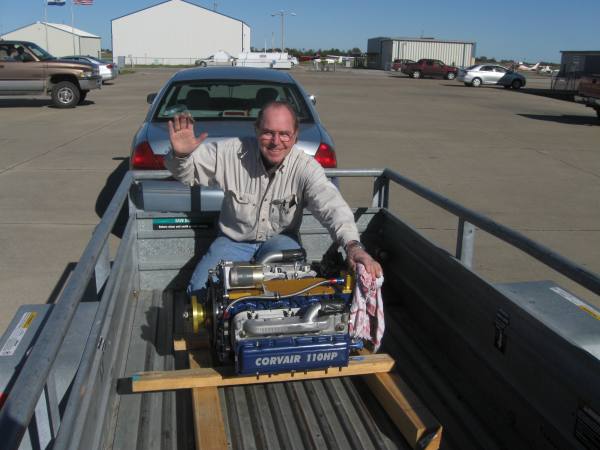
William Dominguez of Miami strikes a pose with his 2,700/Weseman bearing engine. He started with parts that he had prepped before the College, and did the complete assembly at the event in two days. The engine ran beautifully. It was the first engine he ever built. He had previously brought a core to CC #23, had a good look at how things are done, and then took action to make things work for him. The engine will power his 601 XL.
Spencer with his engine. It is the only Corvair I have seen that not only has gold parts, but is also painted gold. It ran great.
Joe Sarcione with his 3,000/Weseman bearing engine on the last day of the College. He also started with just raw parts. His prep work consisted of doing a lot of reading, including all the on-line installation directions that are in our parts catalog. The engine is destined for his Zenith 750.
Father-son team of David and Bryan Walker from Arkansas stand behind their freshly torn down core engine.
Roy Szarafinski and his lovely daughter Liese made a brief appearance at the College. They were on the return leg of an international trip and detoured over to spend much of Saturday at the College with builders. In between getting his display set at SnF and conducting the first flight of the Panther on Sunday, Dan Weseman also had a chance to assist builders at the College.
Many friendly hands made short work of getting William Dominguez’s engine ready for the first run.
Mike Schwab (black shirt) and Michelle Tomalo were in attendance. They started their 3,000/Weseman bearing engine at CC #23, finished and ran it at CC #24, and returned to help others at CC #25. Mike is the best source for alternators and voltage regulators. His email address is info@mikessynoil.com
William Dominguez’s engine during break in. It went from ice cold, never started, to live and running in less than 3 seconds of cranking.
The Redditt family works on their 3,000/Weseman bearing engine. It is destined for the family Zenith 750.
Lynn Dingfelder’s 2,700/Weseman bearing 601 XL from Pennsylvania. Lynn had previously flown the plane to CC #20 in Michigan. After the College, Lynn took a short tour of southern Florida and then headed to SnF, where his aircraft was on display at the Zenith booth all week. Lynn is very mechanically inclined, and he has very good judgement, but he is relatively new to flying. He got his sport pilot license four years ago and has slowly and carefully accumulated a few hundred hours, gradually expanding his personal flight envelope. His experience and path is an excellent model for anyone new to homebuilding and flying.
Larry Magruder and his lovely spouse Diane enjoy the prop blast from Larry’s engine on the run stand. The engine briefly ran at CC #24, but Larry decided he wanted to return to CC #25 and reset the valves and do some detail work under my supervision to make it run perfect. It worked according to plan, exactly. I have great respect for any builder who sets his standards high and sticks with them until his work is outstanding.
Wittman Buttercup builder Daniel Kelley from California flew in commercial for the event and stayed for most of SnF also. He has attended many Colleges. His plane will be powered by his 3,000/Roy bearing engine.
EAA Chapter 534 had a Pietenpol project in the hangar that was the work of a very nice older gentleman who has a Ford Model A for it. They are assisting the man with the completion of the aircraft. I took a photo of the project’s cabane strut arrangement. There is nothing wrong with using aluminum lift strut material; the loads on the vertical cabanes are not that high. However, no one, ever, should use this type of arrangement for the diagonal cabane going down to the top of the firewall. This would fold up like cooked spaghetti in the most minor of mishaps, and could even injure or trap the front seat occupant. The diagonal cabanes should be at least 7/8″-.049″ 4130 tubing, preferably welded to the front vertical cabane tubes.
The Redditt family with their packed van at the end of the College. Charlie wears his ceremonial Corvair College tie for the photo.
A close up of the Redditt’s 3,000/Weseman bearing engine. It started as a pile of parts before the event, all the way down to the case halves. They attended CC #24, made a plan, and followed through with it. Above, they are most of the way to an outstanding, first class engine.
.
Looking at all the builders in the above photos, all you have to do is decide that you are going to make this year, 2013, the year that you get more out of experimental aviation. We have more events planned, more Colleges in the works, Brodhead and Oshkosh. Decide right now that you are going to be a part of this. I have been giving Colleges for 13 years. You know the most common thing people say after their first College? They say a variation on this common theme: “I heard about the Colleges, and I was always planning on getting to one, but never did. Now that I have, I really wish I came sooner; I would have been making a lot more progress at home.” Consider this your invitation to the next College. If you are waiting for me to send you a personal engraved one, be advised, you must take a little more initiative to have success in this game. The builders pictured with their running engines are not better people than you, they are not secretly blessed, nor are they special friends of mine. They are just like you, with one small exception: One of the many times I wrote about builders having a great time at a College, they read it, got serious, made a plan and decided that it would be their time now. … -ww
Corvair powered Dragonfly, Charlie Johnson, aka ‘One Sky Dog’
Builders,
One of the guys who has been around the Corvair movement for a long time is Charlie Johnson. He is a very unique guy, an aerospace engineer of great experience, and something of an actual rocket scientist. In aviation circles he is best known by the name “One Sky Dog.”
Charlie is well-known in the Dragonfly building and flying community, but he also has a lot of other flying experience from hang gliders to GA aircraft. We first met Charlie in 1999 at a small West Coast fly in. He had a long-term plan to eventually convert his VW powered Dragonfly to Corvair power.

The Brothers Johnson, straight out of Utah. Charlie on the left and Bob on the right are both Dragonfly builders and pilots. This photo with me in the middle was taken at CC#11 in CA in 2007.
Through the years we saw him at the tandem wing fly-ins and a number of Colleges. He is good company and an insightful guy. One of the things that demonstrated that he has good judgement is that he was immune to external pressure to change the pace or plan for his own project. There was a competitive spirit to see who would have the first Corvair powered Dragonfly. Charlie would have none of it. He was not competing with anyone, he was doing things for himself.
The first guy who flew the combination was in a big rush and did a poor job. He didn’t want to get an ignition from us because he wanted to build his own. He didn’t understand that “32 degrees of timing” is total advance, not a static setting. Flight #1 ended in a field. The guy also mutilated the Corvair to fit it in a VW cowl. If your neighbor had a Lycoming cowl for his RV-4 but wanted to put a Continental in it and his solution was to saw pieces off the Continental heads, you would think the same thing about him. Fortunately the man quit before too long and went back to VWs. There was also a second Corvair/Dragonfly, built in Minn. It worked much better, but the builder sold it to a guy who rarely flew it again. None of this affected Charlie, he just marched on to do it his way.
The Dragonfly is not an easy plane to mount a Corvair on. Just building the mount and finding strong points is an issue. Early on, Charlie decided to use all the things he could from our regular engine builds. He recognized that having the starter on the front like we do brought a lot more room at the back of the engine and allowed the engine to be moved further back. He also selected to build a fiberglass cowl that incorporated one of our nosebowls. This solved a lot of the most challenging packaging elements. He did an outstanding job fairing this into the Dragonfly’s aerodynamics. I actually like the way his plane looks a lot more than traditional VW cowls for the design. Charlie went through some teething issues, much of it centered on a trial Y-shaped intake manifold, as opposed to the T-shaped ones we use. Slow and steady, he has advanced the plane to where it is now in flight testing. Unlike previous attempts at the combination, I think everything about Charlie’s plane is well thought out. Although he did the work for himself, I also think that he has pioneered a very good path for any other Dragonfly builder to follow.
Below is a letter from Charlie. Make sure you check out the two video links in it. Utah is a very beautiful area to fly in. Hats off to Charlie Johnson, for a job well done and setting a great example of the golden rule of homebuilding, persistence pays. -ww.
“William, Thanks for all of your help. Many years have come and gone since I first met you at Bullhead City.
Phase one test flying is proceeding with about 20 hrs on the plane. This last video is from Ogden to Wendover. I have my choice to go through class B over dense urban environment or avoid class B and follow Antelope Is. to the south shore of the Great Salt Lake. I think it is safer over the lake.
Below, prototype of my spinner, not so pointy as Van’s, I think it goes with the nosebowl.
Weseman baffling, not to say mine would not work, the intake “Y” seems to have been most of the problem.
(Charlie’s engine is a 2,700 cc with a Weseman bearing. -ww)
Dragonfly/Corvair 8000 MSL over Utah.
Two Video Links:
http://contour.com/stories/dragonfly-test-flight-4-climbout-ogd-to-bmc-to-ogd
http://contour.com/stories/flying-my-dragonfly-across-the-great-salt-lake-ogd-to-env
“Regards, Charlie Johnson, Ogden, Utah”
Sun N Fun 2013
Warning: This story contains a four letter word in bold print, it is a direct and exact quote, it is here for a reason. The story also makes literary reference to an imaginary day with Richard Branson. If you can’t or shouldn’t read such things, skip this story and read the next one.-ww
Builders,
Here is a photo review of Sun ‘N Fun 2013. It was my 25th consecutive year at the airshow. The modern era of the Corvair movement actually began right in Lakeland in 1989. That year was my first Sun ‘N Fun, and I was new to aviation. I stopped in front of the Teledyne Continental Motors booth and directly asked them why they no longer made engines like the C-85 or the O-200. (For a long time Continental focused only on very expensive engines like the TSIO-550 and the Tiara, both over $50K even back then.) I pointed out that as an A&P mechanic, I was something of an unpaid field rep for Continental’s products. I was expected to stay up to date on all of their ADs and service letters, techniques and models, all while being compensated at the then A&P wage of $8/hour. Was it too much to ask that Continental produce an engine that mechanics might save for several years for? Were we relegated to being spectators and errand boys for wealthy people who could afford engines that had price tags of many years’ gross income for an A&P? What was Continental’s position on this?
.
After checking to make sure his boss was out of earshot, the sales guy leaned forward and slowly said “We could make C-85s again tomorrow, but we won’t, because Teledyne Continental Motors Inc. does not give a shit about you or anyone else who works for a living anymore.”
.
To put it mildly, I was stunned. A flash of anger passed as I realized that this man had just said the most honest thing I would hear from corporate management of aviation. I actually thanked him, and as I walked away I determined that I would proceed to develop something out of the two old Corvair engines that were in my workshop. Whoever the man was, he was the spark that lit the flame.
.
In the 25 years since, I have often thought of that day. Countless times I have spoken with good people who harbored a terrible mistaken belief that big corporations in the aviation marketplace would eventually produce something affordable for them, the working class guy. For the past 25 years, I have known that this was never going to happen. It works just the opposite: Businesses that once had affordable products phase them out to chase the easy dollars of the wealthy. Need two quick examples? Lancair was founded to make aircraft that used an O-200, and sold for $10K in 1984, with a remanufactured engine. In a few years this was all abandoned to focus on pressurized four-place aircraft and certificated models. Rotax used to make some affordable engines, the 277, 377, 447 and the 503. All gone now, in favor of 912s that start at $20K, injected models for another $8K, and the turbo 914 in the $34K range. Go back to what the Continental rep said; I spelled out the four letter word, not just because he said it with great emphasis, but because I want you, the builder to wake up and know this in your heart.
You are the only person looking out for you in aviation. Don’t wait around for a white knight, he isn’t going to show up. The inventors who are working on new engines like diesels are all aiming for wealthy people’s budgets, not yours; you will never stumble over a good engine for $4K in the fly mart no matter how many times you look. (If it were good they would have sold it at their home airport rather than dragging it 1,000 miles to sell anonymously.) You can wait for something that will never happen, or you can choose to take the path that will always work: You decide to count on yourself, get your hands dirty, learn some stuff, and build your own engine.
.
Even if this takes time, it will pay off. In the past 25 years I have watched hundreds of people who could have been builders fritter away their remaining years because they held on to their daydream that there was a solution around the corner that would allow them access to flight. It never happened for them. It only materialized for the people who understood that working people were only going to get the things out of aviation that they were willing to take with their own hands. If you have persistence, time and experience will teach you that you, the real homebuilder, the person who struggled, will actually know the real rewards of homebuilding. The people who did nothing more than write a check only ended up owning the hardware; they robbed themselves of the experience of becoming an aviator.
.
In December of 1903, when Wilbur and Orville got to the bottom of the sand dune at Kitty Hawk, they did not turn to each other and proclaim “I think we have made something for Vanderbilts and Rockefellers!” They had solved the first stage of flight for all people, not just wealthy ones. You own the sky just as much as any other human being. For the past 100 years there has been a lot of talk about “affordable flying,” but virtually all of the commercial effort has been aimed at providing a wealth of products for the wealthy. It is a lot easier than making something practical and affordable for working people.
.
Few designers like Chris Heintz and John Monnett devoted their work to affordable planes, they have my highest respect. I was once a fan of Rutan’s, but I slowly woke up to the fact that he abandoned working class homebuilders decades ago. Today he still enjoys broad admiration among EAA members, people he wouldn’t stoop to designing a homebuilt for in the past 25 years. Only a person who has resigned themselves to spectator status still takes close interest in his work. I save my praise for designers who still work in this industry, not those who elected to leave decades ago.
(I type the last sentences with bad conscience; If Richard Branson called and invited Grace and myself to his villa on Bora-Bora to be fed martinis on the beach by mostly bare Tahitian women, I would be pulling up a chair on the beach right beside Burt.)
.
Below are photos of builders who have long since decided that they are going to be their own white knights, look after themselves, and make their own adventures happen, instead of sitting down and waiting for a ride that isn’t coming. Take your pick, it’s your life. If you are willing to accept the challenge your seat at the table awaits. You will be in good company, and we will be glad to have you aboard.
Above, many of the 60 people we had at the FlyCorvair/SPA Panther cookout.
Dan flew the Panther the Sunday before the show. It attracted crowds all week.
Richard VanGrunsven, designer of the RV series aircraft, leans on the Panther and speaks with Dan.
Lynn Dingfelder flew his Zenith 601XLB down from Pennsylvania. Sebastien Heintz warmly welcomed the plane in the Zenith factory booth because it was an excellent example of economic building. Lynn started with a regular kit, but finished the plane with a full paint job, panel, 100hp Corvair, Weseman 5th bearing, and interior for a total of $24K, including the kit.
CC#23 grads Mark and Sandrine stopped by. Mark is an ATP who flys for a major airline, but is working on something more fun to do with planes.
Longtime Corvair builders Bob and Pat Pustell, down from New Hampshire. Bob has had adventures around the globe in flight, but he is still working to add building and flying a 601XL to his list. No matter what else you have done in flight, homebuilding is still a very special facet of flight.
Many old friends stopped by for the cookout. In this photo, Skycoupe pilot Gary (with wife Vicki) Coppen, my ERAU roommate Chris Welsh, 1,000 hour Corvair pilot Mark Langford, and editor Pat Panzera. 
Skip and Dan Kelley at the cookout. Both were also at CC#25.
Because rain threatened (but didn’t happen) we served the food buffet style by having friends walk through the Panther trailer. Off the wing tip walks Son of Cleanex builder/pilot Chris Smith. Flybaby/Corvair builder/pilot Glenn Goode speaks with CC#24 grad Irv Russell. Dan and Rachel stand on the tailgate.
Many people at the show saw the privately owned Douglas A-4 Skyhawk in the airshow. The guy flying it was Dave Dollarhide, in the flight suit. He flew them in Vietnam, took a short 40 year break, and went back to it this year. Both he and Dan are in our EAA chapter. Everyone is having a hard time deciding if Dan or Dave is having a better year in flying in 2013. Whatever you do after reading this, decide that you are going to have the kind of smile that Dan and Dave got from being In The Arena this year.-ww
Floats on Snow, Corvair powered Merlin
Builders:
Jeff Moores, of Newfoundland Canada, who flies his Corvair powered Merlin on full lotus floats sent us a few more pictures of his bird in action. Not only does it fly well off water, Full Lotus floats also work well on snow. Jeff pre-heats the engine before starting, but the Corvair has no issue working in bitter cold. Jeff keeps the aircraft in a small hangar that is on the edge of a lake. Once frozen, the hangar is now on a very long runway. The photos came with the short note below.
“Hi William. Some pics from flying today. The engine is performing flawlessly. -Jeff”
Outside the hangar. The aircraft has a 2700 cc /Dan bearing engine that Jeff built. It uses our standard nose bowl and stainless U-2 exhaust. The prop is a Warp Drive. The floats are made of inflated cells, the design is very versatile for this reason.
Airborne on a very clear day. Jeff Moores, northern most Corvair pilot in the world.-ww
New 3,000 cc Cleanex, Dale Williams, SC
Above, The Cleanex of Dale Williams taxis out at Corvair College #27. The story below was written 10 months before the photo.
Builders,
Back in September my sister and I drove to NJ to see my parents. Before leaving, I had spoken with Dan Weseman about Dale’s project. Because it’s a ‘Cleanex’ and a mechanical clone of Dan’s Wicked Cleanex, Dale had worked very closely with Dan on the engine installation. Because I was going to pass within 80 miles of Dales’ place I offered to divert to make a house call on my way back from NJ.
Dan had assembled Dales’ engine for him previously, long before his airframe was complete. When he was later doing ground tests the engine exhibited a slight miss. A quick investigation revealed that the engine had broken a rocker stud, and was actually only running on 5 cylinders. To give you an idea of how rare an event this is, in 24 years of working with Corvairs I had only ever seen it happen once before. Because of the Corvairs smoothness, it was not readily apparent that it was only making 5/6 ths of its power. A less observant operator might have flown it that way, and it was certainly making enough power to take off.
After confirming the issue in the house call, I picked up the engine at Dan’s request to return it to him in Florida. Dan takes standing behind anything he touches very seriously, and he told Dale that he would replace all the rocker studs with brand new ones and test run the motor on our stand at no charge. Dan also used the time to upgrade the engine with exhaust valve rotators.
You find out what people are like when there is an issue, not when things are perfect. This works both ways; Dan insisting that he correct the issue and Dale being very understanding about it. The task was done shortly, and as you can read below, Dale is very happy with the outcome.
Funny note: Just to show you that all airports have a self-appointed ‘engine expert’, read Dales letter. When we were having a very peaceful time in Dale’s hangar, the local expert pulled up and Dale knew that quick thinking would avoid a long lecture from this guy on the evils of Corvairs. Dale just introduced me as his brother from out-of-town, and the expert was soon on his way.
Hats off to Dale Williams, builder of the “Daughter of Cleanex” N-319WF.
William,
I can verify that you do make house calls and on short notice! It was September 3rd, 2012 while on vacation that you came by St. George Airport (6J2) to pick up my 3.0 Corvair and take it to Dan for some repair/upgrade work. We spent a few hours talking in the hangar and when the local “VW engine expert” (a.k.a. “all” engine expert) drove up I introduced you as my brother so that we could be saved the time of him giving us lessons of why the Corvair was a bad idea for my Cleanex.
I want to thank you for what you did for me and commend you for giving such great service with a personal touch. Dan had the work to my engine done quickly and I have since installed it and the Cleanex I call “Myunn” now has nearly 20 hours on it. What a combination this air frame and engine make! Smooth and powerful with the sound of “authority” (pun intended) roaring out of those WW straight pipes.
I had mentioned in another reply about the “rolled on” painting process I used. It was the same one Clarence Dunkerley used on his Cleanex. Here is the nearly final result:
https://s3.amazonaws.com/expercraft/daleandee/7316326185125987631da3.jpg
https://s3.amazonaws.com/expercraft/daleandee/40160954751259876121d6.jpg
Thanks again William. You truly may never know how much you have changed the experimental aircraft industry for the better!
Dale Williams
N319WF @ 6J2
Myunn a.k.a. “Daughter of Cleanex”
New Pietenpol, 2700 Corvair, Don Harper SC
Builders,
About a month ago word got out that Don Harper’s Piet was ready to fly. The first flight of some aircraft are anticipated by fans of a design because the particular rendition is of great interest. Other first flights are looked forward to because the creator is a salt of the earth, well liked guy. In Don’s case, both are true, and when the plane did its first test hops, word went out in Pietenpol circles that Don was now “in the club.”
I spoke with both Don and PF today, and heard the good news that the plane is now fully operational. The pictures below were taken at Corvair College #24, where Don and friends all pitched in with our local host PF Beck to run an outstanding event. Even from a distance, the plane shows a lot of craftsmanship and attention to detail. There are numerous small details that are very clever, the kind of stuff you would never see looking at 200 RV’s at Oshkosh. As neat as these are, the most talked about detail on Dons plane is that it utilizes a Ribblet airfoil in place of the original Pietenpol section. although they plan to release comprehensive data from testing later, neither PF or Don are leaking any preliminary data. For right now they are focused on running a low risk flight test program at Barnwell, their home airport.
Above, Pietenpols of Don Harper (near) and PF Beck (far). They are sister ships in almost every way, with two exceptions: Don’s is a long fuselage and it had a Ribblett airfoil instead of a traditional Pietenpol airfoil. Shortly, PF will be able to offer factual comparative data on the flight performance of each of the airfoils. On the internet, armchair aerodynamictists have pontificated about this from imaginary data for years. Thanks to PF and Don, we will have information worth reading.
Above, A look at Don’s engine compartment with swing out side panel. This plane uses a front starter and a basic 4 bearing set up. Both Don and PF are master old-school scroungers and skilled fabricators. These two aircraft are some of the least expensive examples of the type. When PF’s plane was done about 6 years ago, he told me that he only had $6,800 in the whole plane, including the engine. While most Corvair builders elect to buy a new carb or pay for an overhauled one, Don worked to put his own together out of parts, and spent the time to tune it. He has some small stuff to be corrected on the engine, and Grace and I were glad to help him out with this as a small thank you for all his work at several Colleges. In short order the plane ran great, and PF reports that it is a strong runner. Both planes fly 64 x 34 props that PF made.

Don Harper, (left) and P.F. Beck at sun n fun 2009. What is the best thing you have in aviation? It might be your plane you created with your own hands, engine included,…or it might be having a life long friend who loves all the same things about flying that you do. Don Harper doesn’t have to choose, he has both. I can make a pretty good case that he is one of the luckier guys in aviation, but I would also gladly say that it couldn’t have happened to a nicer guy.-ww
Pietenpol review in pictures, 15 more Corvair powered Piets
Builders:
In addition to the four ships highlighted earlier in the week, here are a few more selected Corvair Powered Piets. I drew these photos from our regular website Flycorvair.com. We have a lot of others, this is just a sample. There are a number of other well-known Corvair powered Pietenpols like Virl Deal’s 1,000 hour bird that I am saving for a second post. If you have a Corvair powered plane and have not sent us a photo in a while, please do, we would like to have it in a follow on album.

Above, P.F. Beck getting ready to take off. Photo Taken at Corvair College #12. PF was the host of Colleges 19,21 and 24. His aircraft has flow more than 200 passengers. It has electric start and a very quiet exhaust system. PF was awarded the Cherry Grove trophy in 2011 as ‘Corvair aviator of the year.’

Above, Shad and Gary Bell’s Piet in flight. Aircraft is based in Ohio. It has made a number of appearances at Brodhead. Gary and Shad came to CC#7 to get started on their engine. It is a modern 100 hp Corvair with electric start. The plane has a very nice finish on it, accomplished with industrial latex enamel. If you ever hear a fool say something like “latex paints make planes look like houses” ignore them. There have been Oshkosh grand champion aircraft painted with latex systems.

Above, Tom Brown’s pietenpol, flying since 1982. Although it has spent its life in a cold climate, and it has competed with all the other beautiful aircraft that Tom owns and has access to, he has still managed to put nearly 1,500 hours on it. By my count, it is the highest time Corvair powered aircraft in the fleet. We did a weight and balance on this aircraft and it came in at a feathery light 624 pounds. This is 125 pounds lighter than one of the A-65 Continental hand prop aircraft at Brodhead. It is a very effective demonstration that it is a myth that Corvair engines are inherently heavy. Good aircraft building technique is far more important than which engine you choose when shooting for a lightweight plans built homebuilt. The engine is a BHP conversion without any modern updates, yet Tom has never put a wrench on the inside of it in the last 30 years.

Above, a photo of Kevin Purtee’s Pietenpol airborne. This plane flew 340 hours in a few short years before being heavily damaged in an accident in 2012. The rebuild is well underway. The engine ran with mild updates at CC#24, where Kevin and Shelley were awarded the Cherry Grove trophy for 2012. Kevin credits his wife Shelley Tumino with much of his success. They hosted CC#22 in their home state of Texas. His engine is a modern electric start 100 hp and a Dan 5th bearing.
Above, Bob Lester of FL with his aircraft. It was powered by a 65 hp Lycoming, now a 100 hp Corvair. This is a radically different aircraft than it was a few months ago. It when from barely having a positive rate of climb with two people on a hot day to being able to climb 800 feet per minute at the same load and conditions. It now has safe and smart-looking gear that works correctly. The Mount, spring gear and intake were built at our shop. The plane is 25 mph faster now on the top end. The engine is equipped with electric start and a Dan 5th Bearing. It was built at CC#17.

Above, Harold Johnson’s ‘Big Piet’ at Brodhead.This aircraft won Best Auto Engine Conversion at Sun ‘N Fun in 2010. The Big Piet builders completed and flew 5 of the 6 planes started, a record in group project success. Their first visit to our hangar was back in 2003. The planes met with great reviews for both their operation and their attention to detail. They have 28″ wide steel tube fuselages. They all have modern 100 hp engines with electric start and MA-3 carbs.

Above, Frank Metcalfe’s plane at sun n fun the day before the tornado. This plane and her sister ships, the ‘big piets’, exhibit extraordinarily high craftsmanship. As many people know this aircraft was extensively damaged by the tornado. The plane is currently being rebuilt.

Above the plane of Bruce Laird who is also one of the big Piet builders from Carrollton. If you look closely you can see Frank’s airplane in the background. Like Frank’s, Bruce’s aircraft was extensively damaged. If these were factory built aircraft, they would have been considered totaled. But these aircraft are different. They represent years of hand work and care. They will not be written off as the majority of damaged aircraft at Lakeland were. The same hands that created these aircraft are back at work, making them right again. I look forward to seeing these planes again in 2013.

Above is Gardiner Mason’s Pietenpol, photographed before it was damaged in the tornado. The plane is now repaired and flying again. The plane had made its public debut at CC#19. Debugging his aircraft was the subject of an 18 page set of notes on cooling systems that we wrote. After working with us, the plane flew beautifully. After the tornado I spent some time with Gardiner at the show, and he was stoic about it. Everyone wanted to say they were sorry when they spoke with him and buy him a beer. It made me think about A.E.Houseman saying, “Ale does more that Milton can to justify God’s ways with man.” The plane has a 100hp Corvair with a Dan 5th Bearing and electric start. If you have an hour to learn, read the 18 page report here: http://www.flycorvair.com/pietengineissue.html On the internet there are a small number of critics that take every opportunity to say negative things about Corvairs and my work with them. Read the report and understand that while negative internet vermin type their bull, I am doing things like rebuilding Gardiners engine for free, running the Weight and Balance project and hosting Corvair Colleges. Take your pick on who benefits Pietenpol builders more. I don’t need to be thanked for doing things I want to, but I take a dim view of being criticized for it.

Above,Randy Bush of TN. at Brodhead with Miss Le’Bec (it is a combination of his girls’ names coined by his wife). His aircraft was seven years in the making. A consistent work of craftsmanship, the plane’s creation spanned both easy and hard years in Randy’s life. Many people new to homebuilding think that it is something you do if life is treating you great and you’re rolling in dough. Here is reality: The most successful builders I know understand that hours spent in your own shop, creating things with your own hands, is a vital part of a worthwhile life, and that this reality will be most evident at the hardest of times. Learning to make things is a crucial investment in your own sanity. Does it surprise anyone that really happy people always have a way of being creative? The plane has more than 400 hours on it. It has a 100 hp Corvair with electric start and a Roy 5th bearing.

Above, Kurt Shipman of Illinois with his Pietenpol at Brodhead 2009. His super clean installation features one of our Electric Start setups, Falcon heads and a standard rebuild straight out of our Conversion Manual. Kurt is a 39-year-old ATP who flys for the airlines. A prolific ‘internet personality’ made the claim that Corvair Powered Piets all have ugly cowls. Kurts cowl housing his starter is so ugly that when he flew it to Oshkosh for the first time the plane won the Bronze Lindbergh trophy, as the 5th best homebuilt at Airventure. So much for critics.

Above is a photo of Texan Hans van der Voort’s Corvair powered Air Camper at the Southwestern Regional EAA Fly In. His NX15KV won the Tony Bingelis Memorial Award for Best of Show there recently. Tony Bingelis was the greatest how-to writer homebuilding ever had, and Texas was his home turf. I’ve yet to see it in person, but everyone who has says Hans’ airplane is outstanding. How do planes with such ‘ugly cowls’ keep winning trophies? Hans’s plane utilizes a Zenith carb and one of out stainless exhaust systems.
Above, the Jim Ballew of OK, lands his Piet. It is a traditional BHP conversion. What is notable about Jim is that he also has a Corvair powered Davis DA-2 and a Corvair powered 601XL that he has built and flown. When a man has 3 Corvair powered planes you can be assured that there is a lot to like about the powerplant.
Above, BHP’s last original. This plane has 800 hours on it today, it lives at Brodhead and belongs to our friend Bill Knight. We did the weight and Ballance on this plane two years ago and overhauled the engine last year. On the outside it looks just like BHP made it, but inside it has a nitrided crank, Arp bolts forged pistons and one of our Black prop hubs and hybrid studs. Look closely and understand that BHP kept the thrust line low because he had the stock automotive blower fan on the engine, which sticks up higher than our electric starter set up. BHP’s Corvair Thrust line was very near the location of the Ford’s thrust line. It was a familiar location, but if you look at most classic planes, the thrust line is closer to the top longeron. Note that the last original has the main axles far forward and it has die spring in a tube gear like we made for Bob lester’s Piet.

Above, the Pietenpol of Duane Duea of Minn., at right, (and Kurt Shipman’s at left). The photo was taken at Oshkosh 2009. Duane’s aircraft was completed in 1972 and is so true to Bernie’s plans that I initially mistook his aircraft for Bernie’s first Corvair-powered ship, which resides at Oshkosh in the Pioneer Airport. This aircraft has approximately 1,000 hours on the clock. We spent some time with Duane at our booth, where he reflected on the privilege of knowing Bernie Pietenpol in person. This aircraft is nicely complemented by Kurt’s, which was completed in 2008, 36 years later. Although Kurt’s aircraft retains a very classy, pure look, it takes advantage of all of our research and development.
If you’re a Piet builder or just a fan of Corvair powered planes, I hope you have enjoyed ‘Pietenpol week.’ We have a lot of shop work over the next 72 hours, but I am going to get in a mail sack update this weekend and also get an engine building series started for next week. Stay tuned-ww.
House Call on Pat Green’s 1,000 Hour Pietenpol
Builders,
In keeping with the developing “Pietenpol Week” theme, today Vern and I drove about 2 hours to the northern edge of Florida to make a house call on a Corvair powered Pietenpol that has been flying since 1977. The plane is the handiwork and pride of a builder named Pat Green. Even though I have known him for 15 years and we live in the same state, Pat and I don’t often have a chance to get together.
Above, Pat’s Pietenpol. It has more than 1,000 hours on Corvair power. The installation has always been very close to BHP’s plans externally, but internally Pat went to forged pistons and an OT-10 cam more than 10 years ago. He was flying long before I started working with Corvairs, but he was never reluctant to adopt any improvement that my testing revealed. His original conversion manual from us was one of the first 50 I had printed, I have known him that long.
Many years ago he flew the plane to Corvair College #9, where he was much appreciated by Piet builders in attendance. In the years since, we have been very busy and Pat was deeply involved in the hour by hour care of his late wife. After beating a few health issues of his own, Pat paid a visit to our hangar where he explained that his personal plan was to get back into flying full-time and really enjoy all the elements of it that he used to before greater responsiblity took priority. A key element of this was switching from a traditional Bernard Pietenpol hand prop/blower fan engine to one of our electric start systems. He had been hand starting the plane for 35 years, but being 77 and having had back problems, he thought going with key starting was a safety issue, and made the prospect of operating the plane solo a lot more appealing. From that point we made a plan for a house call and to get him a running start on a conversion to electronics doing the starting.
Above, a shot of the original BHP/blower fan conversion from an angle that illustrates why an engine set up this way doesn’t fit well with a high thrust line engine mount. engines with starters and J-3 eyebrow scoops can utilize a higher thrust line and still fit inside the shape of the fire wall. The Prop hub is an original BHP model. It is mounted by the original short flywheel bolt in very deep wells. I developed Hybrid studs 15 years ago to improve the mounting of the prop hub for engine with more output than traditional BHP conversions. A BHP hub can not be used with any of our starter set ups.
Pat actually traveled to Cherry Grove and spent time with the man himself. Pat stuck with the project and finished it after 10 years of on and off building. The plane was not the only aircraft in his life, there were many. But as he gets to the other end of his flying years, he is very clear that his Pietenpol is the centerpiece of his aviation life, and without question the best thing he ever did in planes. The Sport Pilot rule will allow Pat to fly the plane for many years to come, so it is inevitable that it will be the last plane in the stable of planes he has kept, but he says that all medical factors aside, if he were to have had only one plane, the Pietenpol would have made him the most happy. He will be very glad to finish out his flying hours in the plane, and he will log a lot more of them with a starter.
Above are the blower fan parts that came off the engine when putting the Front starter on. There are people who have suggested that this stuff weighs a ton, but it doesn’t the fan is magnesium ( we put a story up last year about burning them in a bonfire at one of our airport parties) and weighs less than a pound. All in all, an electric start system is going to add about 20 pounds to the airplane after you take into account things like the larger battery. It isn’t shown in the photos, but Pat is going with a John Deer style front alternator driven off the Gold hub.
Above is a look at the engine being test fitted with the starter and the gold hub. The parts, including the starter kit, a new hub, hybrid studs, the alternator , brackets, regulator and a belt cost Pat about $1,400. It is going to take a bit of time to re-configure the cowl and wire the electrical stuff, but overall, it isn’t a lot of money or time to get the plane set up to layout that is a much better match for Pat’s next few years of flying.
Below: Blast from the past, Pat and I stand with his Pietenpol at Corvair College #9, seven years ago. The caption in blue italics below is the original words from the 2006 College. note to fashion critics: I haven’t always had long gray hair, but I have always dressed like a refugee, even long before it was stylish.