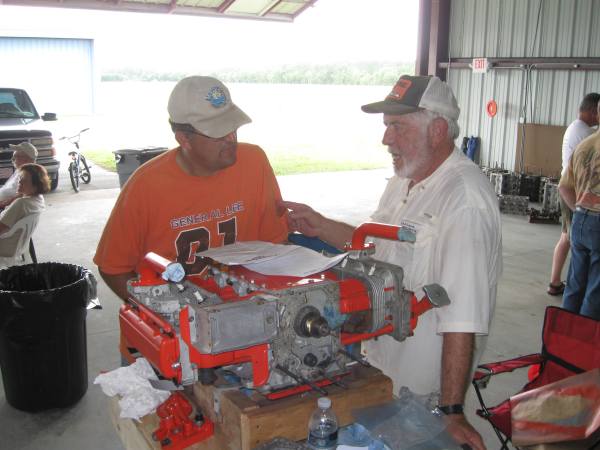
CC #23 Redux Part I

Friends,

It has been a very busy season. Starting with CC#22 in Texas, then Sun n Fun, then CC#23 in Florida, Brodhead and Oshkosh, and the Zenith open house, we have put in a lot of work and travel beyond our regular production schedule. Along the way we have updated builders with the essential news, but I don’t have the same time to write that I do in the winter season. Consequently we are going to have a few retospective pieces from events of this season covered now. If you were not there, get a good look at the builders in the photos and honestly ask yourself if you were part of enough fun in the 2012 flying season. If the answer is probably not, then the solution is five weeks away in Barnwell SC, where we will be holding Corvair College #24.  Below are a handful of photos we took at CC#23 this summer. We already covered engines that were built at the event, but Colleges are far more than a count of running engines. They are a story of builders making friends and progress at all levels. #23 was a medium-sized event, the first in its location, held in a hot season. #24 is different, it is a third year event, which has always had excellent, if cool weather. We already have more people signed up for #24 than attended #23 total.  While smaller colleges fill a vital role of getting people into the movement, Big events like #24 have a decided productivity advantage, draw more corvair powered planes, and have more people to meet. Our local host PF Beck and his crew do an outstanding job of organization, and I am looking forward to #24 with anticipation of fun and productivity.  Get a look at these picture of good times from #23 and decide today that you will not miss out on #24.

Above, most of the gang from #23. In the background, Jim and Rhonda Weseman’s Celebrity biplane. The City of Palatka rented us the 60×70 hangar for a week for the event, a decision that confirmed their support of innovative ideas at their location.

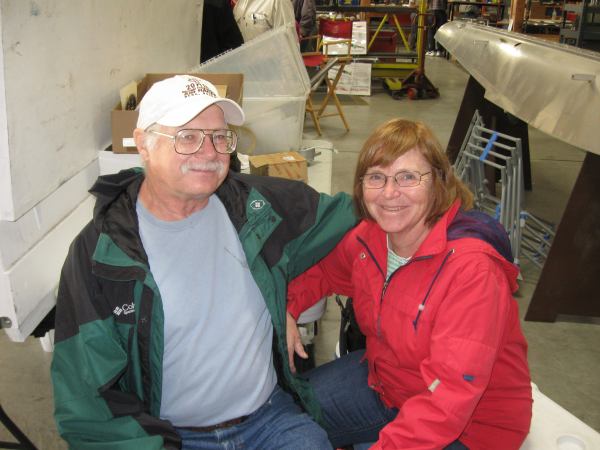
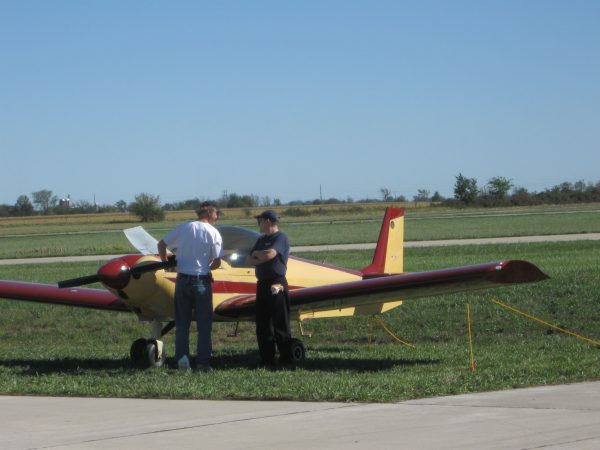
Above, Rhonda and Jim, and a better look at their plane. It has a 3100cc Corvair, and of course, one of their 5th bearings.  Both Jim and Rhonda know a lot about aircraft construction, Jim is an IA and had a long career in US Navy piston engine maintenance. They work out of their hangar and produce very fine Corvair baffling kits and the sheet metal portion of our Zenith cowls. This said, I personal think that their greatest contribution to aviation is Dan, their son sitting in the cockpit of their plane. This was a very nice family moment.

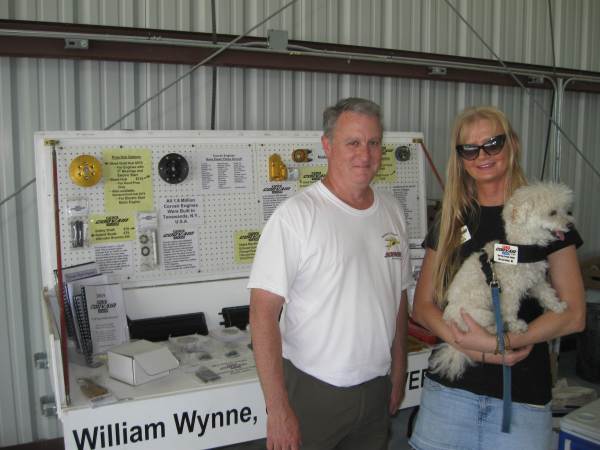
Above, Corvair Waiex builder Greg Crouchley, stands with Grace and ScoobE at the College. Greg is headed to #24 to assemble and run a 3000cc Corvair with the best of all parts, including a new billet made in the USA crankshaft, a Weseman Bearing, Falcon Heads and all our Gold conversion parts. The build will be one of the centerpieces of learning experience at #24. Note Scoob E’s name badge, a souvenir of attending CC#17.

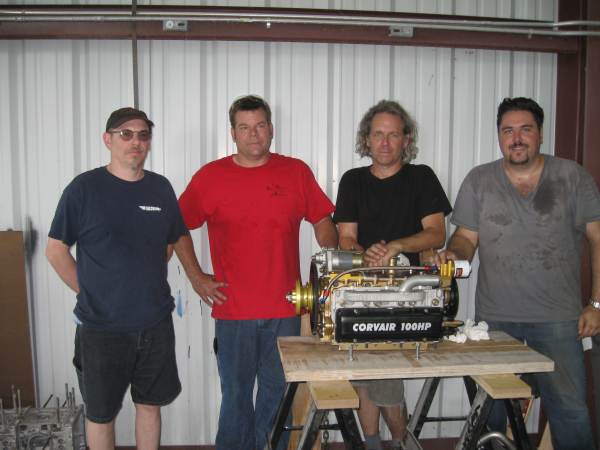
Above, four of the people who worked to make the modern Corvair movent: Mark Petinunas of Falconmachine.net,  Dan Weseman, yours truely, and Spenser Gould. Spenser worked with us on a number of CAD and enginnnering projects, mostly on the gold series of components and our 5th bearing. His day job is working for Pratt-Whittney in south Florida. In the forground is his 2700cc Dan bearing engine destined to power his unique design, the SP-500. The engine was assembled at #23 and ran like a banshee. 

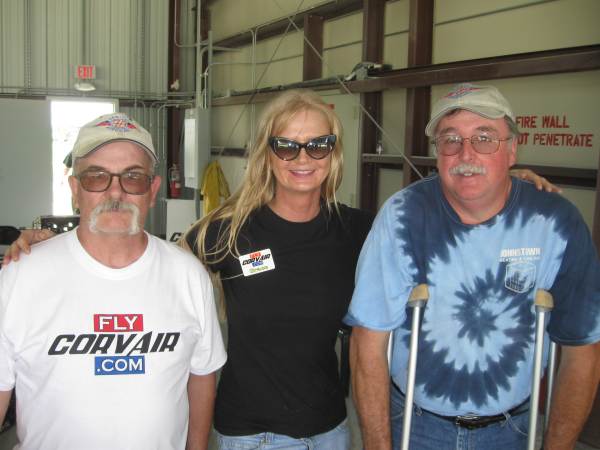
Above, Grace stands between Albert and Dan Glaze. If you look at the coverage a few days ago of the Zenith open house, you can see another photo of these two. Going back and looking a previous colleges, they appear and almost all of the last half-dozen. Dan’s engine ran at #20, but the keep heading back to events to help out and have a good time. 2013 will bring colleges #25, 26 and 27. #25 is slated for California, probably in Chino in May. #26 is open-ended, but in all likelihood #27 will be back at Barnwell.  Today is a very good day to decide that you are going to get what you always wanted out of experimental aviation.  Deciding to attend CC#24 is how progress is made and motivation is found. Years ago, Dan decided to attend a College, and his progress on his engine and CH-750 really began to move forward. Albert and Dan have already signed up for #24. With a good winter and spring of work, they will return to Barnwell in 2013  to attend #27 also, but the will arrive in style in Dan’s 750. It all starts with the decision that today is a good day to do something decisive. -ww.

The link to the registration is: https://corvaircollege.wufoo.com/forms/corvair-college-24-registration/

Zenith Aircraft Open House

Friends,

Here are a few photos and thoughts from last week’s Zenith open house celebrating 20 years of operation in Mexico, MO. (Zenith has been in operation more than 30 years, but was based in Canada for the first years.) After I took them, I realized that almost all of them were shots of people. This is fair enough, because in the real measure, homebuilding is about people and their hard work to achieve something extraordinary in their lives, people un willing to settle for what others will accept.

This month marks 9 years since Grace and myself bought our 601XL kit from the factory. When it flew several months later, we started the era of ‘Zeniths powered by Corvairs’, something we shortened to “Zen-Vair.” The years since have seen almost 60 more Zeniths take to the air with Corvair power. We now have another 50-60 aircraft that could fly in a year, and a completion rate that is close to one every 12 days. It is a success story make possible by Zenith providing outstanding designs that are well supported. Choosing an airframe is something of a marriage between the builder and the factory. In the case of Zenith, they have a long track record of successfully working with builders of all experience levels. They are one of the longest lasting and most stable companies in our industry, and as one of their builders, I will gladly say that they are first class people to work with.

Some people show up everywhere. Albert and Dan Glaze have been to the last half-dozen Corvair Colleges, a number of airshows and several Zenith open houses. Dan’s engine ran at Corvair College #20 in Michigan last year. Yet he and Albert return to events to give back a little more than they received, a common thread in the Corvair movement. These two long time friends have an ongoing comedy routine like Bing Crosby and Bob Hope. Dan’s aircraft is a 750. he is now past the 75% mark, and having the engine done and running is a lot better feeling than having a big expense looming in the future.

650 builder and pilot Dave Gardiea. His aircraft was the polished one with the red nosebowl.  Dave’s plane has also been seen at Oshkosh, and is another outstanding example of the breed. Although I like pretty much anyone into homebuilts, Dave is a good example of the self-reliant, thinking kind of builder that we attract to Corvairs, easy people to admire and get along with. At first glance, builders considering engine choices often compare weights and prices. truthfully, finding the best match for your plane is much more about your personal goals in homebuilding. For people who want to know everything about their aircraft, on both sides of the firewall, we have the Corvair.

Delton Perry and his better half. He is closing in on finishing his Zenith. Last year, at College #21, Delton ran his magnificent engine. A life long mechanic, his powerplant displayed a very high level of detail and gave a very smooth test run.

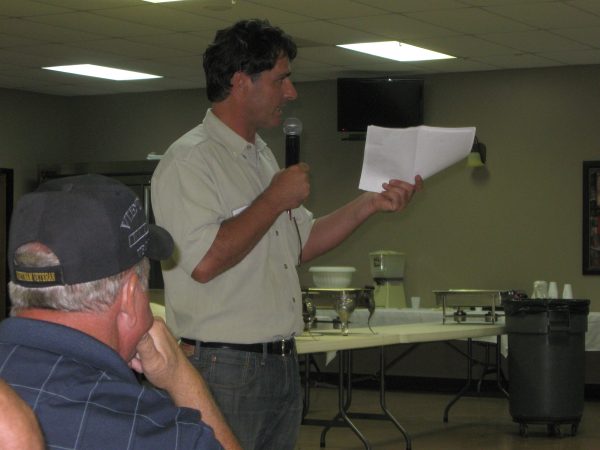
Sebastien speaking at friday night’s dinner. He made sure to personally thank his staff for the success of the factory. When he recounted how long each of the people had worked there, it stood in contrast to many other aviation companies that go through employees like water, unable to generate stability nor loyalty required to attract and keep a first class staff like Zenith’s.

Craig and Valerie Westedt.  The both came to Corvair College #22 in Texas and CC#23 in Florida earlier this year. Craig is quick to point out that the project is actually Valerie’s build, he is playing the support role.  At the Zenith dinner Valerie won a deluxe VIP Oshkosh Package from the EAA’s president, Rod Hightower. It included an up close parking pass. All the Corvair builders who have met Valerie understood she isn’t going to need the parking pass, as she is determined to fly into Airventure.

Lynn Dingfelder’s 601XL(B). This is the first time I have seen his plane since he flew it into Corvair College#20. The engine is a 2700cc power plant with a Dan bearing and an Elison EFS-3A carb.

Shane and Phyllis McDaniel stand in front of their 650, which was the first amature built 650 in the country. They brought it to Oshkosh to great praise, it is a outstanding example. They recently finished a 601XL, also Corvair powered, for a his and hers combination. They are both skilled builders and pilots. Both of their aircraft have 2700cc engine with Dan bearings and MA3-spa carbs.

Dr, Steve Minart, of Iowa, stands beside his 2700cc Corvair powered 601XL(B).  His aircraft was the 4th Corvair powered Zenith to arrive at this years event. Over the years we have had a steady stream of builders bring their Zeniths to Mexico, Colleges, Oshkosh and Sun n Fun. This is the best measure of success. Sales numbers mean little, I am in the game to get people flying.  Our Corvair program for Zeniths has been around a long time. On our 2005 Midwest Night School tour, one of the stops was Dr. Minarts home. Here today, gone tomorrow companies in experimental aviation have stolen more builders dreams than most people first guess. Few people understand that less than 10% of the firms in our industry 20 years ago are left. Even many of the familiar names went through ownership changes and bankruptcies, often at builder expense. Zenith’s record is a complete standout in our industry.


Above, Mark Petinunas of Falcon machine speaks with Lynn Dingfelder about Lynn’s 601. Mark ‘Petz’ is one of our Corvair All-stars. He came down to the open house to meet with builders and Deliver a 3,000cc Corvair that is destined to power Clark Taylor’s 601XL. Because we are primarily in the business of teaching people how to build their own engines, the Corvair All-Stars are all mechanics and builders, not sales people.

Above I stand beside Ray Huffman from Lexexa Kansas. who has a long personal history with aviation. I noticed his hat and asked him about it. I listened closely while he spoke of Flying Hellcats and Corsairs in WWII, and Banshees in Korea, including ditching in the sea of Japan and being rescued by a helicopter. He is 88 today. About 10 years ago he built and flew a 601.  It says a lot to me about the experience of homebuilding that a man who had flown the front line of aircraft in combat in his youth still found homebuilding a vital part of the panorama aviation, something he was unwilling to miss. 

Listening to this man will likely turn out to be the best hour I spent in aviation in 2012. In another decade, we will still honor the courage of aviators of the greatest generation, but they will be gone, and you will never again be able to listen to one of them while standing in the sun on the ramp at an airport. You will always be able to see a F4U or a F6F at Airventure, or read about the history, but these are just machines and books, and are not comparable to meeting the man. 99% of us will never see nor do the things this man has, but as fellow homebuilders you have some common ground with him, a connection that can give you slightly better perspective on his experience. I have casually wasted many hours in my life, but from 3 to 4 pm CST September 22, 2012, I spent one of my hours doing something very worthwhile.

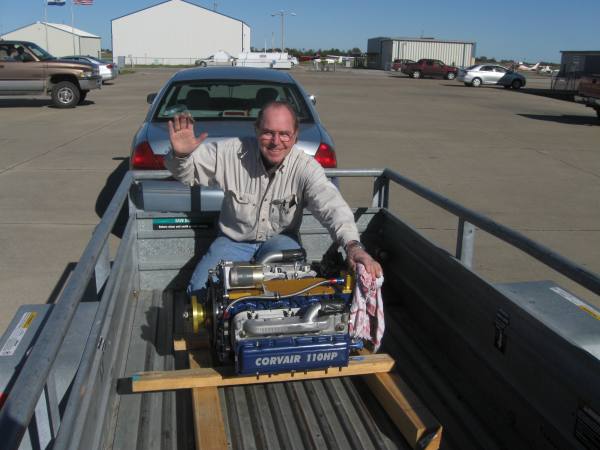
Above, Gary Burdett with the 2,850cc Dan bearing engine we built for his 750. He picked it up at the open house. He is on the fast track to finish the plane and have it out for the 2013 flying season.  Our upcoming Corvair College #24 is an excellent place to make your own progress and lay the ground work for your own outstand year in 2013.-ww

Corvair College #24, November 9-11, South Carolina

Friends,

We are now approaching Corvair College #24. The event will be a large, full-scale College held at the same location of the highly successful Colleges #19 and #21.  Corvair/Pietenpol builder/flyer and Cherry Grove Trophy winner P.F. Beck, and his great crew, again are the location hosts. We have many early indications that this will be the largest and most productive College yet.  Although we are just now opening the registration, the prep work for the College has been ongoing for 10 months, and it builds on the outstanding work that P.F. and crew did in earlier years.

The online registration is being covered by Corvair/601 builder Ken Pavlou, aka “The Central Scrutinizer.” Ken takes care of all the College registrations for us from the “undisclosed location” (his basement in Connecticut). Hats off to Ken for his long-standing support of Colleges.

The link to the registration is: https://corvaircollege.wufoo.com/forms/corvair-college-24-registration/

If this is going to be your first College, I highly recommend that you read about all the previous ones at this link to our main Web page: http://www.flycorvair.com/cc23.html

In recent years, the Barnwell Colleges have become the year end event in the world of Corvairs. They are highly productive, and we have had a lot of engine runs and building progress with a good collection of flying Corvair powered planes on hand, but the events also have a strong social side, where builders can relax in the company of like-minded aviators. Barnwell has seen a lot of married couples and father/son builder teams, and these builders fit in well at the kind of classy events that P.F. hosts. College #24 will also see the 5th presentation of the Cherry Grove Trophy, the award that recognizes the outstanding Corvair aviator of the year.

#24 will be a great place for any builder to learn, make progress and meet fellow builders. We will be updating builders with more information on this site leading up to the College, but it all starts with you looking at a calendar right now and making plans. Act today, you will not want to miss this opportunity. -ww

__________________________________________

Shelley Tumino & Kevin Purtee, Corvair/Pietenpol builders and flyers, and location hosts of the outstanding CC#22 in Texas earlier this year, have put up a Facebook page for #24 the way they did for #22. It is another good source of information, particularly the visual stuff:

http://www.facebook.com/CorvairCollege24

Both Kevin and Shelley are headed to CC#24, where they plan to inspect and run their 2,700cc/Weseman bearing engine.

__________________________________________

P.F. Beck and crew at the Barnwell airport add the following information:

"If you need more specific information, either e-mail us at barnwellairport@bellsouth.net
or call the airport at 803-259-1090."

“For those driving, we are about 60 miles southwest of Columbia, S.C.  If you are flying in on an airline, the best connections are usually into Columbia, but one can also fly into Augusta, Ga., about 40 miles northwest of Barnwell.  Both airports have rental cars.  If you are flying your own plane to the event, there are plenty of tiedowns.  At the present time, all hangars are filled.”

“Some builders start arriving early Thursday morning to get a head start on engine work.  Others will drift in during the afternoon.  Actual ‘official’ engine work starts on Friday morning.”

“There are three motels nearby, but make your reservations early as they stay booked up.  They are:

Days Inn – 31 rooms – newest motel in town – (803) 541-5000;

Carolina Lodge – 39 rooms – located next door to the Huddle House – (803) 259-2014;

Villa Motel – 25 rooms – located in Williston, S.C. – 10 miles north – (803) 266-7001.”

“Camping is available at the airport at no charge.  In the past, some folks came in motor homes, some had campers, some slept in tents and some elected to sleep on the floor in the terminal building. The weather is usually pleasant but bring warm clothing.”

“There is a newly built restroom in the work hangar and others in the terminal building.  There is one shower in the terminal.  If you elect to use the shower, please bring your own towels, wash cloths, soap, etc.”

“The airport supplies 12  4′ x 8′ work tables, three engine assembly stands and cardboard to keep oil off the hangar floor.  Please bring your own tools, rags, oil dri, etc.  This year, we have added more fluorescent lights over the work area as well as over the eating area.  It will be much brighter.”

“Tables and chairs will be set up on one side of the hangar, as last year, for eating, taking breaks, etc. We plan to handle meals as in past years.  More information will be added to the Barnwell airport site [http://www.barnwellregionalairport.com/Corvair_College___19.html] as we approach the November dates.”

Zenith Open House, Sept. 21 and 22

Friends,

The Main Event on the Corvair schedule this month is the Zenith Factory Open House in Mexico, Missouri. The Open House date is Setptember 22nd, but we are planning on being there on the 21st and attending the dinner on Friday night. This is going to be a big event, because it marks the 20th year of Zenith’s U.S. factory. For a more detailed look at the event, follow this link to Zenith’s Web site: http://www.zenithair.com/news/oh2012.html 

Sebastien has directly told me that he welcomes all Corvair builders to the event, not just guys working on Zenith airframes. At last year’s event, Grace and I used the opportunity to meet with dozens of Corvair builders from the Midwest. This is an excellent opportunity for Corvair builders to attend an event in their area, have us answer their questions, inspect flying planes, have a “parking lot tour” to see core engines and meet other builders. As always, we will have a full complement of parts, but if there is something specific you would like to pick up, please let us know in advance. We are planning on having half a dozen powdercoated Zenith 601-650 and 750 mounts on hand. Builders will have a chance to avoid the shipping cost by getting one in person.

The main day of the event is Saturday, but I am going to be there on Friday to get a jump on the event and attend the dinner in the evening. Traditionally the open house draws several hundred people, but this year being the 20th anniversary, will likely be a bit larger. Rod Hightower, the president of the EAA, is the Friday night speaker, which gives a good indication of the respect due the Heintz family and crew for their longevity in an industry often marked by here-today-gone-tomorrow LLCs. From a builder’s perspective, it is the ideal sized event to come and learn and get to know other builders. Oshkosh has 200 times the amount of people, but I find the open house to be made of serious builders and planners, not spectators and daydreamers. The entire setting is conducive to builder progress. We will have far more time for one on one questions and answers than at a major airshow. 

A number of builders with finished Zeniths have said they are making plans to fly to the event. We are going to have a complete Zenith firewall forward installation on hand with a 2,850 cc Corvair mounted on it for display. Again, the event is open to all Corvair builders, and Sebastien and crew will welcome you as their guest, but it will be particularly beneficial to everyone planning on bolting a Zenith airframe to their Corvair engine.

Looking forward to seeing many of you there. -ww

Wisconsin 2012 Air Adventure

Friends,

We are just back from a 13-day trip up north to the Brodhead Pietenpol Fly In and to a week at Oshkosh. I am sending out this report in several sections to give everyone a sense of what the events were like in person. After more than two decades of making this pilgrimage every flying season, it still remains an adventure, because it is filled with characters who make every year something new. As you read through the notes, picture yourself there and part of each day. They were all well spent in the company of good people. If you are going out to your shop tonight to put in a few hours on your project, work knowing that you have many friends out there, people you are yet to meet, but people with whom you share a basic passion of learning, building and flying. When you make it to Brodhead, AirVenture or a College, you will be warmly welcomed by your fellow aviators who also remember the type of people who founded the EAA.

The first aircraft I saw at Brodhead was Randy Bush’s Corvair powered Piet Miss Le’Bec, making its 4th appearance at Brodhead.

The emcee of all the Saturday forums at Brodhead is Corvair powered Piet pilot P.F. Beck. PF is also well known as the host of Corvair Colleges #19, #21 and the upcoming #24 in South Carolina in November. P.F. shared that he has now flown 250 people in his Pietenpol.

A quick glance around the airport revealed Tom Brown’s Corvair Powered Piet hiding from a short rain shower in one of the art deco Brodhead hangars. Tom’s plane is the high time Corvair powered aircraft in the world with more than 1,500 hours, all logged on a very basic B.H. Pietenpol style installation.

Brodhead is also a gathering place and home to a very wide array of antique aircraft.  I walked around a corner and found this pre-war Chief. These are rare enough that I had not seen one in person in more than 15 years. This one was flown up from Texas.

Tom Brown’s Piet in flight over Brodhead.

A perfect replica of a Bleriot (the first plane to fly across the English Channel-1909) was on hand complete with rotary engine. This was later flown in the calm air of sunset. Igor Sikorsky’s most famous quote is, “In the beginning, aviation was not science nor art, it was a miracle.”  This aircraft design was the transition point from miracle to rudimentary engineering.

Above, The Last Original, B.H. Pietenpol’s last aircraft of more than 20 he built. A masterpiece by the patron saint of homebuilt aircraft. It has more than 800 hours on it. It is owned by, cared for and loved by Bill Knight. Bill understands that this aircraft is a treasure, but he also knows that it doesn’t belong in a museum, it needs to be flown in front of people, especially Piet builders. Very, very few other homebuilt aircraft groups have a their most significant aircraft in its natural element and totally accessible. My wife Grace has flown this plane, and considers it a complete honor and perhaps her best day in aviation. Bill decided to have the inside of the engine brought up to current specs with forged pistons and a nitrided crank, Falcon heads and Dual Ignition, while retaining the complete original look. This will keep this aircraft in good shape for another 30 years. Hats off to Bill Knight, patron of the art of aviation.

The Piet of Kevin Purtee and Shelley Tumino at Brodhead. The aircraft has more than 300 hours on it. Kevin and Shelley are well known in both Piet and Corvair circles, and they hosted Corvair College #22 in Texas. Brodhead ends Sunday morning, and Kevin had plans to fly on to Oshkosh. He had a power loss right after take off and had a forced landing off the end of the Brodhead runway. Kevin was very seriously injured and the aircraft was heavily damaged. We were already at Oshkosh, but a number of people saw the accident in person and were justifiably shaken. Within a day, word came back that Kevin would have some new scars, and some time off, but he is going to make a full recovery. With Oshkosh just up the road, the FAA sent an accident team right to the undisturbed site in the cornfield where they found a lot of water in his fuel system. At the end of the week, Grace, Mark Petz and myself had a chance to spend a few hours with Kevin and Shelley, who were on their last day in the Madison hospital. They both ran out of words to express their thanks to everyone who had called, written and gone out of their way to help. It was a very moving example of how aviators care for each other when it counts. It lifted my spirits greatly when Kevin announced that he and Shelley are going to rebuild his plane in the next year, and he is going to run a 5K by the end of this year.

On Saturday, Ron Lendon of Michigan flew in to Brodhead in his new 601 XL.  Ron is well known in Corvair and Zenith circles. His aircraft is plans built, and displays first class craftsmanship. When I took the photo, his plane had 55 hours on it, but it had been flying just 30 days. He flew his first 40 hours off in 10 days. This only happens when two things come together: He followed a proven path that we advocate, and he put care and craftsmanship into his work. These two combine for an absolutely trouble free test period. Countless times we have heard of people having an issue with a new homebuilt, particularly alternative engine ones. Every bit of my work with Corvairs has been aimed at never having these issues for our builders. Problems that other people have are often directly linked to some new installation or an overworked design that was never proven over years of testing. We have countered this with a careful program of seeking out “Old And Proven” in the place of new and exciting. The ultimate benificiaries are builders like Ron who get to achieve their dreams of flight and self reliance with as low a risk and stress as possible. Hats off to Ron Lendon.

On Saturday I had an afternoon forum on Piets, Corvairs and Weight and Balance. Above, P.F. Beck and  I get started.

Standing with the Corvair shirt is Ryan Mueller, who did the 5 part series with me on Weight and Balance that appeared in the Brodhead Pietenpol Association Newsletters, available at www.Pietenpols.org.

Randy Bush offers his testimonial on Corvairs and Piets in combination. He now has more than 420 hours on his plane. This is a lot for an open cockpit aircraft based in Tennessee. Many Corvair people met Randy at previous Colleges. Both he and I have had many conversations about how homebuilding and developing and exercising your craftsmanship in aircraft building is a refuge of sanity and stability in our personal lives.  We have both noted that when many people hit a rough patch in life, one of the first things they think of doing is quitting their aircraft project. Either of us, and everyone else who has finished an aircraft under challenging circumstances, would gladly offer that selling your project is the last thing you should do. When little else is going right, and few people are on your side, hours spent in your shop will show you that you still control much of your life, and the opinions of you held by others are often worthless. In your own shop, your are in charge, and any hour spent building something with your own hands is well spent and the things you learn can never be taken from you. Go back and read the Sterling Hayden quote about what men really need to lead meaningful lives.

On hand at Brodhead forums were Ed and Val Fisher, hosts of Colleges #12 and #16. Ed has restarted the SAA, Paul Poberezny’s core EAA values group for people who want to preserve and enjoy the spirit that started the EAA 60 years ago.

Forums lead to “Tailgate Seminars.” Here, we go over details of engine selection and building with a good core example. Teaching is at the root of all of our work. At Oshkosh, engines are often promoted and sold by people who hardly know a camshaft from a crankshaft. You can buy something from a salesman, but you can’t learn anything from him. When I went to Embry-Riddle, every professor was required to present each student a very detailed syllabus on the first day of class, often several pages long.  My first class in aerodynamics was taught by the department chair. He understood the syllabus requirement, and met it by handing out a single piece of paper with one sentence on it: “You are here to learn, and I am here to teach, and all else is secondary.”

It was nearly 100F outside, but we covered more than an hours’ details.  I have heard that most Rotax seminars are PowerPoint presentations held in Holiday Inn banquet rooms.  I will put the engine knowledge of our successful Corvair builders against any other make of powerplant. We have always made learning the focal point. Everyone who gets started in experimental aviation should have personal goals of expanding what they know. The depth of these goals varies greatly from person to person. After 24 years in this game, I am in a very good position to confirm the obvious: The people who get the most out of this are the people who are willing to learn the most; People who think only spending money here will offer the same achievement as those who invest time and real effort will end up finding otherwise. If the engine section of a person’s personal goals in aviation are so shallow that they can be met with an “appliance” that basically has a tag  saying “No user serviceable parts inside,” then a Rotax 912, or any of the other “imported-in-a box” engines, will cover their needs. For those who got into experimental aviation to find out how much they could learn, not how little, we have the Corvair. I do not begrudge consumer mentality people an engine product to meet their modest personal goals. And it comes as no surprise that people with the consumer mindset might fail to understand those of us who approach aviation as the learning opportunity and challenge of a lifetime. The goals and choices of others are not my concern nor focus. I am here to serve and work to advance the goals of the people who are in experimental aviation to get the most out of it. Since 1989 these people have always proven to be the best people I have met in aviation, and I look forward to every hour in their company.


Above, four Piets in flight at sunset over Brodhead. You might have a hard time remembering what you had for dinner last night, but this is the kind of 15 second moment that you can remember for 10 years. In years to come I will be able to glance at this photo and remember the sound, how hot it was and who was there. Getting something out of aviation is made of putting together as many of these moments as you can in the company of good people.

When the air was flat calm, the Bleriot came out, and we got to see what aviation looked like 100 years ago.  If you took out a 1912 Model T and drove it down the road, chances are that you would have some D-bag in a Prius next to you text messaging instead of driving.  (To the three Prius owners in North America who don’t text message and drive, Becky, Mark and Bob, I apologize in advance.) The sunset sky over Brodhead offered no such distraction, and the moment was perfect. The planes’ motion through the sky was as mesmerizing as watching an eagle riding on a thermal.

On to Oshkosh 2012

Above, three Zenith builders who flew their Corvair powered planes to Oshkosh stand with Sebastien Heintz, president of Zenith, in front of our tent. Left to right, Ron Lendon, Michigan, 601 XL, Roger Pritchard with his son Ben, New Hampshire, 601 XL, Sebastien, and Dave Gardea, Indiana, 650. All three planes were making their first appearance at Oshkosh.

We have many more stories of Oshkosh in the next two segments we are working on. … We will have them up shortly-ww


Panther Prototype Engine 3,000 cc/120 hp to OSH

Friends,

We are 30 hours away from leaving for Oshkosh. Dan and Rachel Weseman are also heading up, and we will both be at booth 615 in the North Aircraft Display area, between Zenith and Vans. The Wesemans are bringing The Panther prototype airframe to display all the progress they have made in the few short months since Sun N Fun. Because they are good friends and we wanted to do something to support their new effort, I offered to assemble the 3,000cc Corvair that will power Panther #1. Here are a few photos of the completed engine. It will also be on display at the booth.

Above, the engine is a 3,000 cc engine with a Weseman bearing, Falcon heads and all of our Gold System Parts. The engine features some of the latest developments and a unique fuel system. The pictures of this engine are a good visual complement to our previous post on 2012 Engines For Sale. Other than the intake and the injector, this engine is the same as the ones that we assemble for builders. This engine is also an excellent blueprint for anyone building their own engine from our parts. The valve covers are one of our powdercoated sets with welded on oil filler and breather lines.

Above, a rear view of the engine. Behind the harmonic balancer is an alternator driven off the crank through a flexible coupler. It is a joint project that Dan and I have been working on. It retains the balancer and cannot put bending loads on the crank. I have never been a fan of belts on the back of the engine, but this system does not use one. The alternator is the same Yanmar unit we traditional use on the front of the engine. The set up will be flight tested after Oshkosh.

The intake is a custom stainless part made in our fixture so that it mates with our traditional welded on head pipes. On the bottom of the intake is the Precision mechanical fuel injection unit. Dan has designed the Panther to have tremendous airframe strength. The test wing took more than 9Gs at gross weight in a sandbag test conducted after Sun N Fun. Although Dan designed the plane to be easy to fly, it will be capable of impressive aerobatics. With the intention of ultimately being able to fly it with inverted systems, Dan has selected the Precision injector as his fuel delivery system.

Here is a good frontal view of the Corvair. It is only 28″ wide. This is 4″ narrower than an O-200, 6″ narrower than an O-235 and several inches narrower than a VW. The Corvair is a tough compact package. Six cylinder engines will always end up as a smaller package than a four-cylinder one of the same displacement. This view shows our new simplified adjustable starter motor bracket that eliminates the previous link arrangement. The single oil line runs direct from the Gold Oil Filter Housing to Dan’s bearing. Braided stainless hose and full flow AN hose ends look and work great but are not as expensive as people think. This hose was easily assembled from $36 in parts.

Of course Dan’s plane is going to use one of his bearings.  Originally a heat-treated casting that matched the finish of the Corvair’s cast case, the Wesemans switched to CNC machining the same design out of solid billets of aluminum. As part of their commitment to keeping aviation affordable, they did not raise the price when making this improvement. It goes without saying that this unit is entirely made in the U.S. out of U.S. material. With well over 200 of these bearings in the field, it is by far the most popular bearing. It has three strong cards to play: It is by far the lowest cost bearing, it is retofitable in the field to existing engines, and it is readily available, as the Wesemans now have them machined in large groups to have them on the shelf.

The photo is also another good look at the simplified starter arrangement. We have four-part kits for engines with Weseman bearings that consist of the new starter ear, two machined aluminum spacers and a pre-made tail bracket that allow any of our starters with a bolt on ear to be adjustably mounted on an engine in 15 minutes without fabrication or drilling. We will have these sets at Oshkosh.

Looking at the above photos and thinking about the Corvair’s well deserved reputation for strength and cool operation, it is easy to understand much of the popularity of the engine. I have been working to develop the Corvair flight engine continuously since 1989. The engine has matured tremendously during this time, but it has never lost it basic simplicity in the 52 years it has been an experimental aircraft powerplant. While others may be captured by engines sold as “new and exciting,” the Corvair remains a very popular option for builders looking for “Old and Proven.” 

I have said many times that the Corvair isn’t for everyone. We sell assembled engine just like the one above for roughly half the price of a Rotax 912, but there are plenty of people who pathologically purchase imported mechanical items. We can teach people to build a Corvair just like the one above for less than $8,000 in parts, but learning things and getting their hands dirty are alien concepts to many people who claim to love experimental aviation. For the rest of us, the Corvair is a great opportunity to have a proven and affordable powerplant.-ww

Corvair College #23, 2700cc Engine, Spencer Gould, SP-500

In the above photo, from left to right, Spencer Gould, Dan Weseman and Mark “Petz” from Falcon Machine at work on Spencer’s engine at Corvair College #23. Dan is covering the installation of his 5th bearing onto Spencer’s engine. Originally built as a plain 4 bearing engine, Spencer elected to add Dan’s bearing, a fairly easy upgrade that does not require the engine to be disassembled. Dan’s presentation on how to do the process complemented the clear directions that come with his bearing.

Above is the same process from a different angle. Here the prop end of the engine with the Safety Shaft is sticking straight up. Installation is easier on the bench, and it is easiest if the pistons and rods are not yet installed, but Dan has demonstrated many times that the upgrade to his bearing can be done without ever removing the engine from the airframe. He now has well over 200 bearings in the field, and they have been proven over 5 years of service. Upgrading an engine requires a shorter hub to keep the same length of Studs, Shaft and cowling. The Wesemans offer this machine service to builders who already have one of our Black Hubs or a Standard length Gold Hub. Builders that are planning on using a Dan bearing from the start order a Short Gold Hub from us.

Above, is a good look at the clean lines of an engine equipped with a Front Starter and alternator. Note that the engine has just one oil line on it, running from the Gold Housing to a Weseman Bearing. In its final installation, the engine will have a Gold Sandwich between the Filter Housing and the filter, and two short lines feeding a large cooler mounted on the engine baffling. This is another view of our new Starter Bracket. The outboard side of the triangular bracket is slotted allowing the adjustment of the starter engagement. This eliminates the previous system that had a drilled link plate. Spencer’s engine has the oil fill in the top cover because it is going on his single seat design, and he is planning on a form fitted cowling that would come too close to the right hand valve cover to have room for our standard oil fill location. The left hand valve cover has our standard crankcase vent line and oil return. The engine uses our Short Gold Hub because it has a 5th bearing. The bearing is one of the Weseman’s original cast housings, before they went to billet CNC production.

Another view of the engine. The welded on intakes were welded on the heads by Mark Petz at Falcon Machine. Like most flying Corvairs, Spencer’s engine has one of our E/P Distributors. Oil filter is a K&N 1008, the plugs are AC-R44Fs, my first choice for both of these. The dip stick is an aftermarket one for a 289-302 Ford, with the tube shortened 5″. The engine hardly needs more than a set of ignition wires and a baffle set to be installed on an airframe. None of the engine systems need to be mounted on the firewall: The engine is largely a self-contained, neat package. The engine will be flown with a HD oil cooler because the airframe is designed for strong maneuvers and solid acrobatic work, and excess oil cooing makes sense on a plane that will be flown at full power and slow climb speeds. On the run stand, engines can be operated without oil coolers because the oil comes up to temp very slowly with the engine uncowled.

Above, Spencer’s engine at power on the stand. Note the size of the cooling baffle we use on any engine we are running on the ground. We recently had a builder extensively damage the engine he built by running it on the ground without any type of cooling baffle or cowling.  In every photo we have of running engines at the Colleges, especially brand new ones being broken in, they have a generous amount of cooling air being pumped through them by the baffle. Prop wash over an uncowled engine does not work, period. Without a cowl or a cooling baffle box, none of the air has any reason to flow down through the cooling fins on the head. How long does it take to hurt the engine? How much running is OK? Answer the question for yourself this way: If you just spent $5,000 and a lot of time to rebuild the V-8 in your classic muscle car, how long would you run it without a radiator?

Actually this isn’t a fair comparison. A v-8 in neutral turning 2,000 rpm is only making 10 or 15 hp, it is not pulling any load. It has a several hundred pound mass and lots of oil to heat up. Conversely, a Corvair with a flight prop turning 2,000 rpm has to be at half throttle and may be making as many as 60 horses. It doesn’t have the mass to heat soak either. You could run the V-8 longer without damage.

Keep in mind, if you hurt your newly overhauled v-8, it may leave you by the side of road later. If your flight engine is wounded by cooking it during break in, it may choose to get even with you later, and it is much more likely to do so on a full power climb out than it is idling on the ground. In the end, what exactly was to be gained by running the engine on the ground without cooling? Building a box too much work? Few scraps of sheet metal cost too much? Building the most elaborate cooling box will never take 10% of the time nor 5% of the cost of rebuilding your engine. The longest time I ever run an engine without a cowl or cooling box (once it is fully broken in) is 45-60 seconds, and only 5-10 seconds of this are much above idle. I would do this while setting the timing on an engine after maintenance. On many of our cowling designs like the Zenith cowls, you can just pull the top hinge pin on the passenger side and remove the top access panel. The cooling system will stay in place with the exception of a 4″ square hole. You will have full access to work with the Distributor and set the timing. Our cowling design took factors like this into consideration, and that is why it makes a lot more sense than trying to scab together a cowl from leftovers of some other engine.

Above, Spencer enjoys the finest form of air-conditioning on the planet, prop blast from an aircraft engine created by your own hands. A close look at the exhaust on the run stand shows that I have oxygen sensors on both sides to run an air/fuel meter (lean-rich gauge).  Initially, I liked the idea, and a number of well-known Corvair pilots like this instrumentation as well. Here is the turn off for me: The sensor works on a tiny signal difference, and it is very prone to any type of grounding issue. This is a pain, but not too hard to overcome. My real objection it that when the device loses its signal, its default position is reading perfectly in the green arc. I find the very concept annoying. Would you use an oil pressure gauge that indicated 45 pounds every time the wire was disconnected? How about a fuel gauge that always read 1/3 full when it was having an issue? To me, I want instrumentation that when it fails, it clearly indicates that it is dead, it doesn’t provide misleading info. There is probably some electrical reason why the air-fuel meter reads green when it is dead that makes sense to an engineer at a computer, but if I put it in a plane, it has to make operational sense to me. Lest you think I am making a mountain out of a molehill, than consider that the airliner hitting the 14th street bridge in D.C. was primarily caused by an instrument error on the EPR gauge; the airliner that went into the Everglades 30 years ago had the crew fixated on a failed instrument light; there are enough stories about professionals being undone by faulty instrument data that homebuilders should consider this issue with attention. In my personal opinion, almost any Corvair engine can be well served by 2 simple EGT probes in the exhaust. EGT systems are stupid reliable, and when they are disconnected they don’t read.

Above four of the major contributors to the modern Corvair movement: From left, Mark from FalconMachine.net, Dan Weseman from SPA.com, myself, and Spencer Gould.

Today, Spencer’s day job is aeronautical engineering for the world’s greatest aircraft powerplant company, Pratt-Whitney. Contrary to the popular image of serious engineers being challenged by practicality, Spencer is a multi-faceted renaissance man of aviation. He is a very skilled pilot of complex aircraft, he is the master of CAD drawing and machining, he can fly any RC aircraft with skill, he has designed and flown dozens of them. He designed and has built 98% of his own composite acrobatic aircraft, the SP-500, and has a broad array of practical knowledge in the world of aviation. If you need a technical solution to a structures issue, a finite element analysis, or a process, Spencer always has valid input. In the years between his graduation from Embry-Riddle Aeronautical University and Pratt, he worked as a powerplants engineer for Piper in Vero Beach.  During that time, Spencer was an adjunct member of  The Hangar Gang, and covered a lot of our CAD work. Designs that I had for the Gold Oil System, the modern Hubs and our 5th bearing were refined by Spencer’s CAD ability, and they went directly to CNC production from code we e-mailed to the machine shop. He was and remains a very important force multiplier in our efforts, an asset that few other engine programs could claim to match.

If you are new to homebuilding, stop and think about this: The Corvair not only has appeal to people whose day job is far from aviation, but it also has great appeal to builders like Spencer who are immersed in aviation, men who understand all the issues involved in powerplants. Spencer could afford any piston engine he wanted for the front of his aircraft. Yet he selects the Corvair because after careful evaluation, it all adds up to the right choice for him. The engine isn’t for everyone, but no builder new to aviation need worry that the engine isn’t capable of meeting the demands of educated professionals and amateurs alike.-ww

Oshkosh 2012. Our booth is between Zenith and Sonex.

Friends,

We will be at Oshkosh from July 23 to July 29, 2012.

Our Booth Number is 615 in the North Aircraft Display Area, between Zenith and Sonex.

We will have our full Catalog of Parts on hand. However, we will have limited quantities of some items such as Motor Mounts, Intake Manifolds, and Stainless Exhaust Systems. If there is a particular item you would like us to bring, please contact us. If you purchase them in advance, we will reserve it for delivery at the show.

As always, we are more than willing to inspect any customer’s core engine or part, and we will gladly cover any procedure in detail and discuss any building or installation issue. Please bring photos of your project.

I am scheduled to give four forums at AirVenture. This is the tentative schedule. The latest schedules will be at http://www.eaaapps.org/forumsearchresults.aspx

Ken Pavlou and Dan and Rachel Weseman are planning a cookout. As we get closer to Oshkosh, we will have more information on FlyCorvair.net, our news site.

Travel safe and we will see you there. -ww

Corvair College #23 – 2850cc Engine, Roger Grable, CH-750 Builder

Friends,

Here is another builder’s story from Corvair College #23. Below is a sequence of photos of the 2850 cc 110hp engine we assembled for Zenith 750 builder Roger Grable from Missouri.  All of the action pictured took place at the College.  

We met with Roger and his wife Sarah at CC#22 in Texas a few months ago.  It didn’t take long to understand that he knew engines fairly well, and had considerable experience working on them. His questions were observant and thoughtful. He spent #22 carefully considering a plan that made sense for his project and timetable. By the end of #22, Roger made the decision that he wanted to have us assemble a 2850 for him, and this would keep his fast paced 750 project moving.  I have no problem building an engine for a guy with Roger’s approach. He still wanted to learn as much as possible, and that in my book is what makes him a good Corvair guy.


Above, Roger and I stand beside his engine on the run stand.  Every engine we run has the oil system primed for 20 minutes with an electric drill. The only oil we use for break in is Shell Rotella T 15w-40. In every engine we add ZDDP. You can get it from a lot of places, but Clark’s sends it with camshafts they sell. We run the engine for 25 or 30 minutes without stopping, at 1500-2000 rpm. This has proven over hundreds of engines to protect the cam and lifters, which are the primary thing you are concerned with during the first hour.


Above, a number of the builders at CC #23 admire the smooth power of Roger’s 2850. The engine is equipped with a billet Weseman bearing and a very nice set of Falcon heads. We configured the engine for a heavy-duty oil cooler. On aircraft like Zenith 750s, the slow climb speed capability and the high angle of attack challenge the stock oil cooler capacity in hot weather. Thus, we set the engine up with a cooler block off plate and a Gold Sandwich Adapter and a 20003 series aircraft oil cooler. The baffle kits the Wesemans offer are fitted for either the stock cooler or the 20002 or 20003 series. When complete, the oil system is contained on the engine, none of it is mounted on the firewall or cowling. This gives the engine installation a clean, organized appearance.


Above, Roger keeps an eye on the oil pressure. His engine is equipped with our new high volume pump. For these, I carefully  use the mill and expand the capacity of the oil pressure bypass, to prevent the engine from having a very high peak oil pressure on start up with cold oil.  When the engine is first started, several minutes of operation to warm the oil is a good idea, and we do this at 1000-1200 rpm.  In a few minutes the oil will regulate at 50 psi or so. When the engine is at full temp, this will settle down to 45 pounds of pressure. This slight reduction in regulated oil pressure between 140 and 205 degree oil is a Corvair characteristic. Beside Roger in the yellow shirt is his grandson Graham of Kansas. The young man proved to be very smart and good company. Many of the builders though Graham was 20 or 22 years old by his manner; it was a small surprise that he is far younger, still in high school. He is very interested in flying, and it is easy to guess that he will do very well. The kind of younger person who defies all the common media stories about youth.

We often get inquires about complete engines. Most of these are from people who only know about the low price of the engine. They have no other attraction, they know almost nothing of our development or support. Experience has taught me that any guy who decides to buy an engine he never heard of before after reading a one paragraph news release is not a guy who is in things for the long haul. Any guy who thinks you’re a genius in 1 minute is just as likely to decide you’re a fool without reason. Steady people who consider merits thoughtfully are typically the people who succeed in homebuilding. To understand an extreme case of people who are only interested in price shopping, I had a guy ask about a 3,000cc engine. He said it was priced at $50 more than his other choice, a four-cylinder, geared, tiny displacement computer controlled, imported car engine. I pointed out that philosophically these were radically different concepts in aircraft engines, and he needed to think his choice over a bit.

His response was to ask if I would sell him an engine but not the Conversion, Installation and Operations manuals, so it would reduce his cost and make up his mind. I calmly asked him why I would sell an engine to anyone who told me they didn’t want any instruction on how to operate it. I hope he is happy with the other engine, I don’t work with people who know the cost of everything but the value of nothing. Roger and his family impressed me as the perfect antithesis of such people. We have room in the Corvair movement for many types of people, but I can make a good argument that experimental aviation and flying in general has had quite enough of people who have no interest in learning anything.


Above, Roger and his grandson Graham. The picture provokes a thousand thoughts on where their adventure will lead. Will they both be there for the first flight? Will his grandson solo in the plane? Will Grandfather be the first passenger in his log book?  I watched the two of them at the College, they were having a very good time together. Roger, obviously proud of his grandson, and the young man accompanying his grandfather on an important and fun trip. Both of my grandfathers passed before I was born. Looking at these two made me think about it many times during the College. I have been very lucky in many ways, but as a young man I would have treasured having a grandfather. In person it was easy to tell that Roger’s grandson felt the same way about Roger.-ww


Corvair College #23, 2700cc Engine, Ray Fuenzalida, KR-2S Builder

Friends,

It has been a few weeks since Corvair College #23 here in Florida. I have a few stories to write up and share from the event. We have been busy heading into Oshkosh, which is now only a month away. We have ended up with a little free time because of tropical storm Debby. It has been raining cats and dogs over the past three days, but it is expected to peak tonight, where we can end up with another 4″ of rain on top of the 12″ we already got. As a precaution on flooding, we have shut down the hangar for a day and picked up everything near the floor and turned off the power. This involved picking up the TIG welder with the engine hoist and putting the planes up on ramps. It is a lot of prep work, but it prevents damage and we will be back in action the day after the storm passes. For now, it provides time in the house to write up a story from CC #23.

Above, Corvair/KR builder Ray Fuenzalida from New Orleans. Ray has attended three other Colleges, but he decided to make #23 the special one and finish and test run his engine there. His basic engine is a 2700 with a Weseman 5th bearing. It will be more than enough power for an outstanding KR installation. Over the years Ray had considered several different starter/alternator configurations, but after seeing a lot of finished engines run at previous Colleges, Ray moved to using our standard front starter/front alternator configuration, primarily because he liked the simplicity of it. In the photo we are admiring the diamond plate top cover Ray made. We said something about a guy in Lake Charles, Louisiana, with one running board on his 1970s Dodge conversion van being ticked off…..

Above, Ray’s engine was about 1/2 complete when he brought it to the College, but we took the time to go over the engine with a fine tooth comb. One of the things we changed was his rear oil case. Ray’s core had come with an oil case from a 1960-61 Corvair. They fit, but they are a heavy sand casting. We replaced it with a die-cast one that had been fitted with one of our high volume pumps. The pump is a good idea with a 5th bearing. Standing with Ray is Dean Smith, long time Corvair movement guy, also from Louisiana.

My talented and  beautiful wife Grace painted the sign above. We have few rules at the Colleges, but we always abide by them. We lay off the top two subjects of conversation (as they rarely bring people together) and the third is that we teach builders to avoid products from totalitarian police states noted for poor quality. Ray has been a really good sport while we tease him about bringing a torque wrench made in the Peoples Republic of China. Over the years, I have shown many people that these are not accurate enough to build an aircraft engine with. Particularly offensive to me is the brand name “Pittsburgh.” I was born in the actual Pittsburgh in 1962. We bring a highly accurate Snap On digital torque wrench to every event so builders don’t have to worry about this if they are assembling at the College.  For those working at home, I suggest a Craftsman beam type wrench in 3/8 drive. They are good and cheap.

Above is a good overall view of Ray’s engine. Note the top cover has been replaced with our standard one, it is part of the Front Starter package. Ray painted it to match his engine. The diamond plate one was too thick and not smooth enough to mount the Front Starter Brackets. Ray also picked up our last non-anodized front Alternator Bracket. The only thing about Ray’s engine that is slightly different from our production 2700 engine is his use of bolt on head pipes. We used them for a long time, but every engine we have built in the past nine years had used welded on intake pipes. There is a slight flow increase with welded on pipes, but I particularly like eliminating the gasket. Our Intake Manifolds can be made to work with bolt on pipes, but they are really designed to work with welded on pipes. Mark at Falcon has a set of fixtures to do the job that are set to perfectly match our manifolds. Guys with personal skill at welding aluminum have purchased the manifold and used it in reverse to locate the head pipes without a fixture. If you do use bolt on pipes, do not use the gasket for a Corvair carb, instead use Clark’s part number C-12A, which is the gasket for the turbo intake on the car.

Ray’s engine has a very clean look because it has only one external oil line, a -6 line right from the Gold Oil Housing to the Weseman bearing. His oil cooler is a stock GM unit. These have long proven to work on small, fast Corvair powered planes like KRs and Cleanexes. All of Dan Weseman’s hard-core 3100cc powered Wicked Cleanex flying was done on a stock 12-plate cooler. The faster the plane, the smaller the oil cooler required.

Another look at Ray’s engine. Engines built with 5th bearings use the Short Gold Hub. For the past several years, we have used a sold Ring Gear in place of the 2003-07 model we used that had spokes. (It was an FRA-235 Pioneer, no longer in production.) The new model is from a late-model Ford. We buy them in the unmachined state from NAPA and individually machine each one on our lathe. This is a good view of our new Front Starter Bracket, which eliminates the drilled link of our previous starters. This new bracket comes standard on the starter we sell. We also have pre-made tail brackets for starters going on engines with Weseman bearings. The Fram 6607 filter shown is just for ground runs; we use a K&N 1008 in flight. Again, look at how clean the configuration is; it needs hardly more than plug wires and baffling to be installed. Ray’s engine will not need anything like the filter, cooler nor bypass mounted on the firewall. All of these are on the engine itself, which makes for a very organized engine compartment.

Above is the moment that counts: Ray’s engine at power on the run stand. Here is a proud hour where the learning and the effort has paid off. Ray got to share this in the company of his fellow builders. In his home EAA Chapter, he may not have a single other guy who has ever built a flight engine. At the College, this is the common ground, everyone is there to learn. At times, it can be hard to find other aviators who understand the desire to build and fly your own airframe and engine. Here is where the Corvair movement really shines, as it is made up entirely of self-reliant individuals who prefer to get the full measure of creativity and pride from homebuilding. People not content to go through the motions of the consumer experience of buying an imported engine in a box. The Corvair movement is for individuals who have willfully chosen to see how much they can learn, create and master in aviation, not how little. If this sounds like your mindset, welcome aboard. Hats off to Ray Fuenzalida, an individual who has earned the title Corvair engine builder.-ww