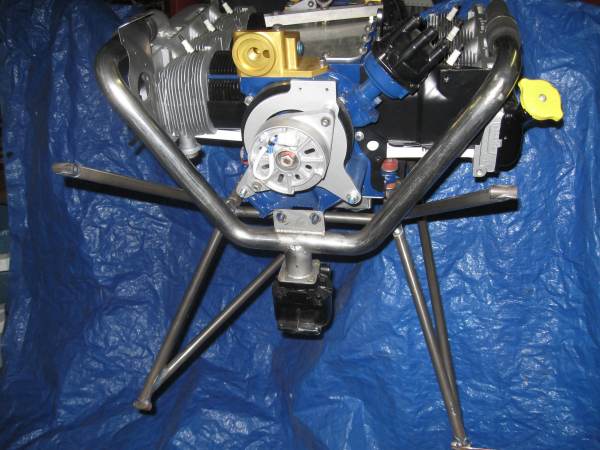
Getting Started in 2013, Part #19, Cylinder Heads

Builders,

There is a lot of small detailed information that goes into heads. But first, it is good to look at the big picture. What kind of heads do you want?  From a practical perspective, the top of the line are FalconMachine.net’s heads.  This is the product of “Mark from Falcon” or “Mark Petz” Or “M.P.” You could actually use Mark’s legal last name Petniunas. I have known Mark for about 10 years and I barely know how to spell his last name, and I know 5 ways to mispronounce it. Linguistics aside, they guy knows Corvair flight heads like no one else, he has produced well over 100 pairs of magnificent heads, and the work is beyond reproach. If you send him your cores, he will rework them, including welding on the intake pipes, for $1,270.  Theoretically you could spend more elsewhere, but you can’t find better work.

Is $1,270 a lot? Consider this: A guy with an O-200 buying 4 cylinder assemblies is going to spend about $3,800. If you add the cost of a set of 2700 cc forged pistons and rings and rebored cylinders to the cost of the heads, you end up with an apples to apples comparison of $3,800 to the Corvair’s price of $1,965.  Yes, the top half of a Corvair, built with the finest stuff, costs 52% of the same parts for an O-200. Even the top half of a 3,000 cc Corvair is only 82% of the cost of putting a top end on a Continental. (BTW, the 65 hp Continentals cost the same.)

Every time I show math like this at an Oshkosh forum, some guy will hold up his hand and say “There is an O-200 in the flymart for $5,000, and I’ll bet it is just as good as a $7,500 Corvair, and I won’t have to build it.” … Where do I start? First, if a person’s goal is to not have to build things, than what are they looking at experimental aircraft for? I like most things about O-200s except for the new owners of Continental (the communist Chinese), but the chances that the example in the flymart possesses and will demonstrate all of the qualities associated with the design are very low. Note the guy’s words carefully: “I’ll Bet”. If you are new to aviation, you might think that the man’s wager is $5,000. Heck, the guy saying this probably thinks that is what he has riding on his guess of wishful thinking. In reality, he is actually wagering far more; in escalating order of importance, the $5,000, his airframe, his safety, and his passengers’ safety. It is a lot to bet on a guess that your flymart engine has good internals.

There are two types of mindsets at work here: The flymart buyer is inherently lazy, and he doesn’t want to know what’s inside his engine. For him ignorance is bliss. On the other hand, if you are the kind of builder who wants to know what you’re doing, what you have and can count on, and where you stand, then you are always going to choose to count on your own learning and craftsmanship. You are not going to have to “bet,” you know what you have, and this is bliss to thinking people.


Above, Mark stands with his $38K Dynamometer in his shop Outside Madison WI. Note race car in background. No one should take fashion advice from this man, but is commentary on Cylinder heads is followed by many motor heads.

.

The lowest cost short block with a 5th bearing we looked at in the chart was an Allen Able with 2700 cc cylinders, the AA-1 engine configuration. This cost $3,057. Add a set of Falcon heads and you are looking at $4,357. This is not a complete engine, but it is well past the halfway point and any builder getting this far already knows a lot more about aircraft engines than he did going in. The most important point: Such an engine is not made of worn parts or salvaged stuff like a flymart engine. Such an engine isn’t even how Corvairs have typically been built in years past. This is a first class engine with a 5th bearing, nitrided crank, ARP rod bolts, forged pistons, stainless valves, an excellent cam, new lifters, bearings seals and gaskets. This is something very real and high quality, produced by a set of hands and a mind that will be the master of the machine, not its servant nor victim.

The most expensive long block on the chart is the Davie Dog 3,000 cc engine, the DD-5.  Adding a set of Falcon heads to its price brings the total to $7740. That isn’t cheap, but for that price you are putting together some very fine metal. I am pretty sure no other popular alternative engine has a U.S. made crankshaft in it. Think that one over for a minute. We were the country that invented powered flight, flew the Atlantic, finished WWII with it and then went to the moon, and today, the selection of  non-certified engines at Oshkosh is almost exclusively made elsewhere. When did that become OK? Yes, virtually every VW engine sold in the past 20 years has had a Chinese crank in it. Jab, Rotax, UL, and Honda based engines are all made by people far away. I have never owned an imported car in my life, and I don’t have any desire to own an imported motor in any airplane I am building. That said, I think I can effectively demonstrate to any person with an open mind that there are very good mechanical reasons and a long proven history behind the Corvair that make it the engine of choice even for a person who didn’t care where it was made.

If you search the words “Falcon Heads” in the search box of our main page, www.Flycorvair.com, you will find many long stories describing them in detail. In the past few years there have been only small refinements in Mark’s heads. Every set now comes with the previously optional exhaust rotators,  and the final machine work on the seats is now done on ultra expensive state of the art machinery. Other than theses touches, it’s much the same. As a builder, do you have to have Falcon heads? No, but learn two lessons from others without paying for the education personally. First, I have seen a number of people drop $750 for trash work and junk valves thinking they saved $500 over Mark’s price. In some cases they just flushed $750 and had their core heads mortally wounded in the process. They didn’t save anything, they lost. Second, a great number of people who started out with local machine shop heads later converted to Falcon heads. It you are going to get there eventually, it’s less expensive to draw a straight line to the destination rather than having a several hundred dollar way point. -ww

Head group (1500)

1500- Pair of heads with seats and guides

1501- Valve spring set

1502- Retainer set for intakes and keepers

1503- Exhaust valve rotators and keepers

1504- Intake valves -6-

1505- Valve seals

1506- Exhaust valves -6-

1507- Exhaust stacks -6-

1508- Welded on intake pipes

Getting Started in 2013, Part #18, A look ahead

Builders,

There is a look at the next five group topics in the new numbering system. The Head Group (1500) is the last expensive component of building a long block. The other groups here are mostly made of parts that came with your core engine and basic labor you can add yourself. Getting through groups 1000-1900 will give you an engine that is internally complete, and it is the lion’s share of the money spent building the engine

Later groups address oil systems, starters, ignitions, etc, all external systems that are bolted on your long block. All of this can be purchased as you go, adjusted on your own timeline and budget.  The later parts are intentionally broken down into affordable blocks that can be installed at one time, like the $516 starter system group (2400).

.

Head group (1500)

1500- Pair of heads with seats and guides

1501- Valve spring set

1502- Retainer set for intakes and keepers

1503- Exhaust valve rotators and keepers

1504- Intake valves -6-

1505- Valve seals

1506- Exhaust valves -6-

1507- Exhaust stacks -6-

1508- Welded on intake pipes

.


Valve train group (1600)

1600- Pushrods  -12-

1601- Pushrod tubes  -12-

1602- Pushrod O-rings  -24-

1603- Rocker arm set  -12-

1604- Rocker balls  -12-

1605- Nuts  -12-

1606- Lock nuts  -12-

.


Head clamping hardware (1700)

1700- Guide plates -6-

1701- Stud O-rings -12-

1702- Rocker studs -12-

1703- Upper head nuts -12-

1704- Upper head washers -12-

.


Steel engine cooling baffles (1800)

1800- Under cylinder cooling baffles -2-

1801- Clips to retain engine cooling baffles -4-

1802- Baffle between #1 cylinder and distributor

1803- Baffle between #2 cylinder and oil cooler

.


Valve Cover Group (1900)

1900- Valve covers -1 pair-

1901- Hold down clamps -8-

1902- Hold down hardware 1/4″-20 -8-

1903- Valve cover gaskets -2-

1904- Oil fill cap

Getting Started in 2013, Part #17, Short block cost chart.

Builders.

Phil Maxson sent in the following chart so we can look at the different approaches outlined in Part #16.


1) -2700 CC

2) 2700 CC

3) 2775 CC

4) 2850 CC

5) 3.0 L


$995

$1,295

$1,377

$1,750

$2,200

Allan Able

$2,062

$3,057

$3,357

$3,439

$3,812

$4,262

Bob Baker

$2,516

$3,511

$3,811

$3,893

$4,266

$4,716

Chas, Charlie

$2,770

$3,765

$4,065

$4,147

$4,520

$4,970

Davie Dog

$4,270

$5,265

$5,565

$5,647

$6,020

$6,470

Eddie Easy

$3,157

$4,152

$4,452

$4,534

$4,907

$5,357

Later tonight I am going to go over some Mail Sack questions and comments on this series, Any builder with input can send it in this afternoon and we will cover it later tonight.-ww

Getting Started in 2013, Part #16, 3,000 cc Piston/cylinder kits

Builders:

The last option I want to look at in the piston department is our 3,000 cc stuff. These are basically 92mm versions of the 2,850 cc kits. This bore requires the case and the heads to have machine work done to them. This work is included in the price of $2,200 for the piston/rings/rod/cylinder kit. Last year I wrote a fairly detailed description of the 3,000 cc engine choice at this link:

3,000cc Case Modifications.

3,000 cc engines have been very popular with Corvair builders, but they are significantly more expensive than other Corvairs. As I pointed out in the last part, this increased expense seems small to a guy who was  looking at a Jab 3300 or a Rotax 912. People who had previously felt restricted to expensive imported engines find even the top dollar Corvairs very affordable by comparison.

For this part I am going to skip the individual part listings for the 1300 and 1400 groups as they apply to the 3,000 cc kits, builders following the series grasp that we sell the 3,000 kits just like the 2,850’s but the 3,000cc kits require machine work to the case, work we are glad to do and is included in the price.

Looking ahead, let us imaging a chart with the 5 case options listed below , AA through EE, on one axis, and the 5 piston/cylinder choices on the other. This chart will outline 25 different engine build options. Does this begin to illustrate the flexibility of Corvair building to suit individual builders needs and budgets? Technically, the 2,775 cc option in column #3 doesn’t yet exist so it is really just 20 main options. But even from here there are variations and sub options.

No one should tax their imagination very hard to picture the chart because I have 601 builder/flyer Phil Maxson working on it for Part #17 right now. Once we have this in front of us I can demonstrate the power of the new numbering system to quickly and accurately describe individual Corvair engines, and builders will have a very good idea of what it will cost to produce their own version.

Here is an example: Dan’s Panther prototype engine,

Panther Engine Is Alive … ALIVE 

can be called a DD-5 short block. Greg Crouchley’s engine,

World’s Strongest 3,000cc Corvair, built by Greg Crouchley 

is also a DD-5 engine, but the  connecting rods, #1302 were upgraded to the new forged rods. I can use the system to describe almost any engine accurately with few words; another example, Woody Harris’s engine,

Zenith 601XL-2,850cc, Woody Harris 

Is an AA-4 in this system (it also has new rods for #1302) Jeff Cochran’s engine:

New “Zenvair-750″, Jeff Cochran, 2,850cc engine, N750ZV

Is an EE-4 in this system, and so on.  The numbering system also works to say things like “Ron Lendon just upgraded his engine from an EE-2 to an EE-4.” and “Phil Maxson’s 601 is powered by a AA-1 engine.” and “Kevin Purtee’s Pietenpol engine is a CC-1, Ed Lienweber’s flybaby engine I am assembling in the shop is an AA-4.” At first pass without the chart in front of you yet, it may seem like an added complication, but with the chart, you will be able to compare the costs of all the short blocks listed above at a glance. -ww

.

Engine options with 5th bearings:

Allan Able = $2,062

(See part #5)

Bob Baker = $2,516

(See part #6)

Chas, Charlie = $2,770

(See part #7)

Davie Dog = $4,270

(See part #8)

Eddie Easy = $3,157

(See part #9)

.

1)…2,700 cc, Sealed power pistons/rebored stock cylinders = $995

(See part #13)

2)…2,700 cc, Sealed power pistons/ new clarks cylinders = $1,295

(approx. price)

3)…..2,775 cc Forged Dish pistons/ rebored stock cylinders = $1,377

(See part #15)

4)…..2,850 cc Forged Dish pistons/ new clarks cylinders = $1,750

(See part #14)

5)….3,000 cc Forged Dish pistons/ new cylinders/ machine work to heads and cases = $2,200.

(See part #16)

Getting Started in 2013, Part #15, 2,775cc.

Builders.

The next piston option we are going to look at is one that doesn’t yet exist. That may sound funny, but it will give builders a look at how new options come about, and how we work to make parts that really serve builders needs and make sure they are carefully introduced.

If you do the math. a .060″ overbore (in motorhead jargon this is called “Sixty over”) on a Corvair produces an engine that is 2,775 cc. Pistons already exist in this displacement and we have built plenty of engines for aircraft using them. What is different? The piston I am proposing here is a baby brother to the 2,850 see in part #14. The primary difference is that the 2,850 requires the new Clark’s cylinders to get the .105″ overbore. the 2,775 cc would bring the advanced combustion shape to Corvair flight engines using stock core cylinders. We have actually been looking at details on this design for two and a half years.

In the last post I pointed out that the flat top pistons have a long service history in Corvair flight engines, but it isn’t the perfected design to compliment the combustion chamber in flight engines. If you don’t have a clear picture of the advantages, review part #14.

Just so every one stays on the same page, I am going to always call the flat top forged piston engine a “Sixty over” engine, and just refer to our dished piston engine as a “2,775 cc engine” even though they have the same displacement.

Any piston we would make would sell, however, I don’t base my decision to make products because they will sell, I base it on if they are a real definite improvement over what already exists and can be flight proven to be so. We flew this displacement as the initial engine size in our 601XL in 2004. There are advantages for people who choose to be able to run auto fuel with these pistons.

Who would go after building one of these 2,775’s? Good question. I visualize it as a maximum upgrade on a guy’s engine who is building on a very tight budget. The potential cost savings over a 2,850 is at best $400-$445, not a giant difference, but not pennies either. The engine would end up being 2 or 3 pounds lighter than a 2,850, but that isn’t a big issue.

The main issue is that we have builders approaching the Corvair build from two different angles: Often guys who are looking at 2,850s and 3,000s originally were looking at very expensive engines like Jab 3300s or a 912. To these guys, any Corvair is comparatively low-cost, and an extra $445 isn’t going to change that perspective one bit.

On the other hand, we have plenty of builders who are very carefully budgeting their engine because they were first looking at buying a ‘flymart’ A-65 for their Pietenpol or an O-200 without logs for their 601. They choose a Corvair because they know that it is far better to trust their own engine building and parts selection rather than relying on the naive belief that the inside of a uninspected engine “should be alright.” For these guys, $445 matters. If we can show these guys that there is a path for them to have the same advanced combustion characteristics in a slightly smaller displacement, then we are staying true to out goal of keeping the engine affordable and keeping our R&D in a position where it benefits most builders, not just the ones building engines on looser budget.

.

Piston and rod group (1300)

.

1300- Piston set with wrist pins

Our piston sets come with their own pins. Pistons would be set to use either standard Corvair rods or ones bushed for floating wrist pins.

1301- Ring set

1302- Connecting rods -6-

The rods here are standard rebuilt ones with ARP bolts.  Clarks 9203ww rods end up costing the builder $261 after he sends in his cores.

.

Cylinder group (1400)

.

1400- Cylinders -6-

The Cylinders for a 2,775 cc engine would be rebored ones from your core engine. Again, Clark’s is your best bet, they have bored at least 20 sets of stock cylinders to .060″ for us over the years. After you mail in your cores, the final price on the exchange cylinders is about $150.

1401- Base gaskets -6-

The base gasket that I prefer for all Corvair engines is the all copper Clark’s part number C-1180. As a part number for an individual gasket, you will need to order six of them for a complete engine. We install them in the engines dry, with nothing on them. We built engines for many years with the stock steel gaskets, but they are less forgiving than copper base gaskets. A set of six is about $42.

1402- Head gasket set

For 1965 headed engines, the standard head gasket that we recommend is a .032” solid copper gasket. These are available from Clark’s, part number C-3946 The head gasket set is about $30.

.

The proposed total for the 2,775 cc Piston/rod cylinder combo is $1,505. We sell the 2,850 kit for $1,950.

.

 That is a reasonable price to pay for a better piston that is designed from the very start to run on reasonable quality unleaded car gas without complaint nor re-tuning.  The nominal HP rating of the engine would be 105 hp continuous.  If it appeals to you, by all means, drop me a note and say so. But for now, let it just be a proposed place holder between standard and increased displacement engines.-ww

Above, a 2,850 piston made in the USA, specifically designed for flight engines. The proposed “2,775 cc” would look identical, but be .045″ less in diameter and have a different chamber volume. 

The case of the Murphy Rebel, “eyeball vs. testing”

Builders,

A Murphy Rebel builder forwarded the comment below in brown from the Murphy builders list. He was interested to know how I would respond to the writers comments. Rather than send back a private email, I thought it was worth putting up here, as we have about 10 builders putting the Corvair on the front of a Rebel, and I wanted them to understand why we know the combination will work, and why the guy below is not correct in all the assumptions he wrote into a single paragraph…..

“I seriously looked at the Corvair engines – but decided that with the wide front end of a Rebel – that the faster turning and therefore smaller diameter prop’ ( which you HAVE to use – in order to let the engine get up IN to it’s power band RPM range ) would be “inefficient” on the nose of such a meaty plane ( big front end ) …….
So I was forced by common sense to revert to a Lycosaurus ( Lycoming – dinosaur ) engine – with it’s slower turning / bigger diameter / more efficient propeller !”

Where do I start? OK, I’m not fond of the term Lycosaurus, even when it is used by people planning on buying a Lycoming. Moving on to more technical points, the biggest single argument, and the easiest thing for new builders to understand, is that we have long been successfully flying a plane that is bigger than a Rebel, has more frontal area, more drag, and a greater payload. Our Wagabond, flying since 2005, works great and actually flew with more payload than it’s empty weight……On a 100HP Corvair. So maybe the comments that the writer made don’t count. Simply put, his evaluation was based on his eyeball look and a handful of old wives tales, on the other side we have my testing and a plane that has been flying for 8 years.

Above, a Murphy Rebel. The cabin on the plane is 44″ wide, and it has a comparatively blunt windshield. A guy commented that the recommended prop size is 74” by 56 or 58, but this is only the prop for a 160hp Lycoming. For our comparison, let’s have a reasonable comparison looking at a 3,000 cc Corvair vs an O-235 and a 2,700 cc Corvair vs a Rotax. Below is a Chart off the Murphy site. Like almost every other airframe factory chart on the planet, lets just call the numbers ‘optimistic.’ (We have an O-320 Rebel here at our airport and it doesn’t match the chart, but this is typical in our industry.)

Engine Lyc O-320 Lyc O-235 Rotax 912 Rotax 912 Rotax 912
Horsepower 160 116 80 80 80
Power Loading (lb./hp) 10.3 14.2 18.1 15.4 16.88
Gross Weight (lb.) 1650 1650 1450 1232 1320
Empty Weight (lb.) 950 900 700 625 700
Useful Load (lb.) 700 750 750 607 650
Wing Area (sq. ft) 150 150 150 150 150
Wing Loading (lb./sq. ft) 11.0 11.0 9.7 7.0 9
Rate of Climb @ Gross (ft/min) 1200 800 500 800 550
Climb Speed (mph) 65 65 60 60 60
Take Off Run (ft) 300 400 450 300 450
Landing Roll (ft) 400 400 300 200 300
50′ Obstacle Clearance (ft) 533 754 976 626 976
Stall (No Flap) Power Off (mph) 44 44 40 38 40
Stall (FULL FLAP) Power On (mph) 40 40 36 35 36
Cruise (65% POWER) (mph) 120 105 100 85 100
Vne (mph) 151 151 143 143 143
Top Speed (mph) 140 125 100 105 100
Fuel Burn (gal/hr) 7 6 4 4 4
Fuel Capacity (US gal) 44 44 44 22 44
Range (hrs) 6.1 7.6 11.0 5.5 11
Range (statute miles) 733 797 880 468 880
G Limit (Ultimate) +5.7 -3.8 +5.7 -3.8 +5.7 -3.8 +5.7 -3.8 +5.7 -3.8

O-235 vs 3,000 cc. The 235 listed above makes 116hp.  If I asked the writer what exactly he ment by with it’s slower turning / bigger diameter / more efficient propeller !” He probably wouldn’t have an exact number in mind for rpm. Does 2,800 rpm sound real slow? Well that’s the rpm required to get 116 hp. Think I have been an A&P for 20 years and don’t know what I am talking about? Read the last model on the Wikipedia page: http://en.wikipedia.org/wiki/Lycoming_O-235. Also note that just about every 235 has to hit 2,800 to make rated power. Second, a fully dressed 235 weighs 280 pounds, at least 40 pounds heavier than a Corvair. A 235 is wide, within 1/4″ of the width of a 320. You can’t put a sleek cowl over it.

Now lets look at prop size: Think more diameter is always better for low speed thrust? Think again. Last week I changed props on Grace’s 85 HP Taylorcraft. I am setting it up to tow our glider. It had a 72 x 48 wood prop on it, and I got a 74 x 46 metal to replace it. But before I mounted it, I took it to American Props and paid $865 to have it overhauled, the pitch reduced, and to have its diamerter reduced to 70″. I am not a fool, The diameter reduction allowed higher rpm, and improved the climb rate by 500’/min. Props with diameters of 74″ are only efficient on engines like the Continental 65 with a low red line of 2300 rpm. Low rpm isn’t efficient in itself. A 65 Continental becomes a 75 continental with respect to power output by just a jet change and an RPM increase to 2600.  If turning the prop 300 rpm faster and using one with less diameter actually made less low speed thrust, than no one would have ever converted a 65 to a 75. Almost everything repeated in hangar flying stories or on discussion groups about rpm and efficiency is an old wives tale or pure BS that directly contradicts experience from certified engines and certified prop shops, but that never seems to stop people from repeating it as if it was told to them by Wilbur Wright and Kelly Johnson.

A 3,000 cc Corvair on a big plane can use either a 68 or 70″ in diameter prop. If the guy puts a 74″ prop on his 235, it is going to static near 2250 or 2300 rpm, 500 rpm below the engines rated power. He may tell people he has a 116 hp engine, but he isn’t going to get to use the last 12-16 horses unless he takes the diameter down to 70″ or so. Lets see…where is that big prop diameter difference the guy was speaking of? Yeah, it’s 2″, but don’t forget the Lycoming is 6″ wider, so which prop is operating with more blade area working in the clear?

We intentionally set up the Corvair to turn more rpm static, because more rpm is more power, and the Corvair builds hp much faster than prop efficiency decays, thus more rpm is a net increase in thrust.  A flatter pitch prop on a 3,000cc Corvair will static near 2,800 rpm. The tips will be well below sonic, and the power output will be near 100 hp. The 235 with a high-pitched prop will not only make slightly less power at 2350 rpm, the critical difference is looking at the blade angle of attack: much of the high-pitched blade will be stalled, far more of the low-pitched Corvair prop will be working. The Corvair will accelerate much better. You may have to read that twice to follow it, but real learning and understanding takes a bit more time than memorizing and parroting BS phrases like “Keep your prop as long as possible as long as possible!”

 Above, the wagabond outside our old hangar in Edgewater in 2006. It is built on a PA-22 airframe, which as a four place certified plane. It is bigger than a Rebel. It has taller gear, it has four lift struts, and at 147.5′ of wing area, it has just 2.5 feet less than a Rebel. In short, there is no rational reason to say that a Rebel would not fly as well or better on the same engine. In the photo, the plane is equipped with a basic 2,700 cc Corvair. Look at the prop, it is a 64″ diameter wood Sensenich. It worked great, it is using the same prop in the video link at the end of this story.

The picture above is just after Gus did the first flight in the plane in 2005, he is shaking hands with Dave. You can’t tell these things in pictures, but both Gus and Dave are about 6’3″ and they are both built like NFL defensive linemen. The empty weight of the plane was 804 with a 2700cc Corvair. We arbitrarily set the gross weight on the paperwork at 1320# to make it light sport compliant. We did a test flight at 1625 pounds during phase one. I was not worried structurally because we used a PA-22-108 colt airframe as the basis of the plane  which has a gross weight of 1650 pounds. The lift struts are off a 160 hp tripacer with a 2,000 pound gross.

The plane is not a speed demon. its fair to say that it will do 100 mph on 5 gallons per hour. It 100 hp climb rate at 1320 pounds is about 700 fpm on a standard day. Note that this is about the same as the 235 powered Rebel on the chart above. We are currently redoing the plane with some detail work intended to clean it up and repower it with a 3000cc Corvair. I am shooting to bring down the empty to 780 pounds or so. I have a 68″ Warp Drive for it. We are planning on bringing it to Oshkosh this year. I will gladly fly it against any 235 Rebel from standing start to 1,000′ agl. A smart guy with a light Rebel and a cut down prop would show very well against the Wagabond. But if the Rebel builder was the kind of guy who spent his time listening to old wives takes and bought a real expensive, big slow turning prop for his Rebel, It won’t be a contest at all.

A small number of people who read this will “get it.” The majority will not question the old wives tales they have been spoon fed over the years. They will not even stop to consider that none of the people who told them the tales had done any testing, had any education on the subject, or had put any real effort into learning. I have been sharing this type of information for 20 years, and still people say  “I seriously looked at the Corvair engines”  but evidently they don’t look close enough to really understand how engines and props work.

I used to wonder if I was doing a really poor job of sharing the things I had learned, because a lot of people still said things like the writer. I was operating under the false assumption that everyone in homebuilding wanted to really know how things worked, wanted to see the real tests, was willing to change their point of view if the facts indicated something different that their previous assumption.

I now understand that these conditions apply to just 5 or maybe 10% of the people in home building. I am OK with that, Corvairs are not for everyone, and they don’t need to have a giant following for our work to be successful. Having a few hundred traditional homebuilders, people who really want to learn, build and fly, to be the master of their creation, not its mere owner or operator, is all we need to flourish.  For those that get it, welcome. for those that don’t want to, I genuinely wish them good luck. They will need it, aviation isn’t terribly kind to people unwilling to learn.-ww 

If you would like to see a video of the plane in flight, look at this link to you-tube, it has 7,000 hits:-ww

http://www.youtube.com/watch?v=B7XhuWmqcPw


Getting Started in 2013, Part #14, 2,850 cc piston/rod/cyl. Kits

Builders.

The next piston option we are going to look at is one we developed in-house, as a purpose-built, clean sheet of paper concept, to bring advanced combustion characteristics to Corvair flight engines.

Most people who work with engines understand that the shape of the chamber in the head has a great effect on how an engine runs, particularly in challenging circumstances like aircraft. What a lot of these people miss it that at top dead center on the compression stroke, the head chamber is only half of the shape of the remaining space, the top of the piston is the other side of the equation. While a flat top piston works in many cases, it isn’t the optimal design to compliment the combustion chamber in flight engines. Flat top pistons are less expensive to make, but if you are willing to go a bit further, there are significant advantages to be had.

If you’re talking about putting the piston in a plane, the single most significant advantage is detonation resistance. If you think that you would like to run auto fuel extensively, using a piston like the designs we have in 2,850s and 3,000cc Corvairs is a very significant advantage. Regular flat top Corvair pistons can be run on auto fuel, people do it every day. Smart people doing this reduce the timing of the engine and enrichen the fuel mixture slightly, and resist the temptation to aggressively lean the engine. These things provide the margin of safety. On a 2,850 or 3,000 with our pistons, the margin of safety is provided by the shape of the piston head, and there is no reduction in performance required to have a very wide margin on decent auto fuel.

The 2,850 design predates the 3,000 piston by a year, so it is correct to see the 3,000 piston as a ‘big’ 2,850 instead of the other way around. The bore on a 2,850 is 90mm, which works out to .105″ over the stock 3.437″ (The 3,000cc bore is 92mm).  The cylinder we use for the 2,850 is the full fin, thick-walled Clarks cylinder they have had for a number of years. These are new, not rebored. We have sold the 2,850 piston/rod cylinder package as a kit for a number of years. Using our numbering system, lets look at how this fits in:

.

Piston and rod group (1300)

.

1300- Piston set with wrist pins

 The set comes with their own pins in the kit. Pistons are set to use either standard Corvair rods or ones bushed for floating wrist pins.

1301- Ring set

The rings that come with the kit are made by Total Seal, and they are specified by the Piston maker as the optimal ones for the piston design.

1302- Connecting rods -6-

The rods that come in the kit are standard rebuilt ones with ARP bolts. Most of the kits we have sent out have had the pistons mounted on Clarks 9203ww rods, some of the kits were delivered with upgraded rods with 12 point ARP nuts. We mount the pistons on the rods for the builder.

.

Cylinder group (1400)

.

1400- Cylinders -6-

The Cylinders in the kit are the Clark’s HD, full fin, brand new ones. Clarks has these cylinders in many sizes from STD to .060″. The 2,850 is bored .105 over and requires the boring bar to make several passes to get it his big, thus they cost more than the same cylinder with a smaller bore. A replacement 2,850 cylinder is an on the shelf item at Clarks, and has it’s own part number, C-11628ww. The Cost is $84.  The six cylinders are part of the kit price.

1401- Base gaskets -6-

The base gasket that I prefer for all Corvair engines is the all copper Clark’s part number C-1180. As a part number for an individual gasket, you will need to order six of them for a complete engine. We install them in the engines dry, with nothing on them. We built engines for many years with the stock steel gaskets, but they are less forgiving than copper base gaskets. A set of six is about $42.

1402- Head gasket set

For all 2,850s the standard head gasket that we recommend is a .032” solid copper gasket. These are available from Clark’s, part number C-3946  The head gasket set is about $30.

We sell the 2,850 kit for $1,750. The gaskets to complete Groups 1300 and 1400 bring the total to $1,822. Notice that this is $827 more than a 2,700 builder will spend. What is the attraction? First the combustion chamber shape, second the pistons are even stronger than the sealed power ones, third, up to 9 more cubic inches, and fourth, that the cylinders are new. If a builder had 3 or 4 core cylinders that have chipped fins, paying the core charge from Clarks gets part of the way into the price difference. If a builder is considering leaving the option open for turbocharging later, this is a much better combination to work with than a 2,700.  Below, some photos and commentary about the builders who are using 2,850 engines now.

In the next instalment we will look at an imaginary piston.-ww

 Above, a drop forged, made in the USA piston for the Corvair. The  displacement of this piston is 2,850 cc. Look at the dish in the head of the piston. Notice that it still has a quench area to match the one in the Corvair head. This piston is designed to allow the head gasket step in the head to be completely cut out, have a quench height of only the thickness of a .032″ head gasket, but still have less than a 9:1 compression ratio with a 110 head. With a 95 head and the quench clearance equally tight, the compression ratio is below 8.4:1. The former should be an ideal engine to run on unleaded gas or 100LL. The latter is specifically set for being run with a turbo, or with standard auto fuel.  I like the concept for a number of reasons. It is the largest bore that can be used without modifying the case and heads, the way you must with a 3,000. the ready availability of Clark’s new full-fin cylinders that can take this kind of overbore eliminates any special machining to the cylinders, other than boring them .105″ over.

Above, the 601XL of our west coast man, Woody Harris. It has flown all over the country on a 2,850. Note that Woody is from northern California and the photo above is at Kitty Hawk NC. Read woody’s story at: Zenith 601XL-2,850cc, Woody Harris

Pink Ticket

Above, Jeff Cochran (on the left) the day he passed his airworthyness inspection. Jeffs 750 is powered with a 2,850. Read Jeff’s story at: New “Zenvair-750″, Jeff Cochran, 2,850cc engine, N750ZV

Above,  Ron Lendon of Michigan flew in to Brodhead 2012 in his scratch built 601XL. It was originally powered with a 2,700 but he later upgraded to a 2,850.

Above, Roger Grable and his grandson Graham, with their running 2,850 at Corvair College #23. Read their story at:Corvair College #23 – 2850cc Engine, Roger Grable, CH-750 Builder

Above, Blaine Schwartz’s 2,850 engine a few minutes into its test run at Corvair College #22. Blaine is in the blue hat, his 750 is almost done. Read his story at: Schwartz Engine Runs at CC #22


Above, Clarence Dunkerley at Corvair College #21, beside his 2,850 which we later ran. The engine is now installed on his completed Cleanex.

Roy and Dave Glassmeyer, run Dave’s 2,850cc engine at Corvair College #20. It will power Dave’s Kitfox Model 5

Getting Started in 2013, Part #13, Basic piston/rod/cylinder combo.

Builders;

If a basic builder wanted to go shopping a Clarks Corvairs for base line 2700cc Corvair pisron/rod/cyl. components, here is a break down of what the parts look like. I have rounded off some of the numbers slightly, but the cost is + or – only a few dollars.

I have seen a lot of very poor work come from local machine shops, so even on a basic engine it makes a lot of sense to get all the parts and machine work done at the same place. Make your life easier, don’t be the 100 th guy that found out this is the wrong place for a ‘local expert,’

.

Piston and rod group (1300)

.

1300- Piston set with wrist pins

The basic set of Sealed power forged pistons with rings from Clarks is just under $60 per piston, this includes the wrist pins.  $360 for the set. These are the pistons flying in  80-85% of Corvairs today. These pistons are available in several over sizes, most of the engines I have built over the years have been .030″ over and .060″ over. The price is the same. The .060″ engine will be about 2 pounds lighter and have slightly more displacement. 

1301- Ring set

The rings that we recommend for the above pistons are Hastings Chrome. These sell from Clarks for $120. Consult the catalog to get the correct number for your overbore size.

1302- Connecting rods -6-

The most common Rebuilt connecting rod in flight engines is the Clarks C-9203ww set. Clarks has several different options, and I had Mark their General Mgr. set up this suffix years ago so builders calling in an order always got the correct choice. I want to assure every one that I don’t make any money or kick backs on your shopping, the number is just to make communication easier. 

Years ago, a West Coast Corvair car parts supplier named Lon Wall saw these numbers and went on an internet rampage for 3 or 4 years, telling everyone that there was some secret connection between Clarks and myself; Confession time…There is a connection; I want to have people build Corvairs, Clarks offers normal service, and no one from their organization spends all day on the internet telling people how evil I am. Thats the connection, no money, no deals, just normal sane people. 

I use Lon’s name here because all the things he wrote all still exist in internet archives, and I want people who stumble over them to understand who the axe grinder was. Lon is still around, and 10 years later he still has rotten things to say, but not like his really good years 2003-2007 where he would post gems like “WW tells people things that will get them killed in planes, I know it, but I can’t say what it is..” notably, I am pretty sure that he has never flown in a plane in his life. Do you think I have a negative attitude about the un-restricted things that are said on internet? Google Lon’s name and ‘Corvaircraft’ and you can read 100 joyous posts. It wasn’t the kind of thing I imagined  I would be confronting when I got started developing an affordable flight engine in 1989.  The man didn’t deter many people, but it was a waste of time. In the end Clarks normalcy got all the business, we taught hundreds of people to build engines, and Lon went bust.

The 9203ww rod set is $411, but you get $150 bucks back/off for sending in your core rods, so the net price is $261.

.

Cylinder group (1400)

1400- Cylinders -6-

On a base engine, you just send your cylinders in to Clarks as a core, and get bored cylinders that match your piston oversize. Basically after the exchange of your cores, the bored and honed set of cylinders costs $150. The finish for the chrome rings is #220.

1401- Base gaskets -6-

The base gasket that I prefer for all Corvair engines is the all copper Clark’s part number C-1180. As a part number for an individual gasket, you will need to order six of them for a complete engine. We install them in the engines dry, with nothing on them. We built engines for many years with the stock steel gaskets, but they are less forgiving than copper base gaskets. A set of six is about $42.

1402- Head gasket set

For all 2700 the standard head gasket that we recommend is a .032” solid copper gasket. These are available from Clark’s, part number C-3946 for 1965-69 2700s. Engines with 1964 heads need part number C-3945.  We install copper head gaskets on engines dry with nothing on them. Ignore anyone who suggests coating the gaskets in any type of sealer or anti-seize. The head gasket set is about $30.

Totalling up the above numbers comes to $963. If you add $32 to this you can send your old rods in with the pistons still on them, and Clarks will return your rebuilt rods with your pistons already mounted on them, moving the total to $995. The assembly of these parts are all covered in our engine assembly DVD #2. In the next instalment we will get a comparison on the cost to upgrade to a 2,850 cc engine.-ww

Getting Started in 2013, Part #12, Piston Choices

Builders;

Here is a look at some notes on the 1300 group. I left out the 1302 section on rods because I am revising it now. For right now this is a good overview on piston choices.

Engine kit notes:

Builders purchasing a 2,850 or 3,000 cc large bore kit from us receive the new forged pistons, the wrist pins, Total Seal piston rings, new cylinders, head gaskets (2,850s get base gaskets also, 3,000 cc engines don’t use them), and professionally rebuilt connecting rods with ARP rod bolts with 12 point nuts. The price of the 3,000 cc kit includes the machine work to the case and heads to accept the larger bores. Builders selecting either of these options will be fulfilling the contents of both the Piston and rod group (1300) and the Cylinder group (1400).

 .

Piston and rod group (1300)

1300- Piston set with wrist pins

1301- Ring set

1302- Connecting rods  -6-


Commentary:

In January of 2011, when I still was a part of online discussion groups, I sat down over four nights and wrote the history of pistons and cylinders on Corvair flight engines. It included the who, what, where, when and why of the whole spectrum of possibilities. It was a four-part story that covered nearly 18,000 words. I looked at it before writing this section of the Manual. Reading it now makes me reconsider things. The life of a great person is worthy of such documentation, but is the history of pistons and cylinders on Corvairs a valid subject at this length? Who was I writing it for? Was it to convince skeptics that I really am “The Corvair Authority”? The people who are focused on the Internet discussion liked it, but I doubt it needed that length for people focused on building. I am writing this for people who want to know how to build an engine today, to use it to fly, and a much shorter piece is afforded by this focus. I am just going to cover the pistons we use today, have a short section on what not to use. Please realize that there is no combination that you are likely to hear of that we don’t know about. We probably test ran it, and may have flown it. If it isn’t in here, there is a reason. If you ignore that reason, the odds of your plane ever getting finished just got smaller.

1300- Piston set with wrist pins

There are three displacements of Corvairs that we build today. They are the 2,700 cc series, the 2,850 cc and the 3,000 cc engines. There are two good piston options for the 2700 and they both come in 3.437” standard bore, .020”, .030”, .040” and .060”. The pistons for the 2,850 and 3,000 cc are available from us; they come as part of Piston/ring /cylinder kits, but we will discuss them as a separate part here.

First, a quick mention of all the pistons you should never use in a flight motor: Never use a cast piston of any kind. This includes old GM pistons, the ones sold by Clark’s as “high-tech,” any piston that is labeled as Hypereutectic, and the vast majority of pistons intended for VW applications. All of these cast pistons have flown in Corvairs before, but we have been telling people for 20 years never to fly any kind of cast piston because they are not tolerant of any kind of mistake in engine assembly, tuning nor operation. Their life span in an engine that is detonating hard is about 15 seconds. This will also hurt forged pistons, but they will not break or get holes in the piston tops. The second type of piston never to fly is a forged one made by a company focused on making light weight, high rpm pistons with thin tops. Pistons designed to make the most power at 7,500 RPM are different from ones designed to be ultra-reliable in 4,000 RPM engines.

Traditionally, the most popular Corvair flight piston for a 2,700 cc engine was referred to as the “TRW” piston.  In the past 10 years, a corporate name change on the box led most people to call these “Sealed Power” pistons. Until 2009, these were made in the United States and the quality was very good. About eight years ago, the pistons began coming with a greenish gray anti-scuff coating on the skirts. Approximately 90% of the Corvairs now flying have these pistons in their bores. They were available in standard, .020, .030, .040, and .060. Over the years, I have built more than 100 engines using these pistons, almost all of them .030 and .060. They work very well in flight engines and have an excellent reputation for staying together even in engines that are being detonated heavily. I have never seen a hole punched in the top of one of them.

In 2009 the wonderful world of outsourcing had the manufacturing of these pistons moved to India. The corporate ownership was so proud of this change that they announced it by keeping the box exactly like it was with the sole exception of printing the words “Made in India” on the end of the box in a print size usually reserved for credit card contracts. The pistons manufactured in India look exactly like their U.S. counterparts. There is nothing wrong with them; however there is clear, irrefutable documentation that the manufacturing tolerances of the Indian built pistons are significantly looser than their U.S. built predecessors. I would not seriously worry about this, but it is a reality. These pistons are available from many different sources, including Clark’s.  

1301- Ring set

The kits we sell for the 2,850 and 3,000 cc engines include Total Seal rings. These rings are carefully matched to the bore finish of the cylinders that come with the kits. These rings feature the highest quality chrome steel, from a company known for a quality product. The brand it Total seal, which people thing is ‘gapless’ which is not so. Total seal bakes both gapped and gapless rings, we use the former.

For builders working on a 2,700 cc engine, there are numerous choices when it comes to rings. Over the years we have tried them all. I feel that the best combination for a Corvair flight engine is the Hastings chrome ring mated to a 220 wall finish on the cylinder. There are also moly rings available for the Corvair, and the appropriate finish for these rings is 280. We have built a number of motors around moly rings but I don’t see any particular advantage in our application.  With proper break-in, regular oil changes, and breathing filtered air, the lifespan of chrome rings should easily be 1,500 hours. Moly rings would theoretically last longer, but they are far more difficult to break in and they are less forgiving of the wall finish. We have also flown a number of engines on regular cast iron rings. These break-in literally in minutes and they are surprisingly tough. Their Achilles’ heel is any kind of detonation. Even a few moments of knocking will often crack a top ring if it is only made of cast iron. Although their low price makes them tempting, stick with chrome rings.

The rings that go in your engine must be the same size as the pistons. For example, .030” over bore pistons require a .030” over ring set. Corvair piston rings are expensive by automotive standards. If you shop around you can often save a significant amount of money.


Front and Rear alternators, their part in numbering system

Builders,

I am going to jump ahead in the numbering system to alternator choices. As you will see, The standard charging system, the front alternator system we have used for 9 years is Standard charging system group (2900).  This is the system that we sell on our Flycorvair.com website at the link below. It is the working system on about 150 aircraft.

http://flycorvair.com/altbrackets.html

Above, the Hangar Gang Wagabond in it original configuration that it had from 2005-2012. This is made of early parts and has a black hub and a modified alternator pulley. This system evolved to a much cleaner configuration when the Gold hub came in 2006. The photo also shows an early FRA-235 ring gear that has been superseded by a solid model. The Alternator is used with its stock pulley on a Gold hub system. The photo is a good representation of how the current systems evolved over time and have long been flight proven.

.

In the last year I worked with Dan Weseman to develop a direct drive rear alternator set up for the engine. Dan was looking for a system that he could use as a very compact arrangement for his new Panther aircraft. After much development, Dan took the lead on the project and worked out the details and manufacturing on it. I wrote it into the numbering system as Rear charging system group (2950). Although it is ground tested, Dan wants to hold off sending any out until we have it on an in-house test bed aircraft, either the Wagabond or his Panther. The target date for having them available pending flight tests is Sun n Fun. Dan and Rachel have had some notes on the rear system on their website, linked below. When the system is up and tested, it will be available from them as an alternative to our front system. More updates will be on their site as it develops.

http://flypanther.wordpress.com/2012/12/02/corvair-rear-alternator-project/

Above is a high thrust line Pietenpol mount bolted on a Corvair with our standard intake an MA3 carb and the prototype rear alternator. All of our components are integrated to work together on this. The rear alternator makes its amperage output at a higher engine rpm because it doesn’t have the ratio advantage of the pulley. In ground tests, the rear set made good output, plenty for most simple aircraft. For single seat or tandem seated aircraft, a sleeker cowl may be possible. On side by side aircraft like the Zeniths and the Cleanexes, the front system fits inside the cowl nicely.

.

One of the first questions builders ask about the rear system is if we think it will allow more cooling air into the cowling. This is to be determined, but I don’t think that the front system is a choke point like some people eyeball it to be. Further down the road we can have some type of before and after test on the same airframe, but for now I would like to have people interested in cooling to review the four articles I wrote on the topic here last year. The links are below:

Corvair Cooling, Three 2007 examples from our hangar.

Corvair Cooling, something of a human issue…..

Corvair Cooling

Engine Cooling Factory Sheet Metal

.

Getting back to the numbering system, Below are how the two groups are laid out in my system. After both outlines, I give an example of my full notebook entry on the 2900 group, not just its outline form. It is lengthy, too long for the overview we are working on here, but I wanted to show builders the full depth of the information on this one topic. After this I am going to go back to the Rod and Piston group (1300) and the Cylinder group (1400). The full set of notes on those two groups is about 7,000 words. A lot of detail, but too long for keeping people focused on the big picture. I want builders to see enough to picture which engine they want to build in 2013. After that decision, we can go back and look at any component in the kind of detail seen below.

.

Standard charging system group (2900)

2900- Front alternator bracket

2901- Mounting hardware

2902- Permanent magnet alternator

2903- Altermator mounting hardware

2904- Drive belt

NOTE: If you opt for group 2900, then delete group 2950.

.

Rear charging system group (2950)

2950- Rear alternator bracket

2951- Mounting hardware

2952- Permanent magnet alternator

2953- Alternator mounting hardware

2954- Drive coupling

NOTE: If you opt for group 2950, then delete group 2900.

.

Below is a sample of the full write up on the 2900 group from the build note book, -ww

.

Standard charging system group (2900)


Commentary:

The standard charging system that we utilize on Corvair flight engines mounts a 20 amp belt drive alternator on the front of the engine. The system has a perfect reliability record while meeting the needs of Corvair builders in an economical manner that does not compromise any other system on the engine.

Over the years I have used many different charging systems on flight engines we have built. These include the stock Corvair alternators on blower fan engines on Pietenpols, one wire alternators, 60 amp teacup ND alternators, and several different models of the current AC dynamo mounted in several different places on the engine. The designs we recommend are based on this experience. Many people jump to the incorrect conclusion that we recommend 20 amp alternators because I have not tried more powerful ones or explored other ideas. A quick look at our FlyCorvair.com Web page will show several Zeniths we built engines for in 2009 with 60 amp alternators.

The first question that most builders have is whether or not 20 amps is enough output for their aircraft. The most common mistake builders make when adding up the electrical power usage of their aircraft is assuming that they are going to be utilizing all systems at once. This would make the assumption that all of the loads would be full-time rather than intermittent. Looking at the most basic version of this concept, cranking the starter pulls about 250 amps. Does this mean that you need a 250 amp charging system? Of course not because cranking the starter is an intermittent load, and the reserve energy for it is stored in the battery. On a smaller scale, transmitting on the radio is the same concept. To an extent, operating a landing light is the same idea. Any time the electrical system demands are briefly higher than the output of the charging system, the battery is there to make up for the excess demand.

We frequently have builders tell us that they’re going to put a glass cockpit in their airplane, and they erroneously feel that they would need a much larger alternator to run this. In reality, glass cockpits use almost no energy as they are modern electronics and they run with significantly lower power consumption requirements than other types of instrumentation. The same goes for modern LED strobes and lighting, which consume a tiny fraction of the power required by traditional systems. Even modern radios transmit much more efficiently. Any realistic analysis of the power requirements of 99% of Corvair powered airplanes will show that they can run on 20 amps or less. To have a larger charging system is to be carrying excess weight on every flight. New builders are often attracted to unproven or unreliable modifications to the engine in order to reduce its weight. The same green builders will often be interested in charging systems that weigh more than double the 20 amp system that we use. In time, these builders will learn by studying successful installations to prize proven reliability above all else and learn why aircraft have charging systems sized as they are.

There is a second temptation among new builders to want to see the alternator moved to the rear of the engine because they imagine that it somehow interferes with cooling. The best proof that it does not are the dozens of airplanes flying with it up front. The Wicked Cleanex flew hard aerobatics at wide open throttle on a 120 hp Corvair, as you can see on our Corvair Flyer #1 DVD. It never overheated, and of course, its alternator is up front. There’s a serious liability to having a belt driven alternator on the back of the engine. The Corvair’s ignition system is on the back of the engine and is vulnerable to the belt being thrown off. This is not an imaginary scenario. My friend John Blackburn was killed in a Ford V-6 powered Mustang II from this exact scenario. On the handful of engines that I put a belt driven rear alternator on, I always had a belt guard that would prevent a frayed or thrown belt from getting to the ignition wires, and I always mounted the alternator on the opposite side of the distributor.

The only airframe that has a layout for a belt driven rear alternator that makes sense is a Pro-Composites Corvair Personal Cruiser. I built the engine and the rear alternator prototype, which is tucked in the place where the oil cooler normally is. It is well away from the ignition on the opposite side of the engine.  Over the years, we have sold several hundred front alternator brackets to builders who were choosing to make their installation a duplicate of the flight proven ones we promote.


2900- Front alternator bracket

Our front alternator bracket is a two-piece assembly that is CNC machined out of quarter-inch aluminum plate and then gold anodized. The two-piece nature of the bracket allows the inboard piece to be mounted on two of the 3/8” bolts going to the front of the case. The outboard section is bolted to the inboard with three AN-3 bolts. These two plates can be shimmed in relation to each other to allow perfect alignment of the belt groove with the alternator pulley. The outboard section forms a complete ring around the alternator to support it. It has a single mounting hole for bolting the outboard bracket to the cylinder head to stabilize it. The bracket set comes complete with full instructions.


2901- Mounting hardware

The inside of the alternator mounting bracket has holes for three AN-3 bolts to mount the two halves of the bracket together. We do not send these with the bracket because the length varies with the installation, depending on how the bracket is shimmed for alignment. These bolts should be finished with aircraft grade all metal lock nuts.

The outboard side of the bracket is stabilized by one bolt to the head. Depending on what year the head is, this bolt is either ¼”-20 or 5/6”-18. The length of this bolt varies depending on whether the engine has a 5th bearing or not. It is held off the head with a simple tubular spacer. The alternator bracket comes with detailed instruction on how to mount and align it.


2902- Permanent magnet alternator

The alternator we use is technically a permanent magnet AC generator. It has no brushes, has sealed bearings, can take over 10,000 rpm, weighs a shade over 3 pounds, is totally reliable, and costs under $150.  The only other thing I could ask for is that it be made in America, but it isn’t. It is made by Kokosan Denki in Japan. It is one of the few imported parts we use in the conversion.

You can’t buy direct from KD, they only sell to giant manufacturers. For a long time, we got these from John Deere dealers because they came on Deere tractors as original equipment. In the past 10 years, Deere has capitalized on the good name of their industrial equipment and moved into the homeowner lawn care market. Their dealers look like Harley Davidson showrooms. Over the years, they have been marking up their parts prices ever higher. The list price of the alternator is now well over $400, and retailers, with their green and yellow polo shirt clad sales staff, expect to get this kind of money from their upscale clientele who are their major customers.

Here is reality: John Deer tractors below 100hp all have had Yanmar tractor engines for decades. Once prices got high enough, I went over and found out that the part cost 1/3 as much if you buy it in a Yanmar box. The part number is 124190-77201. When we announced this on our website, an engineer for Deere got on the Web and stated that Yanmar parts are poor, and that the 300% mark up was justified by Deere’s quality program to make sure that they had a superior product. A very nice story for the members of the green tractor cult, but made of pure marketing B.S. I have bought dozens of both brands, and they are identical other than the box. Several years ago I met one of the chief engineers for Deere at Oshkosh, and he shared the entire history of Deere and Yanmar and confirmed that the parts are identical.

The best place to buy the unit is from Mike Schwab, a Yanmar marine parts distributor in Largo, Florida. He is building his own Corvair powered plane, so it is good to shop with friends. You can contact him through his website SeaFarerMarineSupply.com or by calling (727) 595-8813.

If you have a builder’s page online, avoid directly spelling out the exact source of your airplane alternator, as the legal team from the manufacturer might have something to say to their dealer about entering the airplane market.

As a back up source you can call or order from HoyeTractor.com or (940) 592-0181. They have a website you can order from. If you call them make sure you do not mention that it is going on an aircraft, they have a note on their page about not selling aircraft parts. To my perspective, they are selling a part, your money is good, end of transaction, they are in charge of their business, you are in charge of your life.


2903- Alternator mounting hardware

The alternator is mounted to the bracket with a pivot bolt and a pinch bolt in the top slot.  The pivot bolt is set up as a AN6 (3/8″), the pinch bolt in the slot is an AN-5 (5/16″). Because there is a number of variables on type of front cover, Gold or Black hub, which 5th bearing, etc, it is best if each builder supply his own bolt length. The AN6 bolt does not fit the alternator housing exactly. The hole in the alternator housing varies depending on date of manufacture. If a builder would like a snug fit, a thin wall bushing can be used to bush the size down to the 3/8″ size of the pivot bolt. Both of these bolts should be finished with aircraft grade all metal lock nuts. The alternator brackets include detailed instruction on how to mount and align it.

.

 2904- Drive belt

For engines using a gold hub and a standard 20 amp alternator the correct belt is a Continental Conti-tech SF- AVX10 x 710. This particular belt provides several times the service life of more common belts. It is well worth getting one. For older arrangements with black hubs and previous alternators, we advise builders to measure each installation individually, as there are a lot of variables. Taking an old belt that is too long and cutting it into a form-fitting measuring tape is the best approach.

We have had a number of builders ask about using garden equipment belts, because they heard that one of the most common applications for the alternator is a John Deere tractor. This is true, but it isn’t the kind of tractor that homeowners or lawn service people use. Our airport has two of them for mowers; they have 5-foot-tall rear tires and they cut an 80” pass. The original equipment belts for the alternators are automotive style, not lawn service cross sections.