Builders,
We ran Dan’s 3,000 cc Corvair in our yard the other day to test the static rpm of the Tennessee prop a (62 x 54) he is thinking of using for his first flights. At the bottom here we have a short video clip of the engine running.

Above, engine running on stand. It was about 40 degrees outside. The engine started with just the MA3-SPA accelerator pump for priming. Oil pressure on start and high idle (1,000 rpm) was about 65 pounds. Within 4 or 5 minutes the oil was warm enough for the pressure to come down to 50 pounds. I revved it slowly to make sure it didn’t creep back up at rpm, which it didn’t. The full static runs were about 2,525 rpm. It made excellent thrust, but Dan is in search of more rpm, as his experience with years of flying his Wicked Cleanex taught him first hand that a Corvair builds HP much faster than prop efficiency falls off, resulting in a net increase in thrust when you allow the engine to rev up. The Panther is aimed at being LSA legal, but it has a very wide potential speed envelope, and homing in on the optimal prop may take two or three tries.

Above, a slightly different angle. I hooked the battery charger to the stand because we had not charged the stands battery since CC#24 and it cranked slowly in the cold weather. I installed a NV-4500 5 speed in the red truck last month. It logged 14.4 mpg at 75 mph on the round trip to South Carolina last week. Not bad for a 3/4 ton truck with the aerodynamics of a brick, a 4 barrel carb and zero electronic controls.
My personal philosophy of unwavering allegiance to mechanical simplicity extends well beyond airplane building. Out in my hangar I have a slip roll, a bolt action .30-06 and box and pan brake that are 110, 85, and 75 years old respectively. They are all great tools, made in the US, better than you can commonly buy today. They out lived their original owners, and will likely out live me. Conversely, the computer I am typing this on, the cell phone the tv, microwave and all other electronic goods in the house, all made overseas by poor souls working in conditions I would not want for my nieces and nephews, are destined for the landfill, and I am certainly going to live long enough to drive them there myself. No consumer electronic good has ever made me as happy as a good piece of machinery. Keep this thought in mind when you are building your airplane and answer the question for yourself.
Even if your personal answer is not as polarized as mine, take comfort in the concept that your Corvair engine information comes from a source that worships reliability and simplicity. This is a far better position than taking your engine advice from a person who is fascinated with ‘high-tech’ and ‘new’, and has no understanding for nor appreciation of things long proven to work. Low tech aviation machines that will outlive you are eminently preferable to ‘new and exciting’ high tech aviation appliances that stand a good chance of dying 30 seconds before you do.
Below is a link to the film of the engine running. Notice it blew the hearing protection off my head during the run. Keep in mind that this prop is well below the level of thrust Dan is looking for.
Right now, somewhere on-line, a guy who has never built an engine, doesn’t own a plane and probably has never soloed one is writing a post that says: “Any prop less than 72″ in diameter doesn’t make any thrust at all, it is just a flywheel.” Having just stood behind such a ‘flywheel’, I beg to differ.-ww
Note, new picture added two thirds of the way down….
Builders,
This weekend, 3,000 cc Corvair builder Thomas DeBusk drove down from Virgina with a friend and his Kitfox Model IV fuselage. We had planned this for a while. We had first spoken about it all the way back at Corvair College #16, but what really got things in high gear was Thomas running his 3,000 cc Corvair at College #19, and all of a sudden he got a look at the light at the end of his building tunnel. It was still far off, but he could certainly look at his running engine and a lot clearer picture of his plane getting done.
Below are a couple of photos I shot of his plane in my workshop on Saturday morning. The project took all day and a chunk of the next because we have no tooling or fixture to make this mount, everything had to be developed from scratch. The good part is that it was very easy to picture how this aircraft is going to climb like a homesick angel with 120 hp on tap. The Model IV is an earlier, smaller model, significantly lighter than modern Kitfoxes. The Corvair is right on the upper limit of weight for the airframe, but we were able to preserve the CG of the plane by backing the engine right up to the firewall. This was made possible by using a Reverse Gold Oil Filter Housing, normally only seen on Cleanex and Waiex installations. The additional weight of the engine is offset by Thomas being in excellent shape. If he was a boxer, he would fight as a super welterweight. In the big picture, he is going to have a very smooth running hot rod, in correct CG, with a useful load that makes practical sense for his weight and the smaller dimensions of the Model IV cabin.

Above, we built the mount directly on the fuselage, seen upside down in this photo. Vern is laying don a bead, Thomas is in the middle, and his friend Mark is on the left.

Above, Vern in a close up of the inverted mount. All of the welding we do is high quality TIG. Note the very unusual layout of the mount. It took a while to figure this out: It is a standard tray with a lot of 5/8-.058″ elements, and two 3/4-.049″ compression legs. We added the lower lug to the airframe. It may look heavy, but it is hollow, a 7/8-.058″ tube with a hidden internal NAS nut. What makes the Kitfox unusual is the lack of mounting points on the lower longeron corners. The rudder pedals actually stick past the lower ends of the fuselage structure and are housed in pedal boxes, thus the mount only has one central lower lug. The design checked out when we loaded it to 5 Gs; the deflection on the tray was only .016″.

Another angle of the top mount. The 16 x 30′ workshop is adjacent to our 40 x 50′ hangar. The hangar is a basic wood framed metal clad building. It isn’t open to the elements, but it has no measurable insulation “R” value either. Big projects and all cleaning are done in the hangar. In reasonable weather (50F to 90F), working in the hangar is nice, I like to be “outdoors” for a lot of the working day. For most welding and fine work, we function in the climate controlled workshop. It has a 4′ x 5′ hinged hatch in the end wall which makes it easy to bring something big like a fuselage inside. Looking at the photos, I can tell it’s time to take 3 hours off and clean the shop.

Above is a shot of a welded cluster on the fuselage. All Kitfoxes are MIG welded. Nothing wrong with this if it is done correctly. This particular fuselage was made in 2005. It is one of the last ones made by “Skystar.” While many people think “Kitfox, they have been around since the 1980s,” this isn’t exactly true. The name has had three distinctly different owners. Skystar, the middle owner, had two phases themselves. The current owners are good people whom we know. They run a solid operation.
If you look at the joint, there are a number of places that were missed on welding. Plenty of Kitfoxes have flown this way, and this isn’t related to MIG welding. This is indifferent quality control at the factory. This particular fuselage had to be retrieved as an asset by the original buyer from Skystar’s bankruptcy. To get a picture of the limitations of magazines in our industry, read the Wikipedia page on Kitfox history, then go to your stack of old magazines from the same year, and note how almost nothing was said about the early versions of the company tanking. Part of this is because the magazines had long lead times (loads of glowing articles hit the newsstands the month after the company in the article went Chapter 11), but the other half of the story was that “journalists” didn’t ask any questions as long as the company was buying $4,000/month full-page color ads.
I don’t point this stuff out to make builders cynical or depressed, I do it so that you understand that the only person who is looking out for you the builder in this industry is you. Do some homework: develop a handful of trusted friends with more experience; recognize aviation’s versions of “too good to be true.”
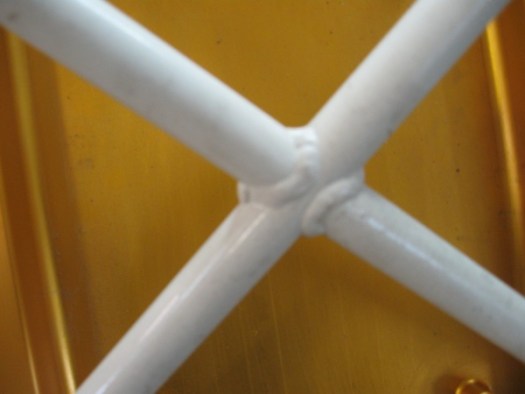
Not a perfect picture, but it gives an idea of what a MIG weld on thin wall 4130 looks like. This is done by a technique called “pulsing,” where the operator repeatedly taps the trigger to form the ringlets in the weld. Conventionally switched equipment didn’t like this pulsing; MIG welders since the early 1990s are not bothered by it. I don’t recommend that people new to welding try to use a MIG on their project. It is the wrong tool in the hands of a beginner. Most new people using them produce brittle welds by letting the puddle cool too fast. (You can slow this by using bigger beads and having more mass in the weld than the surrounding tubing area.)

Above, mock up engine sits on the mount so we can develop the special intake manifold for this installation. Thomas is planning on a Rotec or Ellison carb which will be mounted horizontally under the engine. I don’t view the Kitfox IV as a big untapped market, this may be the only installation we do. The project got one big step closer to being done, and I look forward to having Thomas among the Corvair flyers.
On the Internet you can find a steady stream of negative comments about me and my work with Corvairs from a vocal minority that have two common traits: they have never met me, and they have never assisted another builder in learning or achieving anything. While occasionally annoying, it doesn’t have much credibility. Any reasonable person can review my Web sites and find 100 stories much like Thomas DeBusk’s that define my work as a valuable contributor to real homebuilders. Do I deserve some special award for this? Yes, and I already have it….the real friendship of a great number of quality people like Thomas.
Blast from the past: Thomas at Corvair College #19. The caption below the photo is from the event in 2010.

Thomas DeBusk, above, with his very potent powerplant that will find a home on the front of his Kitfox Model IV. While it was running, we had a chuckle over the old wives’ tales that Corvairs are heavy engines that don’t make enough power. Thomas’ engine is the absolute upper limit of power for a Kitfox Model IV. Anyone who saw it in person would never question its performance potential in that airframe. The engine is a 3 liter with a Roy bearing, Falcon heads and a Reverse gold oil system.
Builders;
Here is a lot of mail on a number of different topics. Putting this together takes a few hours, and for a computer troglodyte like myself, they have to be quality hours of actually being awake, lest I hit the wrong key and evaporate an hour’s work. Builder mail is very important because it is a big part of giving my work feedback and focus. I have experience and perspectives, but many of the builders we work with have far greater accounts on both fronts. They are well worth listening to. I read all the mail carefully, and it fine tunes my picture of the Corvair movement. I spend a lot of the Colleges, Oshkosh and fly ins listening to builder’s perspectives because I, like everyone else, learned most of what I know by listening to, or reading the work of others. Even if I don’t initially see things the same way as a writer, I put real effort into following their line of thought. At Oshkosh every year I speak with a number of people who are very attached to an old wives’ tale or a piece of experience that doesn’t apply to Corvairs. I can tell that these people are not actually listening, they are just hearing enough to develop their next reply, a superficial debate move, not learning. I am not fond of this, and I put a lot of effort into not being “that guy” myself when I hear from people who see things differently.-ww
.
On the subject of cold weather operations,
601XL builder/flyer Dr. Gary Ray writes:
“William, When we installed my remote 4 line Oil Filter with the Sandwich for the Oil Cooler, we removed the original oil by-pass spring and valve from beneath the top block off top cover. Is this still the preferred set up? What is the effect on the oil circulation pattern (cold, hot)?
After reading this, I will definitely pre-heat every time.”
Dr. Ray,
Any time you have the sandwich adaptor in our system, you need to remove the stock cooler bypass. Its function is replaced by the bypass in the gold sandwich itself. With a flat block off plate on the side of the case where the stock cooler was mounted, the circulation pattern through the engine is retained with the sandwich. -ww
Merlin on Floats builder/flyer in Newfoundland Jeff Moores writes:
“Hi William, Thank you, thank you, thank you for your post on cold weather operation. Excellent information. As you know I have been operating my Corvair this winter and have been preheating before every start. It usually takes an hour minimum and I see it as a necessary part of winter flying. I usually spend the time inspecting the airplane, using the snowblower to clear the hangar doors or just having a lunch and a cup of tea. I’m in no rush….this is all for fun!!! The flight afterwards is well worth it. Before I start the engine I’ll also rotate the prop several times to help prevent a dry start. I don’t know where you find the time to write these posts but keep them coming!!!, Jeff ”
Note: More photos of Jeff flying Lotus floats directly off his snow covered lake in Newfoundland coming in an update in the next day or two. -ww
.
On the subject of Cylinder heads,
Pietenpol builder/pilot Kevin Purtee writes:
“Good points about the cost of heads, WW. When I originally built my motor (1999), many of the parts and processes you recommend were not yet available. With the rebuild, we included the basic upgrades that you’ve researched and developed to make a better motor: 2nd generation Dan bearing, gold oil system, MP heads. I’ve followed your work since 1999 and have flown behind your motor for over 300 hours, I’d remind folks to not save on the wrong end. Kevin.”
.
On the subject of “Calling all Zenvairs”,
601XL builder/flyer Lynn Dingfelder writes:
“William, I’m interested in your offer regarding flying in to Sun-N-Fun in my ZenVair 601, though perhaps I’m responding too late. I have uncertainty about being able to depart my home field in early April, due to potentially soft turf. Only the coming of spring here in snow country will answer that concern. I’ve done some initial flight planning, and am excited about the possibility of making this journey. Please let me know if your display openings are all spoken for.
Thanks, Lynn Dingfelder”
Lynn, we still have space in the Zenith booth, we will be glad to have you on hand at Sun ‘N Fun-ww
.
On the subject of Oil Systems,
Land based Corvair guru Bob Helt writes:
“Hi William, You said the following in a recent posting: ‘If you would like to read the whole report, it is on flycorvair.com, search “2003 oil system test” in the search block on the bottom of the main page.’ I can’t seem to be able to locate the original test report. I keep getting the summary where I found the statement. Could you please point me to a copy of the original report. Thanks, Regards, Bob.”
On the subject of numbering systems,
601XL builder Oscar Zuniga writes:
“William: Please stop the world so I can catch up! I’ve been away from the flycorvair.net site for a few weeks since I’m buried with academic work, and I come back to see what’s up only to find a rich treasure of posts about building, choices, and costs, with a numbering system to track it all. Please tell me that this will be organized and published as its own book, manual, or supplement on Flycorvair.com? It’s worth what a builder will save in mis-spent money… and that can be a lot! Please consider publishing it as a separate resource for manual owners and builders.-Oscar”
Oscar, I Chose the title “Getting started in 2013” because that is the goal, to have the people who have hesitated to get started understand that this is the year, there is nothing to be gained by daydreaming another season away. The notes are to give these people a clearer picture of their personal path to success. I have a lot of the stuff written in great detail, but for right now I want to give builders a large overview; we will come back and look at every detail later.-ww
On Part #11, 3,000 cc Waiex builder Greg Crouchley writes:
“Amen. And thanks for continually striving to point this out. The life you save next might be mine.Best regards, Greg”
Builder Henry Vickers writes:
“In looking over your Web page, I note that you have put some supplies in a group – in particular 2775 and 2850. Are those prices firm or just proposed prices? Thank you”
Henry, the 2,850 price is our regular retail on that kit. We have sold about 30 of them. The 2,775 is just proposed, but since it is made of parts from the same suppliers, the estimated price is accurate, but the pistons are yet to be made.-ww
On “Part #14”, Builder “Jacksno” writes:
“CH-750 + 2850 is my main plan. I’m interested in hearing from others who may have used floats and 2 up (about 350# worth of meat). Plenty of fun on wheels to be had and I could drop this romantic notion without much fuss. Or if the notion remains stubbornly in place, elect to go the extra expense of the 3000 if that would make the difference in torque I imagine would be necessary to water operations. Are there others out there with float experience with 2850, 2 up? Or take the big step up to 3000 or fogeddaboudit? Thanks!”
We don’t have anyone who has flown a 750 on floats yet. From land based performance reports of the 2,850s and 3,000 cc on the 750 I have little doubt that either one would pull two people off the water in a 750-ww
Builder Douglas Cooke writes:
“Hello William, I have a 1964 engine/heads that has been disassembled and cleaned and a standard grind nitrided crank. I have the new piston/rod assemblies, rings, and the .060 Clark’s full fin cylinders to make it into a “sixty over” engine. I do plan to use mogas as much as possible (my home airport has 93 oct mogas). I don’t see the engine getting built this year, so going with your “2775″ engine seems to make sense as it would give better quench for more reliable detonation resistance and possibly a couple more horses than my current parts would. Might you offer a trade-in of my “brand new” (but about 5 years old) Sealed Power and Hastings “Sixty over” parts for the “2775″ parts, or maybe I should get my cylinders bored another .045 and go with a 2850? (I don’t quite know what airframe the engine will be going into). I am on a tight budget, but would be willing to spend a couple hundred or so more for a little more power, and most definitely I’d spend it for better detonation resistance/reliability. Thanks, Douglas Cooke”
Douglas, your motivation to build the best engine you can sounds like common sense to me. Since you already have the full fin cylinders, it would make the most sense to go for a 2,850 cc upgrade when the time is right. Your .060″ pistons will find a buyer with little trouble, they are still popular.-ww
On “Part #15”, Piet Builder/ATP/USMC Terry Hand writes:
“William, Count me in on the 2,775 cc pistons. I am still building my Pietenpol, so I am not in a rush necessarily to build my engine. Aviation is a lot like Medicine. For example, if you can hold off having a medical procedure done, the medical technology advances makes it better. The neck surgery I had done a year ago was a 1 and 1/2 hour outpatient procedure. 15 years ago it involved a week stay in the hospital with part of the time in ICU. Aviation advances in much the same way. I can’t wait to see the technology improvement in these pistons! Thanks to you and Mark for your work on these pistons.”
Terry, I consider the Corvair to be fully developed, with only detail improvements and small parts like the 2775 stuff as “mopping up” projects. The largest part of my efforts in the next two years will be improving the accessibility to the engine for first time builders. The new numbering system is the root of this. Having good stuff comes first, and we have that down, and proven with years of service. Now the focus is on motivating people to become builders and use the parts and information we painstakingly developed in the past 20 years.-ww
On Part #15 Builder Bruce Culver writes:
“This is a terrific idea, because if the folks working with the stock cylinders can get the detonation-resistant cylinder-head design, that makes operating these engines safer and improves reliability. Such a deal. You don’t see this sort of thing in most of aviation, or most other activities for that matter. Congratulations on working for us, no matter how we plan to build our engines. Of course, that beautiful billet crank from Dan is still calling my name – maybe for a 2850……William, I forgot to mention my choice of the Corvair….. Although I am thinking of the 2850cc engine, I originally looked at the Corvair as an affordable alternative to certified engines, as in, I can afford a Corvair if I build it and then I can fly. I can’t afford a new or even refurbished certified engine, so that way I can’t fly. I was a loggie (logistics analyst) for 25 years in the defense industry. Our watch word was “life cycle cost” – the total cost of acquiring, operating and maintaining an item. As you are well aware, with the Corvair, we could completely rebuild an engine with all new parts for little more than the cost of the valves in a certified engine. I have never considered any other engine than the Corvair ever since I attended your presentations at Sun ‘N Fun a number of years ago. To me, knowing the engine – its guts, and what makes it work – is more valuable than any engine I could buy, even if I had the budget. That’s why I’m here.”
On Part #17 Buttercup Builder Daniel Kelley writes:
“William, Clark’s Corvair OT-10 and ordering assembled they seem to want to use a single part number. Clark’s (www.corvair.com) sells the stock cam gear or the Failsafe gear as separate parts or you can have them mount the gear you choose on your choice of OT-10 cam (new or regrind) with a new key and thrust washer http://www.corvair.com/user-cgi/catalog.cgi function=goto&catalog=SPECIALTY§ion=OTTO&page=OTTO-8“
On the subject of “Getting Started Pt.#19”, 750 builder Charlie Redditt writes:
“Reminds me of saying ‘There is hardly anything in the world that someone cannot make a little worse and sell a little cheaper, and the people who consider price alone are that person’s lawful prey.’ Of course, most of your posts remind me of that saying, but this one particularly so. The irony is, of course, that Corvairs ARE the best deal for the money. It just requires a bit of self-education to realize this.”
Builder and International Man of Adventure Tom Graziano writes:
“William, Having flown in some of the most remote and inhospitable places on earth and having seen the consequences of various failures, there is no question that reliability should secure the #1 spot on the list for us aviators. (Interesting how safety and reliability so often go hand-in-hand.) Fortunately, we homebuilders and our experimentation and quest for a better mousetrap have led to much innovation and advancement. Unfortunately, there are those of our clan who have their minds made up and don’t want to be confused with the facts nor schooled about that which has already been thoroughly tried and discarded such as carbs, 5th bearings, fuel hoses/fittings, crash resistant fuel tanks, and such. The results are too often bad publicity from the ensuing accident or incident. I really wish homebuilders would put more thought and money into safety of flight vs. convenience of flight or the coolness factor.
I am really enjoying these Getting Started articles! Keep ’em coming! Tom”
601XL builder/flyer Dr. Gary Ray writes:
“Hi William, I am enjoying the new ultra-organized presentation of options for building the Corvair engines. I think this simplifies and clarifies the thought process for builders. Matching their engine requirements for a best fit to the projects is easier and provides a comparison of price/performance. This also lists all of the required parts, services, and timelines that need to be considered for the build. I am becoming inspired to start a new engine build just so I can have some of the fun. This is a really good idea and possibly should include all of the FWF item choices that you offer. Most kits do not include help forward of the firewall. As an earlier builder, one of the reasons that I chose the Corvair was the fact that you were building the same aircraft and I would benefit from going to school on your expertise on FWF systems design. Thanks to your efforts, I know a lot more now and I have avoided countless mistakes, possibly some that saved my life. I am sure this applies equally well to others building in the void between airports.
Thanks, Gary Ray”
.
On the subject of 150,000 page reads,
601XL builder/flyer Phil Maxson writes:
“Your readership may be even higher. I read this blog on email frequently and don’t hit the site directly. My “hits” may not be included in your numbers.”
601XL builder Becky Shipman writes:
“Congrats on your 150,000 page reads. FYI, I generally notice your e-mails on my work computer, which feels that Flycorvair.net is a dangerous site and won’t let me go there. So I read the e-mail but don’t go to the site. So it’s probably a little higher than 150,000 – I may not be the only one. Take care, Becky Shipman”
On the subject of “The JAG-2 Twin Corvair”,
Builder Allen Oliver writes:
“My interest was piqued by your first mention of the JAG-2, so I went over to the Web site before you posted the details of his project. I was frankly impressed at the scope of the work and the thoughtfulness behind his design. I tend to think of it as an 80% Piper Apache.”
Piet builder Bob Dewenter writes:
“Cooler than cool!”
601XL builder/flyer Rodger Pritchard writes:
“William, Thank you for keeping us posted on what people are doing. I had a smile almost the size of the one I get flying my ac just reading about Jim’s design and build. I hope to see it at Oshkosh someday.
Roger Pritchard, N20RB Zenith/Corvair, 106 hours on engine 97 on airframe”
Builder Dan Branstrom writes:
“This is neat, and obviously a labor of love.”
750 builder Charlie Redditt writes:
“Über kewl! A real-live Corvair twin!
I’ve also come across this on the web:
http://www.zenithair.com/gemini/gem-what.htm
but it doesn’t seem to exist quite yet. Spec’d for 80hp jaibaru, but I assume anything that would take a jaibaru could also take a Corvair.”
Charlie, the Gemini is an old project, it flew for many years, it is still out in Mexico MO. Chris Heintz was interested in an updated version based on XL stuff in 2004 when we first had our XL flying. I mentioned to him that Corvairs can be built in both L and R rotation, and were comparatively very cheap compared to Rotaxes or Jabarus. He was interested, but he was already looking forward to retirement in France.-ww
On the subject of “The case of the Murphy Rebel”,
Builder and International Man of Adventure Tom Graziano writes:
“William, Good post. I take it ‘common sense’ is naysayer code for ‘insufficient research’? Whoever stated that about the Corvair and smaller props is misinformed and definitely doesn’t ‘get it.’ (For a few bucks the guy could get a copy of Jack Norris’ book on propellers and, if he read it, maybe he’d get it then, but I don’t hold out much hope in that regard.) Then again, most naysayers don’t want to ‘get it’ and they’re content rolling around in the muck of old wives’ tales and ‘don’t-confuse-me-with-the-facts’ tradition. All the best, Tom
P.S – anyone interested in what a well-designed prop looks like should take a look at the laminated prop example on the http://www.jcpropellerdesign.com/ web page.”
Builder “Jacksno” writes:
“Thanks for the intro to prop theory/practice! Especially interesting was thinking about too much pitch, the excess angle of attack leading to the blades stalling out – maybe they are still pushing wind back over flight surfaces, but no lift component when stalled, reducing forward energy. None of us can be surprised when we discover that people’s opinions are more precious to them than truth – a function of false pride and ego. Out here in the country, it’s called ‘ignorant.’ The meaning thereof is that the individual in question refuses to seek the true facts on purpose. Just my .02, I suggest you ignore them, but please keep on educating us!”
601XL builder and PhD engineer Becky Shipman writes:
“Almost everything we use that is manufactured is made by trying to optimize multiple factors. The one described here is relatively simple – props have performance that depends on things like length, RPM, pitch, shape, etc. Engines have torque and HP curves, and other factors that affect reliability. I think if you look at historical development of engines and props, much of the relevant info has been understood for at least 50 years. Thank you for elevating the debate by pitting 1960′s engineering versus ‘black magic’ and winning. Almost every design that works was done with some forethought by folks who knew what they were doing. Before changing it, it’s vital to take the time to understand why they did what they did, and then what might be different in the current situation. If you take a tractor transmission, driving big wheels with a diesel engine, and put it on a car with a 4-cylinder turbocharged engine and 14″ wheels, would you expect the optimum rear end ratio to be the same? Apparently our Murphy Rebel commentator would. (Probably not exactly the right analogy, but I bet someone who knows more about cars and airplanes could come up with a funny and relevant variation on this.) Sadly this happens in many fields other than aeronautics. For example, I carry around dimensionless heat transfer graphs from Carlsaw and Jaeger which were developed in 1906. I can settle arguments more than 100 years later by referring to these graphs and taking a few simple measurements with a thermocouple and a stopwatch.Thanks for a thoughtful post.”
.
On the topic of “2,500 words on aircraft Finishes”
Builder Steve Dawson writes:
“Hi William, I was employed in EAA’s shops & knew Jack Cox. I also volunteered as an antique judge after my employment there. Finding your article quite interesting and tending to agree, I must say, ‘if’ Jack Cox was naive, he also edited the magazine which did build the movement for many years. This alone made him one of grassroots aviation’s greatest advocates. I flew a Vag., which had Colt wings, tanks, & struts for many years. It would carry anything, passenger, full tanks and all up to the Rockies. Yours is giving me nostalgia, etc…………………”
Steve, I spent little time with Jack Cox, but I read virtually ever article he wrote for the EAA. To me the best thing that Jack did was his own personal magazine, “The Sportsman Pilot.” It was a pretty good demonstration of his personal work aside from the EAA’s agenda.-ww
Builder Dan Branstrom writes:
“Hi Grace Ellen & William, The EAA sent out a request for feedback. I answered all of the multiple choice questions, but, at the end, after thinking it over for some days, this is what I put in the comments section:
The articles in Sport Aviation on hints to homebuilders, building techniques, and theory are too short. They need to cover those topics in more depth. I’m sorry, but while it is good to strive for professional writers and people with experience, too much of the orientation is becoming tilted towards general aviation, as well as flashy builds. Unfortunately, there isn’t enough orientation on the part of Sport Aviation that emphasizes form following function in the articles. Burt Rutan’s original homebuilts were built for performance, not beauty. He built them for lightness, efficiency, and speedy construction, not beauty. Those qualities need to be emphasized more.
Flashy paint jobs with airbrushed graphics are OK occasionally, but none of that helps an airplane fly any better, but often adds weight and work to a homebuilt aircraft. It also discourages people who are building, because they end up spending time on flash instead of flying because they think that is the standard they must build towards. If Burt Rutan built his designs that way, he probably would have had only about 1/2 or less of his designs fly. Another item that threatens the whole experimental aviation movement is the hired guns that turn out award-winning experimental airplanes. We all know they’re out there, and when, not if they are exposed, it will damage the EAA, as well as all of the homebuilders that hew to the rules. The recent rule changes only put them into a more stealthy mode. While I can appreciate J. Mac McClellen’s expertise in instrument flying was great in Flying magazine, but this is NOT Flying. I hope that he starts to change his orientation to more grassroots aviation.
I also object to having Jack Pelton heading up the EAA, particularly since he made the decision to construct the Cessna Skycatcher in China. The issues of technology transfer and lack of Chinese respect for copyright and patent protection obviously weren’t a consideration in the decision. I do not state that lightly, because, as the son of missionaries to China, I love and respect the Chinese people, but do not respect the mendacity of their government nor the way in which it operates. The Chinese government was, I surmise, a large party in the negotiations.”
On the subject of Expert witnesses:
Note: After I wrote the story above, my friend Tom Graziano wrote me a letter defending the work of Harry Riblett. Tom said he had known Riblett and he feels the man’s goals were to inform and educate people about airfoils, and that Riblett had little control over what lawyers did with his data. He said Riblett was probably extreme in his statements for shock value to try to get the complacent to awaken and he didn’t think Riblett should be painted with the same brush.-ww
Jon Ross writes:
“Dear William: I salute your courage in stating these facts, and let me just say that I have had dealings with all three men which has led me to the same conclusions that you have arrived at. There are a few out there in aviation that ‘fly under false colors’ just as these three have.Very warm regards, JR”
Builder Dan Branstrom writes:
“I remember Burt Rutan in a seminar, holding up a dime and saying, ‘This is 10 cents more than any attorney will ever get out of me in a lawsuit.’ They never did. He probably spent far more money, and a lot of his valuable time, fighting lawsuits than it would have cost to settle, but he never lost, and I’d guess that he probably had some sleepless nights worrying about them.”
Builder Sonny Webster writes:
“Following the money trail and the hidden agendas which motivate actions always leads to the place in which truth is rooted. Your stories provide three additional reasons that rational minded, independent thinkers become cynical.”
Sonny, 98% of the people we have met in aviation have been really good people, not infallible, just regular people working hard to do something very extraordinary with their lives. Don’t let anything I say make you cynical of the big picture of building and flying. -ww
Builder Ned Lowerre writes:
“William I couldn’t agree more with your disdain for the tort legal system. Recently I was involved in an auto accident that totalled the car, deployed three air bags, and left me with a concussion and a sore body. I was not allowed drive or fly for several weeks, my primary methods of commuting, and therefore was not allowed to go to work. It cost me a couple of weeks work and pay as well as the cost of a new automobile. The fellow that hit me was in his mid 70s going to visit his wife’s grave site. He rolled a stop sign and accelerated across a posted 65MPH roadway which I happened to be on. After the accident I had attorneys contact me about suing the driver, suing the auto manufacturer, even suing my employer since I was legally on duty.
The reality was a person made a mistake. We will all make mistakes in our lives and some of them may hurt others. If our first response is how do I make money off this at someone else’s expense, than something is very wrong with our society. The eventual outcome will be a society where no activity with a risk of mental or physical injury will be allowed. Once we are painted into that little box the only flying someone in my income category will be allowed to do will be on a computer screen. What a shame!
Ned Lowerre”
……..
Builders,
I am up in the shop this morning at 7am finishing some small tasks that I left on the bench when I turned the lights off at 2 am. We are running some prop tests, as we will have Standard conditions (59F, 29.92 pressure) for a while this morning. Later on today I am driving to South Carolina for a family event and I will be back late night Wednesday. I probably will not have a chance to look at e-mail, but we will cover anything that comes in when I get back.
From that point, we are going to have solid work leading up to the College and Sun n Fun. I will have an update on College #25 by the end of this week. If you are one of the builders planning on making progress at this event, the time is now to line up your plan. Dan told me yesterday that he just got a big batch of 5th bearings, and there may still be time to process gen 2 bearing set ups and cranks before the college. For more info on this, go back and read “Getting started in 2013, part #1”-ww
Builders.
There has recently been some discussion on the net about people flying Corvairs in cold weather. Specifically some builders were concerned that you have to warm up the engine for an extended period, and people were wondering if this could be shortened by having a thermostat of some sort. Some of the tone of the conversation suggested that these were conditions that might never have been encountered before of something I was never involved in testing. Neither of these assumptions are true. I have long known every detail of the Corvairs oil system, and it application to flight engines in great detail. Anyone who would like to learn more on this can write me with any question, review the sample of data taken off our website, or they can come to any college. Asking questions on the internet and sorting through various replies is not as efficient use of time if your goal is to build, finish and fly your plane. If you would like to hear a variety of opinions from people whose data is derived from zero to one Corvair engines, ask the net. If you would like to learn facts from years of testing, ask me. It’s your time and your engine, you decide how to spend it.
First of all, the Corvair has an outstanding oil system. Think of how few core engines ever seen have any kind of damage inside, in spite of having 100,000 miles on 1960s quality oil and few changes in the last years of automotive operation. The work we have done to develop flight oil systems in evolutionary on top of this foundation. If you would like an overview of oil systems, read the link just below. Note it is from our website nearly six years ago. Still think there is an aspect of the oil system I don’t know? You are probably going to change your mind by the end of this story.
When you start a Corvair below freezing, you want to make sure that it is getting oil to the bearings. This is accomplished by having an oil cooler bypass and having thin enough oil for the bearing clearance. The issue that some people are concerned with is that it takes a Corvair or a lycoming for that matter, 6-9 minutes at an outside temp of 25F to get the oil up to 140F. How fast the temp comes up is not a real issue to the engine, but having circulation is vital to not hurting your engine.
Oil clearance; An engine that has .002″ main bearing clearance at room temp will have less at 25F. Why? Because the case is aluminum and it contracts more than the steel crank. This is a function of diameter. The bigger the diameter, the more starting clearance is required for very cold weather operations. This has been long known and understood in aviation. If you were told that German Aircraft engines didn’t start at -20F on the eastern front because of paraffin based oil, you were largely told a myth. A much bigger factor was bearing clearance. The Russians understood reliability in the field. The German fascination with precision clearances worked against them. This isn’t an internet story, one of the first people I ever worked for was named Verner Haberman, and he knew the story from personal experience in 1943.

Above, My 5th bearing running in our front yard in 2008. This is the same design that flew 450 hours on Mark Langford’s KR-2s. Just like a Lycoming thrust bearing, there is no ‘bearing’ in my design. The crank rides directly on the case material. The bore diameter is 3.375″. This makes it more susceptible to temp. growth/contraction issues, but any combination of Aluminum case, steel crank is going to face this in proportion to its size. Lycoming works with a lot of room temp clearance, but at a certain OAT, you have to pre heat the engine to prevent it from having no clearance on start up.
.
To explain why testing is important, let me relate a 2009 story: At this point Mark Langford is flight testing our 5th bearing. We don’t sell things that are not tested, and Mark offered to do this work for us. We set up the bearing housing and the crank at a very tight clearance, with a nod toward seeing if we could keep it tight after the system was at operating temps. The target was .001 to .0015″ clearance. (I chose this number, not Mark.) I had neglected to consider the lesson of Mr. Haberman. One morning when Mark had about 75 hours on the bearing he went outside to start his engine at 25F with no pre-heat. It ran for 30 seconds or so and came to a halt, locked up tight. The engine had 20w-50 oil in it, but I don’t think that was the main issue, it was the clearance. The engine had done fine through the fall, but it reached it’s limit at 25F.
OK, Why will a Corvair car with .0015″ main bearing clearance start at 25F without issue? Because the mains on the engine are 2.0″ in diameter, and my 3.375″ 5th bearing was subjected to different amount of expansion and contraction. On any Corvair flight engine, the 5th bearing is going to be the clearance issue. Roy’s bearing is 3.0″ diameter and Dan’s is 3.25″. It isn’t just the size that matters, it is the starting clearance also. Dan shoots for .0007 to .001″ clearance per inch of diameter. This is why Dan’s bearings require a High Volume pump. When they are hot, the extra clearance will drop the idling oil pressure with a stock pump. Dan didn’t make up this idea himself, he is following the bearing manufacturers specs. You could probably start Dan’s set up down to zero F without issue.
Roy tends to run his bearing tighter than Dan’s. This is why few of Roy’s bearings need a high volume pump to maintain 20 psi as a hot idling oil pressure. The opposite side of this is that people using that design need to ask Roy about the minimum OAT for a cold start without a pre-heat.
On round two with my bearing on Mark’s plane, we polished the crank, and then rebored the bearing for .002-.0025″ clearance. This was the final number after the bearing was ceramic coated. Mark went on to fly the design 350 more hours through several seasons without issue. Again, no bearing design is immune to this, it is a consideration on all of them. You can lower the range by using thinner oil, but all the tight clearance bearings need to be preheated at some point. If you would like to read both Lycoming and Contenintal’s info on why the both require hours of pre-heat below 20F, read the articles at this link: http://www.reiffpreheat.com/Articles.htm
These Articles discuss the relationship to the oil pressure indicating if the engine is ready to be operated. On a Contenintal, you can use full power with oil at 100F, But, the engine must not have excessive oil pressure, caused by the relief valve not being able to bypass cold oil fast enough. If you have a High volume housing and pump from us, I have machined this port larger for you. This is in the photo below, indicated by the drill bit.
Lets’ say its 35 degrees out and you start your Corvair. If your normal oil pressure regulates at 45 psi, then you will undoubtedly see the oil pressure exceed this, even with an enlarged bypass. You may see as much as 75 psi. Do not rev the engine up, let it idle. In a few minutes the engine will warm up the oil enough to bring the oil pressure down. What you are watching for is the point where you can do the run up on the aircraft and have the oil pressure regulate normally, at no more than 10psi above its normal regulated pressure. This will likely happen when the engine oil reaches 140-150F. If this takes a long time with 15w40 Rotella, you are fully invited to switch to 5W-30 Amsoil, and it will happen a lot faster. With Rotella, this may take 6-8 minutes. If this isn’t fast enough for you, let me ask what is the hurry?
The Corvairs requirements are no different from Lycoming nor Contenintal’s. Go to your FBO and tell them that you are going to rent one of their planes, but you are unwilling to warm the plane up for 10 minutes if required, because you’re a busy guy, and your time is so important. Watch how fast they slam the door in your face. They own that engine, they don’t want it damaged, and they don’t want people who disregard manufacturers instructions near them. Your Corvair is your own masterpiece, treat it at least as well as student pilots at the FBO treat the rental equipment.
Why not get a thermostat? This will allow me to take off in 3 minutes instead of six, right? OK, for some background, go to google and search the words “Lycoming Flyer Operations” and get a look at pages 66-69. This gives a beginning description of systems that have a bypass like the Corvair and half of Lycomings, and systems that have a ‘Vernatherm’ (Lycomings term for an oil thermostat.) If anyone wants to debate that an oil bypass system allows the engine to warm up faster, realize that I have Lycoming and all their official publications on my side of the discussion. It does some of the same task as a thermostat in a simpler, smaller more reliable way. Second, know that many Lycomings run 50 weight oil, and they need this system more than a Corvair with thinner oil. A thermostat is something that is only going to operate on your plane for the few minutes until the oil reaches 180F on a cold day. For 98 out of 100 hours a year, it is going to be open and doing nothing more than what the bypass does. Does this justify the added complexity and fittings? Should you just have the oil system set up for how it is going to run 98% of the time, with the most simple system that can accomplish this?
OK, let’s get this point fixed in everyone’s mind: They made 1.8 million Corvairs If they made on 70,000 miles each and drove this at a 35 mph average, then each car made 2,000 hours on average, which means the fleet made it to 3.6 Billion hours of operation. If only 5% of the operation was done below 32 degrees as a starting temp, I would be stunned, but lets use that as a conservative number. That means 180 Million hours of operations we done under these conditions. Was every one of these engines carefully pre-heated? Was every start up held for 10 minutes until the oil was at 140 degrees? Was any of these hours logged with quality oil? Of course not.
The system we use on Corvairs is identical to the system used in cars. There is going to be a car guy who writes me to say that cars had thermostatic damper doors on the bottom of the car, and that they did something to regulate the speed that the car warmed up the oil. To this, I am going to point out that I firmly believe that most car owners waited less than 15 seconds after the car started to put it in gear as a habit. No system, damper doors or not, was having an effect at that point. Today the only people who own Corvair cars are people who love and respect them, and warm them up slowly. Trust me, the last guy to drive your core engine in the winter of 1979, didn’t treat it according to the owner’s manual in the glove box, and the damper doors were long since gone on your core engine. Below are some samples of stories from our webpage. The captions are the original ones with the year added in front. I put them in blue italics to show what we were speaking of at the time. The black notes are my comments today. If you still think that someone this week on the net is going to ‘discover’ something about the engines oil system I have not considered, read on and note the years.

(2007) The Corvair has an outstanding oil system. Builders are disassembling hundreds of core motors a year. These come from cars that have been sitting for many years. Most of these cars never received an oil change the last two or three years of their lives. They were continuously run low on oil and beaten like dogs. Yet just about every builder is rewarded with a crank that can be polished, or have a simple .010/.010 regrind. This is all the evidence you need to appreciate the quality of the GM design. Just like the Doctor’s Oath, your first vow is to do no harm. Many modifications that inexperienced builders propose are a serious reduction on the Corvair’s reliable oil system. Until I understood the operation of the system, I too took detours. My Pietenpol was the first Corvair to fly with a rear starter. It used a 3-hose oil system, an arrangement I now consider a mistake. Read the information here carefully, and you’ll avoid repeating missteps people have already paid for.
All Corvair engines need an oil filter, oil cooler, filter bypass and cooler bypass. The above photo shows two pencils pointing at the Corvair’s stock bypasses. The one in the rear case is the cooler bypass, and the one in the top cover is the filter bypass. They’re both set to open at 7 psi (they’re the same part). You can read all about my testing of oil accessory cases and the specific rig we built to do this on our Web site. Systems without bypasses, particularly cooler bypasses, will starve the engine for oil. Five years ago, we tested filters and coolers by packing them in ice to simulate a start at 32F. The cooler bypassed for more than 10 minutes, whereas a filter packed in ice only developed a 2 psi differential. Coolers without bypasses can cause massive restrictions in oil flow. If your pressure sending unit occurs before the cooler, you’ll have no idea that the pressure to the bearings is dropping on every start.

(2008) Above are two views of the optional Gold HP Oil Cooler Bypass. It is often referred to as a Sandwich Adapter because when installed, it’s sandwiched between the Gold Oil Filter Housing and the oil filter. It’s held in place by a very accurately machined, hollow mounting bolt. It can be installed on the Gold Oil Filter Housing in literally one minute. It includes a square o-ring gasket, held in place in a deep recess. The AN-6 fittings for the lines to and from the cooler can be clocked in any position. It contains an all metal cooler bypass featuring a precision spring manufactured by the nation’s foremost supplier of aerospace springs. On a normal start cycle, the cool oil in the cooler will produce a pressure drop in excess of 7 psi. Any time this is so, this bypass valve senses the pressure differential and allows the oil to bypass the cooler, greatly speeding up the elapsed time until the oil reaches 150F.

The drill bit is pointing to the pressure regulator bypass hole. It has to be opened up when you install a high volume pump. Otherwise the pressure will be very high until the oil temp is thoroughly warmed up. The enlarged hole allows the bypass to work with cold thick oil. Without enlarging this hole it might take 15 minutes of running on the ground on a 40 F day before the oil settled down to its normal regulated pressure. Before this, an increase in rpm will raise the oil pressure. On very cold start ups you want to watch this, because even with the hole enlarged it is possible to have the oil pressure exceed 80 pounds by carelessly revving the engine to taxi it while the oil is still cold. Give the engine a chance to warm up, don’t be in a rush. Oil pressure spikes are very rough on the drive system running the pump. This is true of almost all engines, not just Corvairs. People don’t talk about ideas like this with the buy-it-in–a-box imported engines because they just wanted to buy something and use it. Since the primary motivation with Corvair builders is to learn while creating, we talk about things. Most people are happy to just have things, people attracted to the Corvair were the ones who took apart the toaster at age 10, because for some of us, we need to know why.
Below is a series of photos of oil testing. This is on our website. It is 10 years old this month. Get a good look, no one notices this but there are beers cooling in the bucket next to the oil cooler. Testing is a tough job, but I was willing to do it.

I am bigger fan of Mich than Becks Dark. Oil cooler is in bucket. Bypass stayed open with a 7psi differential or more until the water in the bucket hit more than 130F. Beer as long gone before then. If somebody would like to differ with me on oil systems, that’s fine, but unless they have 10-year-old test photos, it’s going to be their guess vs my test.

Above, look at the instrumentation, were we have probes on both inlet and outlet lines to compare the differential. The engine in the photo is the original Skycoupe 2,700 cc power plant. Note that the stock oil filter is being cold soaked to measure the differential pressure with 32 degree oil. It was only 2 psi.

Above, the gauge pack and the digital tack on the idling engine. If you would like to read the whole report, it is on flycorvair.com, search “2003 oil system test” in the search block on the bottom of the main page. It has been there for a decade, for any one with an open mind who wants to learn. For those that like their theory more, and would like to suggest that I don’t know what I am speaking about, have a good time. When I first wrote the report, I had people say the same things at the time. In the last 10 years we have done a tremendous amount of work, helped countless builders, held 24 colleges and had many great adventures. without exception, the critics of 2003 did nothing. They are still out there, telling people what they will do some day. 2013, is no different, some people will listen to the internet critics of today and be dissuaded from doing anything this year. Decide tonight if your place will be with the builders or the critics. Decide carefully, one path leads to a flying plane and great adventures in the company of people of good people. The other leads to reading about an endless series of ‘problems’ which will be ‘discovered’ without fail by internet critics on 2 week intervals for the rest of your life.-ww
Builders,
There is a lot of small detailed information that goes into heads. But first, it is good to look at the big picture. What kind of heads do you want? From a practical perspective, the top of the line are FalconMachine.net’s heads. This is the product of “Mark from Falcon” or “Mark Petz” Or “M.P.” You could actually use Mark’s legal last name Petniunas. I have known Mark for about 10 years and I barely know how to spell his last name, and I know 5 ways to mispronounce it. Linguistics aside, they guy knows Corvair flight heads like no one else, he has produced well over 100 pairs of magnificent heads, and the work is beyond reproach. If you send him your cores, he will rework them, including welding on the intake pipes, for $1,270. Theoretically you could spend more elsewhere, but you can’t find better work.
Is $1,270 a lot? Consider this: A guy with an O-200 buying 4 cylinder assemblies is going to spend about $3,800. If you add the cost of a set of 2700 cc forged pistons and rings and rebored cylinders to the cost of the heads, you end up with an apples to apples comparison of $3,800 to the Corvair’s price of $1,965. Yes, the top half of a Corvair, built with the finest stuff, costs 52% of the same parts for an O-200. Even the top half of a 3,000 cc Corvair is only 82% of the cost of putting a top end on a Continental. (BTW, the 65 hp Continentals cost the same.)
Every time I show math like this at an Oshkosh forum, some guy will hold up his hand and say “There is an O-200 in the flymart for $5,000, and I’ll bet it is just as good as a $7,500 Corvair, and I won’t have to build it.” … Where do I start? First, if a person’s goal is to not have to build things, than what are they looking at experimental aircraft for? I like most things about O-200s except for the new owners of Continental (the communist Chinese), but the chances that the example in the flymart possesses and will demonstrate all of the qualities associated with the design are very low. Note the guy’s words carefully: “I’ll Bet”. If you are new to aviation, you might think that the man’s wager is $5,000. Heck, the guy saying this probably thinks that is what he has riding on his guess of wishful thinking. In reality, he is actually wagering far more; in escalating order of importance, the $5,000, his airframe, his safety, and his passengers’ safety. It is a lot to bet on a guess that your flymart engine has good internals.
There are two types of mindsets at work here: The flymart buyer is inherently lazy, and he doesn’t want to know what’s inside his engine. For him ignorance is bliss. On the other hand, if you are the kind of builder who wants to know what you’re doing, what you have and can count on, and where you stand, then you are always going to choose to count on your own learning and craftsmanship. You are not going to have to “bet,” you know what you have, and this is bliss to thinking people.

Above, Mark stands with his $38K Dynamometer in his shop Outside Madison WI. Note race car in background. No one should take fashion advice from this man, but is commentary on Cylinder heads is followed by many motor heads.
.
The lowest cost short block with a 5th bearing we looked at in the chart was an Allen Able with 2700 cc cylinders, the AA-1 engine configuration. This cost $3,057. Add a set of Falcon heads and you are looking at $4,357. This is not a complete engine, but it is well past the halfway point and any builder getting this far already knows a lot more about aircraft engines than he did going in. The most important point: Such an engine is not made of worn parts or salvaged stuff like a flymart engine. Such an engine isn’t even how Corvairs have typically been built in years past. This is a first class engine with a 5th bearing, nitrided crank, ARP rod bolts, forged pistons, stainless valves, an excellent cam, new lifters, bearings seals and gaskets. This is something very real and high quality, produced by a set of hands and a mind that will be the master of the machine, not its servant nor victim.
The most expensive long block on the chart is the Davie Dog 3,000 cc engine, the DD-5. Adding a set of Falcon heads to its price brings the total to $7740. That isn’t cheap, but for that price you are putting together some very fine metal. I am pretty sure no other popular alternative engine has a U.S. made crankshaft in it. Think that one over for a minute. We were the country that invented powered flight, flew the Atlantic, finished WWII with it and then went to the moon, and today, the selection of non-certified engines at Oshkosh is almost exclusively made elsewhere. When did that become OK? Yes, virtually every VW engine sold in the past 20 years has had a Chinese crank in it. Jab, Rotax, UL, and Honda based engines are all made by people far away. I have never owned an imported car in my life, and I don’t have any desire to own an imported motor in any airplane I am building. That said, I think I can effectively demonstrate to any person with an open mind that there are very good mechanical reasons and a long proven history behind the Corvair that make it the engine of choice even for a person who didn’t care where it was made.
If you search the words “Falcon Heads” in the search box of our main page, www.Flycorvair.com, you will find many long stories describing them in detail. In the past few years there have been only small refinements in Mark’s heads. Every set now comes with the previously optional exhaust rotators, and the final machine work on the seats is now done on ultra expensive state of the art machinery. Other than theses touches, it’s much the same. As a builder, do you have to have Falcon heads? No, but learn two lessons from others without paying for the education personally. First, I have seen a number of people drop $750 for trash work and junk valves thinking they saved $500 over Mark’s price. In some cases they just flushed $750 and had their core heads mortally wounded in the process. They didn’t save anything, they lost. Second, a great number of people who started out with local machine shop heads later converted to Falcon heads. It you are going to get there eventually, it’s less expensive to draw a straight line to the destination rather than having a several hundred dollar way point. -ww
Head group (1500)
1500- Pair of heads with seats and guides
1501- Valve spring set
1502- Retainer set for intakes and keepers
1503- Exhaust valve rotators and keepers
1504- Intake valves -6-
1505- Valve seals
1506- Exhaust valves -6-
1507- Exhaust stacks -6-
1508- Welded on intake pipes
Builders,
There is a look at the next five group topics in the new numbering system. The Head Group (1500) is the last expensive component of building a long block. The other groups here are mostly made of parts that came with your core engine and basic labor you can add yourself. Getting through groups 1000-1900 will give you an engine that is internally complete, and it is the lion’s share of the money spent building the engine
Later groups address oil systems, starters, ignitions, etc, all external systems that are bolted on your long block. All of this can be purchased as you go, adjusted on your own timeline and budget. The later parts are intentionally broken down into affordable blocks that can be installed at one time, like the $516 starter system group (2400).
.
Head group (1500)
1500- Pair of heads with seats and guides
1501- Valve spring set
1502- Retainer set for intakes and keepers
1503- Exhaust valve rotators and keepers
1504- Intake valves -6-
1505- Valve seals
1506- Exhaust valves -6-
1507- Exhaust stacks -6-
1508- Welded on intake pipes
.
Valve train group (1600)
1600- Pushrods -12-
1601- Pushrod tubes -12-
1602- Pushrod O-rings -24-
1603- Rocker arm set -12-
1604- Rocker balls -12-
1605- Nuts -12-
1606- Lock nuts -12-
.
Head clamping hardware (1700)
1700- Guide plates -6-
1701- Stud O-rings -12-
1702- Rocker studs -12-
1703- Upper head nuts -12-
1704- Upper head washers -12-
.
Steel engine cooling baffles (1800)
1800- Under cylinder cooling baffles -2-
1801- Clips to retain engine cooling baffles -4-
1802- Baffle between #1 cylinder and distributor
1803- Baffle between #2 cylinder and oil cooler
.
Valve Cover Group (1900)
1900- Valve covers -1 pair-
1901- Hold down clamps -8-
1902- Hold down hardware 1/4″-20 -8-
1903- Valve cover gaskets -2-
1904- Oil fill cap
Builders,
We have had this site up and running for slightly over 13 months. In that time we have published 202 articles here, and about 20 more entries on the Mail Sack heading.
The average article on the page has about 1,400 words, you can read one in a few minutes. A double spaced page in 12 point font has about 275 words on it, and most people read 5 pages in about 3 minutes. I hope readers take longer than that to consider the content and use it as a serious resource, but I just wanted to point out that a new reader could cover the whole body of it in week of evening reading. Tolstoy’s War and Peace is supposed to have about 550,000 words in it, there is less than half of that here. I really hope builders have found it more interesting and relevant to their goals than 1,400 pages on the lives of Russian aristocrats during the Napoleonic invasion. I like to set high standards like that for my writing.
This page has really good tracking info on the control panel. It can’t tell me specifically who reads it, but it does tell me very accurately how many people a day and how often they return to individual stories. Today, the total number of page reads on the site passed 150,000. This doesn’t mean that many different people have been here. It is more accurate to characterize it as perhaps 1500 people reading the site on 100 different days each. This is a years average, the daily total has built up slowly. On an average day now about 1,000 different readers show up and read something here. If there are 400-500 serious builders in there who are going to use the information to make something with their own hands over the next year or two, I am more than happy.
The most popular story of the year was:
The biggest engine story (an AA-5 we built for a 750 last year) was:
And the most read story on a plane was Rex Johnson’s
The most popular story on Philosophy was:
A big part of the high numbers for the last three stories are that they have been up for a long time, and many people who have started reading regularly since the stories were first posted have had a chance to read them since. But numbers are not the sole judge of value here. I write a lot of stuff because it means something to me, and I don’t care if it is far from the mainstream or not what some people think of as valuable. The story I wrote on Father’s day:
Is an example of this. About 350 people read it the day it was posted, but since then it has only been re-read 79 times. The numbers themselves don’t tell the story. At Oshkosh this year a guy stopped by the booth for only a minute to say that he works at the Milwaukee airport and he has spent time caring for the contents of the little glass case. At that moment there were a number of wealthy guys having fun flying overhead in restored warbirds and the announcer was saying something to the crowd about celebrating victory and honoring veterans. Inside I was thinking warbirds on a sunny day are great to watch, but the general public might better understand veteran’s sacrifices by looking in that little case an contemplating what a single family’s loss was.
I am well aware that most people in the general public are made uncomfortable by stories like that. I have been told that some of the things I have shared over time are ‘depressing.’ I can only say that contemplating these subjects has brought more value to my life than watching TV or reading Facebook pages. On Memorial day 2010 I wrote the following note on our Flycorvair.com site;
“Every Memorial Day, our little town puts out a cross in the park for each of its sons and daughters that it lost in years past. there are a lot of crosses for a small town, but the city fathers actually put out one for each person who was from our county. the gesture seems at home in this quiet little place. When you walk up close, and read the name, and wonder how young they were, if they died instantly or suffered, if they had kids old enough to know them or if their fathers tried not to cry at their funerals and if their parents live at the same house, and if they do, how dated are the things they had tacked up on their old bedroom walls, and if their mother still has their bicycle in the garage. When you think about stuff like that it really does seem like a lot of crosses, and you begin to think that paying your respects from across the street had been an emotionally safer idea.”
Those are not pleasant, nice nor entertaining thoughts. Here is the connection to flying: I don’t think of flying as pleasant, nice nor entertaining either. I think the valuable parts of aviation have always been, and will always remain challenging, difficult and rewarding. You could finish your plane next week, fly it alone for an hour ever other day for the next 20 years, and you still will never come up with a reason you can put into words why mankind has always wanted to fly. The fact that you will not ever be able to explain it to most people, even many good people whom you love, this will not stop your longing to go spend another hour aloft, another hour immersed in something you can’t explain. It can be your own ‘glass case’ to stare upon and contemplate the value of things.
By the middle of life, most people, even the once adventuresome, predictably seek out comfort and entertainment. For those who resist the required numbing of thought and feeling, I uphold that building and flying is perhaps the best arena to enter. It is a near limitless field of challenge. You will never find all its answers, but neither will find any boundaries. Here, maybe once in a year or so, for a brief moment you will find another person who feels just like you do…..
Last week, out of the blue, the tracking on the site showed that one person showed up every day for while and re-read the story on Sijan. The tracking doesn’t tell me anything about the person, not even their email address. Even though I don’t know where they live, what they do, or how they think, I do know something about the perspective that makes some people return to read that kind of story several times. That kind of connection makes a year of writing time well spent.-ww
Builders.
Phil Maxson sent in the following chart so we can look at the different approaches outlined in Part #16.
| |
|
1) -2700 CC
|
2) 2700 CC
|
3) 2775 CC
|
4) 2850 CC
|
5) 3.0 L
|
| |
|
$995
|
$1,295
|
$1,377
|
$1,750
|
$2,200
|
|
Allan Able
|
$2,062
|
$3,057
|
$3,357
|
$3,439
|
$3,812
|
$4,262
|
|
Bob Baker
|
$2,516
|
$3,511
|
$3,811
|
$3,893
|
$4,266
|
$4,716
|
|
Chas, Charlie
|
$2,770
|
$3,765
|
$4,065
|
$4,147
|
$4,520
|
$4,970
|
|
Davie Dog
|
$4,270
|
$5,265
|
$5,565
|
$5,647
|
$6,020
|
$6,470
|
|
Eddie Easy
|
$3,157
|
$4,152
|
$4,452
|
$4,534
|
$4,907
|
$5,357
|
Later tonight I am going to go over some Mail Sack questions and comments on this series, Any builder with input can send it in this afternoon and we will cover it later tonight.-ww
Builders:
The last option I want to look at in the piston department is our 3,000 cc stuff. These are basically 92mm versions of the 2,850 cc kits. This bore requires the case and the heads to have machine work done to them. This work is included in the price of $2,200 for the piston/rings/rod/cylinder kit. Last year I wrote a fairly detailed description of the 3,000 cc engine choice at this link:
3,000 cc engines have been very popular with Corvair builders, but they are significantly more expensive than other Corvairs. As I pointed out in the last part, this increased expense seems small to a guy who was looking at a Jab 3300 or a Rotax 912. People who had previously felt restricted to expensive imported engines find even the top dollar Corvairs very affordable by comparison.
For this part I am going to skip the individual part listings for the 1300 and 1400 groups as they apply to the 3,000 cc kits, builders following the series grasp that we sell the 3,000 kits just like the 2,850’s but the 3,000cc kits require machine work to the case, work we are glad to do and is included in the price.
Looking ahead, let us imaging a chart with the 5 case options listed below , AA through EE, on one axis, and the 5 piston/cylinder choices on the other. This chart will outline 25 different engine build options. Does this begin to illustrate the flexibility of Corvair building to suit individual builders needs and budgets? Technically, the 2,775 cc option in column #3 doesn’t yet exist so it is really just 20 main options. But even from here there are variations and sub options.
No one should tax their imagination very hard to picture the chart because I have 601 builder/flyer Phil Maxson working on it for Part #17 right now. Once we have this in front of us I can demonstrate the power of the new numbering system to quickly and accurately describe individual Corvair engines, and builders will have a very good idea of what it will cost to produce their own version.
Here is an example: Dan’s Panther prototype engine,
can be called a DD-5 short block. Greg Crouchley’s engine,
is also a DD-5 engine, but the connecting rods, #1302 were upgraded to the new forged rods. I can use the system to describe almost any engine accurately with few words; another example, Woody Harris’s engine,
Is an AA-4 in this system (it also has new rods for #1302) Jeff Cochran’s engine:
Is an EE-4 in this system, and so on. The numbering system also works to say things like “Ron Lendon just upgraded his engine from an EE-2 to an EE-4.” and “Phil Maxson’s 601 is powered by a AA-1 engine.” and “Kevin Purtee’s Pietenpol engine is a CC-1, Ed Lienweber’s flybaby engine I am assembling in the shop is an AA-4.” At first pass without the chart in front of you yet, it may seem like an added complication, but with the chart, you will be able to compare the costs of all the short blocks listed above at a glance. -ww
.
Engine options with 5th bearings:
Allan Able = $2,062
(See part #5)
Bob Baker = $2,516
(See part #6)
Chas, Charlie = $2,770
(See part #7)
Davie Dog = $4,270
(See part #8)
Eddie Easy = $3,157
(See part #9)
.
1)…2,700 cc, Sealed power pistons/rebored stock cylinders = $995
(See part #13)
2)…2,700 cc, Sealed power pistons/ new clarks cylinders = $1,295
(approx. price)
3)…..2,775 cc Forged Dish pistons/ rebored stock cylinders = $1,377
(See part #15)
4)…..2,850 cc Forged Dish pistons/ new clarks cylinders = $1,750
(See part #14)
5)….3,000 cc Forged Dish pistons/ new cylinders/ machine work to heads and cases = $2,200.
(See part #16)


