

Carb applications, choices people make
Friends,
Yesterday at our airpark, 8 RV’s took off in succession, on 6 second intervals. At most airports this kind of flying is forbidden/frowned upon/ illegal. At our airpark it is just called going flying. We only have 40 houses here and 64 planes, but we have a lot of activity. The skill level here is very high, 7 out 8 of the RV’s were flown by former USN attack pilots. The 8th plane was flown by a Vietnam vet, USAF F-4 Phantom pilot. Flying an A-4, A-6, A-7 or an F-4 doesn’t automatically qualify you to pilot a light plane. But it is worth noting that often people who flew in serious settings have a different mental picture of what they want out of planes, how important reliability is, and the value of known proven information.
What does this have to do with Carbs for Corvairs? A lot actually. All 8 of the planes that left are very reliable performers, they have more than 500 hours on them on average, and you could start any one of them and fly it to the other side of the continent without mechanical consideration. Yes, they are all Lycoming powered, but more specifically, Every single one of them has a Marvel Schebler Carb on it.
The MA3-SPA we suggest using on a Corvair is the kid brother to the MA4s and MA4-5s on 320/360 Lycomings. (235/290 Lycomings used MA3s). At a glance, most people can’t tell the difference between a 3 and a 4. They are of the exact same design, and for that reason, they have the same excellent reliability record.
I spoke with my friend Jeff Lange on the phone the other day. Jeff is a well-known VW pilot and an air racer. He is a mechanically clever guy, positive, friendly and out going. He is working to improve a friends KR/Corvair engine installation. The plane has flown about 100 hours on an Aerocarb, the very simple, red, floatless carb sold by the Sonex people. The KR builder did a great job on the airframe, but the engine install had some weak points. The fuel flow was restricted by having 9 (nine) 90 degree 5/16″ brass elbows in it. Additionally, the intake manifold that he fabricated had several vacuum leaks in it. Jeff was in the process of correcting these things.
The biggest thing that Jeff was having an issue with was getting the carb to be jetted correctly. Fuel flow at different throttle positions on an Aerocarb is determined by the taper of a 2″ long needle. Going all the way back to Posa carbs, VW guys in search of a really insepensive carb have often tried to make these carbs flow correctly by grinding a custom taper in the needle. This is not easy, and Jeff was now working on his fourth needle trying to get this to work. Let me first say that the Monnetts get these carbs to work on VW’s first by making the slide parallel to the crankshaft. For some reason, people who put them on Corvairs tend to miss this, which gives the engine poor left/right fuel distribution. Jeff is a skilled guy, and he certainly made the engine run better, but how good compared to an MA3? At the end of the conversation Jeff mentioned that he was looking into a carb from a jet ski as an inexpensive option. He may very well have something that could work eventually. But I have to ask myself if Jeff’s entry point into aviation had been seated in a F-4 headed to attack the Paul Doumer bridge instead of messing with VW powered planes would he have the same point of view? Probably not. These polar entry points are extremes. which end of the spectrum you gravitate toward says a lot about what you want out of your homebuilt.
The RV guys just want something proven that works. This is because they understood the value of reliability in machines that fly. In all their time, I can’t think of any kind of carb issue that any one of them has had, none of them has even taken their MA4 apart once, far less ground down any internal part to make it run. They fly very strong aerobatics every week, they fly to the mountains of Montana and Idaho every summer, and the fly without any internal adjustment to their carb even if it is 20F or 100F outside. Builders who have selected MA3’s for their Corvairs have had pretty much the same experience.
Is using a certified carb the only answer? No. People are free to do what they want, its their plane, their time, their goals. The only point that is very true, and is a hard and fast rule that I, in 25 years of being around experimental aircraft, I have never seen broken; You will not get the reliably of a proven certified aircraft component from something that is extremely low-cost and adapted to flight, especially if it is modified with a file and sand paper. You can’t have it both ways. Plenty of people have heard me say this before. Some people have an instant cop-out sarcastic emotional reaction; “I guess that means that we all have to fly certified Lycomings.” I don’t say it for that reaction. People who are really interested in learning don’t have emotional reactions to challenging thoughts. We are speaking of risk management of a finite budget, finite amount of time, and a skill set that improves, but isn’t going to make a guy into a fluid dynamics engineer in time to build a carb and go flying.
For each person there is a path and a reasonable answer, and I try to share my perspective and experience so that builders can make more educated choices for themselves. I want them to understand that there is marketing pressure to buy an EFIS, but an MA3, Stromberg or an Ellison will serve you better. GPS is nice, but get a 5th bearing first. Rubber hoses, plastic barbed fittings and hose clamps are a great deal compared to AN fittings and braided lines, that is until you factor in the cost of skin graphs at $6,000 per square inch. (there is a bulk discount on them when you get 3 square feet, price drops to much more reasonable $1,500/square in.)
If every single homebuilt that was started got finished, They all had perfect reliability no matter what they had for carbs or other components, and if no one ever got hurt in planes, there would be absolutely no point to writing anything here. Home building isn’t a tee-ball game without score keeping. 80% of planes don’t get finished, it makes a big difference on what your installation is, and this isn’t a ‘sport’ like bowling, people can, and do get hurt here. Your personal politics may be against the death penalty, but understand that Physics and Chemistry are the two unswayable referees in the game of flight, and they both are known to bench players without consideration for good intentions or nice guys.
Here is the good news: success, reliabilty and risk are not random here. They are completely controlled by you and the decisions you make. It’s actually one of the things I like best about flying. No legislature is going to change the laws of physics. Play by the rules, and physics and chemistry become the most reliable allies anyone ever had. If your new to home building, your only task is to dispense with the consumer/marketing infomercial trash that fills most of our industry magazines and airshows, and get down to learning the real rules of the game, the ones that never change. It all begins with deciding who you’re going to learn from. Over time you will come to know that any system or product that promises an end-run on the unchanging rules is likely made of Unicorn dung, and that the very definition of reliability is a system that respects physics and chemistry and has harnessed them as allies.-ww
To show that my positions on these issues has never changed, I share a 2005 excerpt form our Flycorvair.com website below. If you thought my previous post about companies that promote plastic barbed fittings for fuel systems was unfair, get a look at the photo below. Don’t think about it being on me, or even what it would feel like on you. Take a minute to think about how you would feel about a child who was your passenger getting this kind of lifetime souvenir, and the free nightmares that go with it. Thats why it is completely ok to criticize the ownership of any company that promotes, sells, and profits from plastic fuel fittings in the cockpit.

2005-Maybe you just read all the above details and said “Those hose ends are too expensive, and my hardware store doesn’t have Adel clamps.” And then thought, “I’ll just use automotive fuel line, hose clamps and barbed fittings.” Let me show you the real reason why all the above details are worth incorporating in your plane. This photo is what my left leg looks like above the knee. This is a four-year-old skin graph. It actually looks fantastic compared to how it appeared the first year. Of course, my right leg, my right arm from wrist to shoulder, and right ankle match this photo. Besides this, another third of me got it also, but there weren’t enough grafts to put everywhere. Although my accident had nothing to do with the mechanical setup of the plane, you want to avoid at all costs putting yourself in a position where a rubber fuel line in an engine compartment provides you or your passengers with an opportunity to have bodily ornamentation like I do. Flying is a lot of fun. Creating airplanes is one of the great joys of my life. It will always involve some risk, but it need not involve stupid risks and poor craftsmanship. Everyone reading this can afford to do this stuff the right way and make quality parts that will serve you well. That’s what it’s all about.
“William, you ignorant troglodyte”…….(instrument options)
Friends,
If you are old enough, you can remember when the last 5 minutes of the show 60 Minutes was given to Shana Alexander and Jack Kilpatrick for “Point counter point.” I thought of this when I read the first word in Andy Elliott’s letter. Andy and I are friends, and at the very core of this is our mutual need to get the other guy to concede an intellectual point, even just once. (don’t hold your breath for this, we are both stubborn and opinionated enough to qualify for honorary Irish citizenship.) Andy and I arrived in home building from polar opposite starts, so any discussion between us will cover a lot of perspective. In the end, each builder must decide what is right for his needs. Andy and I are just here to shed a little light…and get the other to see the error of his ways. For a little humor, the link below is Dan Aykroyd and Jane Curtin spoofing point counter point: http://www.hulu.com/#!watch/2306 Dan Aykroyd always started his part by saying “Jane, You ignorant slut.” Thus the title of this story.
On the serious side, at the end of the letter I write a bit so builders can see something of the consumer/marketing forces they face in our industry. It’s the kind of writing that has not made me friends with ‘the system.’ Once upon a time I wrote almost 50 articles that were published by the EAA, I was on their masthead, I wrote for many other aviation magazines and was welcome on industry discussion groups. Over time people in our industry found out that I have never been a “go along to get along” type. If the industry has a dirty little secret to keep from builders, I am the wrong guy to tell. If there is an angle/system/ way-its-done that keeps things from builders, it is now understood that I’m not going to keep quiet about it. For this reason, I have a lot less ‘friends’ in industry than I once did. You write stuff like “Ponies vs Unicorns” and point out the new head of the EAA has a fake engineering degree, they don’t invite you to the cocktail parties anymore. Thats ok, I got into homebuilding to learn, build and fly, not be part of a marketing industry.
From Andy Elliott:
Counterpoint: – Some of us *do* have flying missions that take us far from home, over nearly unpopulated mountains and deserts, day and night and in the clouds, and therefore require more than a minimalist VFR panel. I wouldn’t disagree that many people install way more avionics than they will ever need or use. (I saw a Grumman Tiger once with a 530/430 combination, a two-axis autopilot and a 496 on the canopy bow, where the pilot was not and had no plans to become instrument rated!) But that doesn’t mean that modern computerized avionics are “bad”. It just means that some people are not thinking clearly about the mission vs. value proposition.
I don’t know why you’re on the warpath against MGL. IMHO, they offer a wide variety of useful instruments, RF and EFIS/EMS products that are highly customizable, are specifically designed for experimenters and amateur-built aircraft, and have a pretty good price vs. performance ratio. They are built by a small private company where the president and CEO does most of the engineering and testing, that supports its users, and that has real pilot/engineers providing excellent customer service out of an office in Torrance, CA. They’re not a Garmin by any means.
I am not a fan of Apple, but I do carry a $200 Google Nexus 7 (Android) tablet in the plane. It’s built by Asus in Taiwan, an erstwhile long-term ally of the US, not the People’s Republic. My $100 annual subscription to AnywhereMap on the tablet means I never have an outdated chart, never am missing the approach chart for somewhere I end up after diverting, and always know the TFRs, at least as they were when I took off.
The Nexus 7 has a much better built-in GPS than the iPad (and better than the Avmap in the plane!) and also has excellent 3-axis accelerometers and gyros that work as well as my MGL EFIS. For $5 (Yup, five!) I found an app called “Flight Instruments” that serves as a backup EFIS, equivalent to the $1400 unit that Dynon is foisting on the community. I think this is a major flight safety improvement.
So I think the key point is that the builder should *think* about putting in a panel that is *appropriate* to the plane and adequate for the mission being flown. One size does not fit all.
Andy Elliott
Z601XLb/TD/3100
515 hrs since Nov 2008
Andy, To start with, I have to object to your use of the acronym IMHO, as anyone who has met you will testify you have opinions, but not humble ones. In all seriousness, I think your letter does a good job of illuminating some well researched options on the other end of the instrument options. We are certainly in agreement that no instrument of any kind is a substitute for pilot skill. From an engine builders perspective, I think that anyone flying over unforgiving areas first and foremost needs to have a first class engine and airframe. I have seen a number of planes that have $5,000 in the panel but don’t have a 5th bearing or a decent set of heads. I am all for what ever people want in front of them after they have addressed reliability ahead of the firewall. I am also going to point out that it is human nature to gravitate toward things that operate on skills one already has. I am not speaking of my love of mechanical things: My point is that many people spend hours learning to program their GPS, because working with computers is a skill they already have. I meet many of these people a year who have not devoted 10 minutes to learning how to use a timing light or a differential compression tester. Anyone who bought an EFIS before owning both of the other tools needs to re-think wether or not they are interested in learning about an engine, or are they just viewing their Corvair as something cheap to pull the panel through the sky.
On the subject of MGL, here is my issues: A) For a long time the promoted a plastic barbed fuel flow unit as airworthy and suitable for installation in your cockpit. People covered in skin grafts are allowed to call this amoral. B) In the last 12 months they sent an email to a 601 builder telling him to directly wire his tach to the ignition, which made it fail (on the ground.) C) I have had several of their sending units fail., and D, the big one) They have a marketing strategy that makes every tom, dick and harry a dealer. Here is why: They offer virtually anyone with a .com website a dealership. You don’t have to stock anything. If a person clicks on the link on your site, the order actually goes directly through MGL, and drop ships from them, and they instantly pay you off with 20% of price. How this works for MGL is that they have people everywhere who simply appear to be a friendly voice offering testimonials about their products. These people write for every magazine, are on every large email list, and work at nearly every experimental aviation company. To a builder that is yet to understand how many pockets are getting lined, MGL appears to have incredible grass-roots appeal. Take away the money, and most of the testimonials dry up. As long as the money is there, builders will get an endless stream of stories selling them on the idea that this stuff is a “must have.” The strategy works, because there are many Corvair powered planes with MGL avionics but no 5th bearing. I have had a number of builders say “I like MGL because when I email them they send an email back in minutes!” If the email they sent back told you to hook your ignition directly to the tach signal, they are just a marketing tool, not an asset to home builders.
The only positive note I have on MGL/Corvair stuff is that MGL recently made Dan Weseman a dealer. He didn’t even ask about it, they just sought him out because of the Panther project. MGL has made several other people ‘the corvair dealer’ before, but has never contacted me on this. I don’t take this personally, I don’t think they know anything about corvairs or who has developed them. If they think that Dan is going to blindly sell stuff to people, they are mistaken. 5 years ago he developed a tach sensor for an MGL that works off the flywheel. It has hundreds of flight hours on the “Son of Cleanex.” This is the system that Dan would like to steer MGL users to. I have no doubt that Dan would advise any builder that an EFIS of any brand, is something you consider buying for your corvair powered plane after is has a 5th bearing and a real carb.-ww
Heavy Duty Gold Oil Systems, new cooler model.
Note: If the picture is small, try hitting F5 on the top of your keyboard
Friends,
For the last 6 years we have been offering Gold oil systems. The basic element of the system is the Filter housing, which comes in forward and reverse models. There are a number of posts on these parts here on this site, and also on our main page, Flycorvair.com.
Some aircraft, particularly larger, slower climbing ones, benefit from having larger than stock oil coolers. The Gold oil system is a ‘modular’ system that accommodates this. The additional parts in a HD oil system are the Sandwich, a block off plate, two oil lines, and the HD cooler. These parts cost a builder about $500 to up grade to the HD system. The HD system has roughly 2 to 2.5 times the oil cooling capacity of the stock system.
The HD system has been long proven on many large slow climbing planes. Our work with it actually predates The Gold oil filter housing. On the ‘black’ HD oil systems we mounted the oil filter and sandwich on the firewall, in a configuration knows as a ‘four hose’ set up. We flew these in 2004 on our own 601XL, and later installed them on a number of larger, slow climbing planes. The Gold oil system was an improvement aimed at having all the same functions, but keeping the components all mounted on the engine, and utilizing a much more compact and simplified arrangement. It also ended up costing builders slightly less than all the elements of the previous ‘Black’ system.
One of the hallmarks of the system is that it is designed to directly work with all the other systems we promote. Adding an HD system doesn’t start over from scratch with a builder: the Sandwich goes between the Filter housing and the filter; the larger cooler fits directly in the baffling kits; the arrangement fits inside all the cowlings we sell; The system fits with all of our motor mounts and intakes. It even clears the new rear alternator arrangement.
This particular story is about a new cooler we are working with. The two photos below are a little fuzzy, evidently I didn’t have enough coffee when I was holding the camera, however they have enough information to give the general arrangement. The installation pictured is our Zenith 750 fire wall forward display, with a mock-up engine on it. In addition to displays at airshows, I use the unit to test fit lots of small detail items on installations. Some people like to look at drawings or CAD files, but nothing is as good as having the assembly in real life in front of you. Now that Americans spend half their waking hours staring at a screen of one sort or another, Reality is going to have to stage a big marketing campaign to win back people’s attention. Maybe reality needs a catchy slogan like “We have always been 3D! or “Available in high definition every where.” I appreciate that builders can get info here, but unless the time ratio of shop to screen is about 10-1, your plane isn’t going to progress quickly. Read the information, understand it, and then go to your shop and put it to good use.

Above, the new cooler in the baffling. The Cooler is an Aero-Classic 9 row cooler. It is the same size as a Niagara 20003. It is a fully certified, FAA-PMA part. It is available from Aircraft Spruce as part number 08-00641. It sells for $248. I still like the Niagara’s, but they have gotten astronomically pricey. This one is about $140 less. This cooler is bigger than the 20002 that we recommended for installations like 601’s. The 20003 we recommended for aircraft like the 750. In Niagara’s system, there is a large price increase between the 20002 and the 20003. In Aero-Classics, the 7 and 9 plate coolers are only $4 different. The weight difference is minimal, and I would recommend that everyone interested in a HD oil system just opt for the 9 plate model. If it is too cool in the winter on your 601, you can always partially block it off with a tiny piece of sheet metal.

Above is the other side view. This shows how well all the different elements fit together. In the Gold oil system, everything is mounted on the engine, and it all moves together. I actually greatly prefer this to firewall mounting oil system parts. Most common question is about oil spilling during changes. Very little does, the filter has an internal check valve that prevents this. In its original application the filter is on top of the car’s engine upside down. The lines are Earl’s AN-6 units with swivel seal ends. In the last few months I have been working with a CNC tubing bender that produces aerospace lines, looking at having robotically bent stainless hard lines made to replace these two hoses. It may be a long term option, but at this point I am staying with good old braided lines. The reservation issue was about preserving the systems ability to fit all airframes. To get the radius on the hard lines we wanted required an investment in tooling or a quantity purchase that would cover well over a years worth of hoses. Before we take either of those options I want to see the final configuration of the Panther’s cooler location, study how it also fits into a high thrust line Pietenpol cowl, and make sure it would leave open the option for an increased capacity rear alternator. All of wich are about good strategic planning on my part, but each builders aircraft is a tactical problem to be dealt with in a proven way today. The cooler and lines in the photo are in a box on the way to a Zenith 750 builder who is planning on flying his plane by the last day of the year.-ww
Inexpensive Panel……..part one.
Friends,
In a few late hours I am building a new panel for our Wagabond. I am reverting to as simple as I think reasonably practical. When the aircraft was finished 7 years ago in our old hangar, I let the panel reflect Dave the Bear’s taste in things, as he was the primary guy in the hangar gang working on the plane. Dave had a panel full of vacuum instruments. Today, with the plane returning to our ownership, I am revising things to a simpler setting.
Everyone is entitled to make things any way they want. There are Corvairs flying in front of $15,000 panels. If it makes the builder happy, and didn’t financially compromise the engine build (like putting a motorcycle carb on your engine to save money for GPS) then I am all for it. Although I am an advocate of simplicity, I am not a zealot for it. Louis Kantor finished his 601XL in our hangar in 2009. It has a full Dynon panel with two large screens and most every option. It was nearly $10,000 in parts. But this aircraft also had a no compromise engine with a Dan bearing, all our Gold parts and an overhauled MA3-SPA. The panel also matched the pilot’s skill set: Louis is an 8,000 hour ATP/CFI. The weather information and instrument capability of the plane wasn’t going to lead him into a situation over his head.
I myself am a Day/VFR look-out-the window kind of pilot. My flight instructor insisted that I be able to fly the plane without any instrumentation. This was common in the age of stick and rudder instruction. On my last biannual he put his jacket over the panel at 2,500 agl above our airstrip, pulled the power off and told me to land the plane. He long ago taught me to estimate airspeed from control pressure and glide attitude. With alert practice it is not difficult to stay within +or- 3 mph without being able to see the airspeed. This comes from being rigorously taught to pay attention to the plane, not the panel.
Ask any instructor worth a damn, and he will tell you that all types of pilots spend too much time looking at the panel, but this is particularly a problem with people trained in glass cockpits. Cirrus aircraft were supposed to be the safety “aircraft of tomorrow”, yet they have a very poor safety record, and many of their accidents have been traced to pilots who were not looking outside. The accident acronym ‘CFIT’ stands for ‘controled flight into terrain.’ If you are bored you can read accident statistics and find out that even though Cirruses all have windshields, owners staring at panels have been known to fly them into the ground. I was in an industry meeting at Oshkosh this year where the head of marketing for Cirrus tried to claim his company had an outstanding safety record. He was openly laughed at. The man’s office is in Beijing, because Cirrus is wholly owned by the Government of the Peoples Republic of China, and the man was obviously paid to say things that were not true. The FAA and the NTSB investigate accidents and keep records so issues can be identified and improvements can be made. A paid lackey of a totalitarian government isn’t working to improve anything.
My taste in simple panels is not driven by lack of understanding of sophisticated instrumentation. The Lancair IVs we built in the 1990s had an average panel cost of $125,000.Much of that equipment was certified grade stuff that was common to new aircraft like King Airs. It was neat learn about, my friends who were avionics engineers loved it, but shortly it seemed very distant from my personal attraction to flight. To me, the least that does the job is best. If I wanted to fly a long way, I would add something like a Garmin with weather, but this can be done later, no one needs that to get their aircraft flying. Something interesting is that the value of regular instruments has plummeted at flymarts because of home builders shifting to glass cockpits. A lot of the stuff I like is now much less expensive. Be aware that low-cost instruments like “Falcon” have been made in China for the last 15 years and they are junk. You are far better off buying used stuff that still has OEM Cessna stickers on it, or some other marking that ID’s it as a domestic product.
11 holes in the panel;
1) 3.125″ Turn and bank 12 v, found at flymart $25
2) 3.125″ Airspeed indicator 40-140mph, traded my neighbor for $40 set of wrenches
3) 3.125″ Altimiter, taken from 1978 Cessna, flymart $45
4) 3-3/8″” Tach Stewart Warner 82636, new summitracing $116
5) 2 1/16″ Autometer voltmeter 5791, new summit racing $45
6) 2 1/16″ Autometer mechanical oil pressure 5721, $53
7) 2 1/16″Autometer mechanical oil temp 140-280 (fits directly in gold housing) 5741, summit racing, $80
8) 2.1/16″Autometer full sweep Pyrometer (EGT) 5743 with 5429 sender, summit racing, about $175
9) 2.25″ hole for radio (later)
10) 2.25″ MAP gauge, Westach, flymart $25
11) 2.25 ” CHT from radial era aircraft flymart $15, needs 2 ohm sender
Note: #1, 8,9 and 10 are not required. If you total up the rest of the stuff, it is under $400. With the other stuff, its only $619. I still need a CHT sender, some switches and wire and crimps, so lets call it $750. Adding the radio later is $600, but that is down the road, and a hand-held could do the same job if I wasn’t bothered by external cords and wires.
I have previously written extensively about how reliable mechanical gauges are, That this tach can not harm the ignition, That having elaborate CHT/EGT to detect problems caused by a cheap carb is not as smart as having less info about an aircraft carb that works perfectly.
I understand that the world loves electronics even if cave men don’t. In 2006 I let two very sharp Embry-Riddle CFI/aerobatic pilots fly about 10 hours in our 601XL. They were very observant and handled the plane with skill. At the end of the second flight, one of them asked me why the oil temp still read even though he had shut the master switch off. I explained that it was because this was a mechanical gauge, and it worked without electricity, it just read pressure in a capillary tube, just the way putting a mercury thermometer in your mouth worked. He looked at me like I was some kind of monster. “Put mercury in your mouth? what are you talking about?” He was 20 years old and this wasn’t in his life experience. He barely understood why some clocks have hands. I explained that I wasn’t a monster, I am a cave man. He ended by saying “Hospitals put mercury in people’s mouths? that’s right up there with Leaches! Dude, how old are you anyway?”
I understand that I am not likely to convince people who are in love with technology that this is the way to go, I am just trying to point out to new people that there are many people who intentionally aim for the other end of the spectrum for very valid reasons.
Every magazine and every airshow are filled with advertisements for all kinds of electronics, its good business for them, and they are working to get you to buy it even if it doesn’t make sense to you or fit your plan. Electronics are expensive and they have a good markup, and the manufacturers have enough money in the system to make every Tom, Dick and Harry a dealer who gets 15% for closing the sale, so without realizing it, you have been enveloped in voices advocating the stuff because they get paid to do so. It isn’t because they carefully evaluated your personal needs and made a good decision for you. Thats your job.
Mechanical gauges don’t have this kind of industry power. There isn’t a single company at any airshow advocating them, they are not buying expensive dinners for magazine editors nor providing golf carts and free rental cars. They don’t have glossy brochures and they have never picked up the tab for a “business conference” at Bean Snappers strip club just north of Oshkosh. The only thing in their sad marketing program is some cave man in Florida likes them…..and oh yeah, that small point….they are totally reliable.-ww
My favorite Tach; Stewart Warner 82636.
Friends;
Below is a picture of my favorite tach for the Corvair, the Stewart Warner 82636. I have used this tach for almost 15 years. We had one in our Pietenpol and also had one in our Zenith 601XL. I just bought another for our Wagabond. It has a number of features that make it attractive to Corvair builders. It isn’t cheap at $120, but I do find it to be a good value.

The most important consideration for any tach in an aircraft is that it does not interfere with the ignition system. This tach does not have that issue because it was designed to work with diesel engines which don’t have ignition systems. It works by counting the teeth on the flywheel with a small sensor. This is a very clever tach, and it can accurately read any amount of teeth from 60 to 255. The ring gear we use has 135 teeth. The tach has 8 tiny switches that set it for a specific amount of teeth. It comes with very good instructions that explain this. It takes only 2 or 3 minutes to set. Because it was intended for industrial diesels, the full sweep is 3,500 rpm, a useful range for many flight engines. The Tach is available from a number of places on line, I just bought ours from Summitracing.com.
Note: Under no circumstances should builders hook up tachometers to the ignition system directly. If you do this with a traditional gas engine/ignition tach, you are in danger of potentially grounding out the ignition if the tach shorts. I have seen people set these up with 1/2 amp quick blow fuses in the signal line, but I think it is banking a lot on a little fuse. MGL, a glass cockpit company has given builders false information saying that their glass panels can be directly hooked to the Corvair without issue. Don’t believe this, they sell panels, they are based in South Africa, they wouldn’t know a Corvair if it bit them on the tail feathers. If you are thinking of using a glass panel let us know and we will put you in touch with a builder who has one successfully flying.
Since we started promoting the use of this tach it has become the choise of a lot of pilots. At least 25 of the fleet of Corvair powered planes use one. occasionally one of these builders will report having an issue with getting their tach to correctly read the teeth. contrary to what you might first expect, the issue often turns out to be having the sender too close to the teeth, not too far away. .060″ generally works, but if it doesn’t, move toward .125″ instead of going closer. Once set, my experience is that this unit works flawlessly.
The Corvair has flown with every kind of tach you can imagine. Bernard Pietenpol showed people how to adapt mechanical aircraft tachs; We have used a number of different diesel tachs; and virtually every popular glass panel from Dynon to Grand Rapids to MGL. (These later units have required the signal to be buffered to prevent the unit from messing up the ignition and giving a poor signal). If you want to use one of the Glass panels, good, builders have figured out how to make each of them work. For troglodytes that still like gauges with needles, the 82636 is still my first choice.
In the next week or so, I will put up a few updates on the new Wagabond panel, a dirt simple Day/VFR basic stick and rudder arrangement with a minimum of simple engine gauges. It has about $700 in parts in it. Builder interested in a very simple traditional panel can use it as a model for their own.-ww
A question of Carb location…..
Friends,
We got a letter from builder “PJ” who asked this about carb location:
“All the Fly-Corvair designs have the carb slung under the engine while the evil Rotax has two on top as the Corvair motor had in its automotive configuration. Is there a good argument for leaving the intakes unmodified and having the carbs top-side? How was it done in the early Pietenpol models?”
PJ, I have photos of about 350 Corvair powered aircraft that have been built in the last 53 years. Of these only two or three had 2 carbs mounted on the stock intake flanges. I am going to say that none of these aircraft were even marginally successful. Two of these aircraft had stock Corvair Rochester 1 barrel carbs and the other had a pair of Bing carbs.
To cover part of your question, Bernard Pietenpol always used carbs below the engine. In my workshop, carefully protected, is a Ford tractor carb. I treasure this because it was actually BHP’s own carb from an early Corvair conversion. (The carb was a gift from the Mensink brothers.) This carb was mounted on a manifold just like ours, but bolted up to the stock intake flanges on the heads. If you look at the very last page of your conversion manual, it has a picture of BHP standing next to the very first Corvair powered plane, a J-3 airframe. It has this same type of set up.
Why is the carb below? For one overwhelming reason: Because the plane can use gravity feed as a fuel system. Virtually every single classic light aircraft was set up this way. It is r-e-l-i-a-b-l-e. Compare gravity feed vs pumps that would be required by carb on the top: Carbs on the top are 2 times the carbs, you need a regular fuel pup, and of course a back up. then you need a fuel pressure gauge to tell you how the pumps are. you need a pump switch, and each pump needs it own breaker or fuse, and this all needs to be connected by wire, and you need to give some thought to better lines and AN connections because it all going to be under pressure. Now, does that sound simpler than having one carb under the engine? BTW, I have dyno tested the same engine with stock carbs, back to back vs a Stromberg from a 65 hp Continental, and below 3,600 rpm they had the same power output.
Issue#2 is aerodynamics. The stock carbs sit up 6.5″ above the intake log. The GM designed minimum height air cleaner used in vans and wagons adds a full 2″ to this height. A cowl that these carbs fit in would be big enough to house the 505 cid OX-5 V-8 in the previous story. I have seen picture of two Piets with stock carbs set up this way, and I am basically going to say that the people who pursued this needed to have a “mechanical intervention” where their friends showed up and all at once said to them “we love you, please just stop, we will find you help.”
The only person that actually tried to fly two bing carbs on the top of a Corvair was a builder of a “Lite Star” A design that looks like a kitfox from the very respected Canadian designer Morgan Williams. I know Morgan, and he was not fond of this guy, “Pavel” a recient immigrant to Canada from the Czech Republic. As predicted, the plane, which could have used gravity feed, instead a very complex set up and a cowling that looked like a shipping crate. It was a very poor performer. Last I heard from Pavel, (2007) he was in Vancouver and trying to start a business building Corvairs. I reminded him that his signature on the product rights agreement said he wasn’t going to do this, but his attitude was that his word was meaningless, and I couldn’t do anything if he stayed in Canada. My condolences to my friends in the frozen north who are hosting this guy. I really doubt my Great Grand parents had the same attitudes towards their new home land when the came through Castle Garden immigration station in the 1870s.
I particularly don’t like Bing carbs. People generally understand that Rotax as a company doesn’t place much emphasis on mechanical longevity, low parts count, simplicity nor field maintainability. Now, if you are going to look at using a carb off another engine, why choose the one that comes from a company that has values that are the polar opposite of things we are working for in the Corvair movement? There are vastly better motorcycle carbs than a Bing. Rotax just uses them because Rotaxes are from Austria and so are Bings. A few months ago I wrote a story about a guy who insisted on using a Bing on a brand new 3,000 cc engine. It leaned out and wasted the engine on flight#1. At the end of the photos I include a 1997 story about the joy of flying Bing carbs. It should change any ones mind, with the exception of a guy in Vancouver.

Above, I stand with Chris Heintz in the Zenith booth, sun n fun 2004. Our 601XL in the background. Look at how close the intake tube that is visible comes to the cowl. It is only 2″ above the log. You can’t put a Bing carb on an engine and put a cowl on it that is vaguely aerodynamic. They fit on the top of Rotax 912s because the Gear box makes the thrust line much higher than the crank on a 912. No one ever accused the typical 912 of having a really slick cowling.
For all the relentless talk of “PSRUs” (gearboxes and belt drives) I endured in the 1990s, few people mentioned that many PSRU engines had cowlings that looked like bath tubs. If you move the thrust line down on a plane to clear the carbs, your making something ugly with poor prop clearance, and poor motor mount geometry, not to mention your messing with the aerodynamics of the plane, without testing. All this, just to have two of the worlds poorest motor cycle carbs. Don’t even get me started about the fact that Bings are under pressure but don’t have threaded fittings on the fuel lines……

Above, Louis Kantors 601XL engine installation, built in my hangar in 2009. This is another view of how close the intake pipes are to the smooth cowling lines on a Zenith. We use the same intake on all Corvair powered planes with the exception of the Cleanex and the Panther (Dan sells those, they look nearly identical to ours but are different on the bottom to fit those airframes.) Note that this aircraft has a 45 amp tea cup ND alternator on it. I built a number of these as a test, they work, but there is no call for them. Notice that it displaces the oil cooler and makes the plumbing more complex. Today we are looking at direct drive rear alternators, a more promising idea that leaves the oil cooler in the standard location.

Above, three aircraft with carbs below the engine parked in our front yard. L to R, Louis’s 601XL – MA3-spa, Grace’s Taylorcraft – Stromberg, and Dan Weseman’s Cleanex-MA3-spa. The 601/650 is one of the few Corvair powered airframes that uses fuel pumps, almost all others are gravity feed. You might not guess this at first glance, but the Cleanex has no fuel pumps, it is only gravity feed, but it worked great, even during aerobatics. Do not accept complexity without good reason. The 601/650 have the fuel in the wings, which is a good trade-off for complexity. High wing planes can also have the fuel in the wings, but they don’t need pumps.

Above is Randy Bush’s 400+ hour Pietenpol at Brodhead. Note the intake pipes. It should be obvious that this plane would have a very blocky cowl with carbs on top. Note that this aircraft has a stock thrust line, about 3″ below the top longeron. There is even less space for carbs on top when we make the high thrust line mounts. Thats ok because the high thrust line gives more room under the engine for the carb, where it should be.

Above, the last original with a stock thrust line. Note the tiny bulges in the cowl to clear the intake tubes on the manifold that connect the carb under the engine to the stock flanges on the heads. Again, no space on this installation for carbs on top, and no reason to have that kind of complexity on a plane that can have simple gravity feed.
Most of the people who are looking at a carb on top of the engine are driven buy one of two things: they either want to find a ‘cheap’ carb or they don’t think I know what I am talking about when I say having a low carb doesn’t affect power output. I find the concept that a guy who has tested neither assumes that his guess is more valid that my 20 years of testing pretty annoying. On the subject of low-cost, it isn’t a stretch to say that I know more people building a Corvair engine for a plane than any other person on Earth. While cost may be an initial attraction, the reason why people stick with it is to learn something, be proud of what they have done, and experience this in the company of other like-minded aviators. In the last 20 years, these people have largely been the ones who succeeded. I have good reason to state that the ones looking for something ‘cheap’ were the first ones to quit. Every unexpected penny eroded their reason for building. Conversely, those who where here to learn build and share, viewed a lot of the money they spent as an investment in themselves. If you want to fly cheap, rent a Cessna 150. If you want to do something rewarding, fly something you built with your own hands.

Above, a 1 barrel down draft ford carb. If you would like to read more on our testing of this, use the search box at the top of the page to find my story “in search of..the economical carb.”
When I was little, I wanted to be Jacques Cousteau. It hasn’t worked out that way. Sad but true, the lasting portion of my working life boils down to what I have done with the Corvair. In reality, I am neither overly proud of it nor ashamed of it, just OK with it. This said, none of my work is to show cheap people what they can get away with. My work is to show people willing to make a serious investment of themselves (mostly time), that there are great rewards awaiting the individual who perseveres on his own terms. In 30 years I will likely be dead and forgotten. Between now and then I plan on spending as much of my time as possible in the company on people who want to learn build, fly and have a good time. If I ever seem short with some ideas, it is because my experience allows me to see something that many people miss: This vital finite resource isn’t money, it’s time.
Not in the free time sense, but in the years left sense. If you’re not young, nor a millionaire, then you have to make your shot count, you’re not going to get a do-over on this. Let my experience work to your advantage. Build as simple as a plane as you can, work on it every day you can, and understand that some components on it, like the carb, are going to cost money. There is a combination of simplicity/effort/money that can get a great number of people flying. You can be one of them, and the odds that you will be go up dramatically if you use my experience to avoid every mistake I made and paid for.
A personal example of why I don’t like Bing carbs; Steve Rahm, our neighbor at Spruce Creek, designed and built the ‘Vision’. It had a Stratus EA-81 Subaru with two Bings on it. Since they basically ran full time carb heat, he wanted to try cool ram air in search of more power. He went as far as testing the set up with a gas leaf blower on the ground. He did this because some people said Bings don’t like ram air. On take off it worked great, until the plane hit 70mph over the trees at Spruce Creek. Then the carbs shut off all by themselves. Plane slowed to 65, power comes back a little. Very skilled flight at tree top level is executed. Several minutes of listening to the rough engine clawing its way around the pattern.
He appears on final gliding in. Steve was a new dad, and his own father had been killed in a plane when Steve was a young man. I could not believe that I was about to witness a horrific repeat of a family tragedy. He barely made it, touching down at 75 mph. People on hand thank God aloud. as the plane rolls out in the three point attitude, the airspeed drops below 60, engine comes back to full power and tries to take off on its own. Steve later tells me he almost had a heart attack at that moment. He switches to a Lycoming with an MA3-SPA. which operates on the stone age concept of the throttle opening and
closing when the pilot wants. (the throttle on a bing is controlled by a vacuum diaphragm) Steve is a master skydive instructor with
4,000 jumps, he can keep his cool under pressure. I figure most other pilots in a plane with a five mile per hour wide speed envelope and 100′ altitude would have bought the farm. -ww
Stainless Zenith exhaust notes, poor Internet advice.
(If you are having trouble seeing the pictures in this article, it is because I am a computer troglodyte. I will have the Brains and Looks of the outfit correct this shortly, check back in the afternoon and hit F5 or Refresh. -ww)
Friends,
Our friend and 601 builder Russell Johnson sent the following photos of a fit issue with a stainless Zenith exhaust we made in our jigs for him. The issue he was having was that when bolted up, the pipe touched the base of the firewall. He was asking for advice on this. I covered the simple 5 minute solution for him in a private e-mail the same morning he sent the note. Russell also asked the same question on an Internet discussion group for Corvairs which I can read, but I am banned from posting on. (I lack civility at times.) The response he got is posted below the pictures, and it is a fair warning not to listen to some advice you get on the Internet, even when it come from seemingly credible sources. I have no issue with Russell, I am just highlighting the point that customer service issues on parts we sell are always better answered by us directly than by looking for a quick answer on the Web. Discussion groups serve a purpose, but answering installation questions on products we sell isn’t one of them, especially if I am barred from responding on that group. If you’re new to homebuilding let this serve to open your eyes to the limitations of quick answers from strangers.

Above, a photo of our stainless Zenith exhaust fitted to Russell’s 601. First let me point out that we have made nearly 250 of these exhaust sets in the 9 years we have been putting Corvairs on Zeniths. You can see on our FlyCorvair.com Web pages the yellow 60-pound jig they are made in, and see that the CNC bent pipes are absolutely unchanged since 2005. Additionally the blue Zenith motor mount jig we have that makes mounts from CNC pre-cut tubing sets has also been in place, unchanged for nearly 300 mounts. We have more than 60 Zenith 601s flying with mounts and exhausts that came from these tools and work together. The logical question is what is different about Russell’s aircraft that it has an issue?
Several small things that the person who responded on the Internet blew right past. First, we didn’t build Russell’s engine mount. It is a very good job, but it is his craftsmanship. Second, he is using the gold washers under the red mount bushings. We generally do not use these; we put the red bushings directly on the mount. Beyond these points there are other factors that come into play. The Zenith firewall is set in the plane at 13 degrees leaned back. It takes a very small variation in the installation to affect the fit of the exhaust because of the length of the pipes. There are also variables on how the mounts are torqued up. There are also variables in the fit and thickness of the exhaust gaskets and the condition of the pipes coming out of the heads. But either way, there is a very simple solution to resolve any of these variables.

Above, a close up of the fit at the head. The pipe isn’t square because the other end is touching the bottom of the firewall and preventing it from laying flat. This view also shows the bottom gold washer we do not use. The graphite exhaust gaskets are Clark’s part number C-479C. There is some variation in them, and if you have a thin one near the firewall, it will make the exhaust pipe close to the bottom of the aircraft. Additionally, these gaskets seat on the flange welded onto the pipe extending from the head. Many heads have this flange corroded or bent, allowing the exhaust pipe to be displaced. If you have one of these in your heads, it needs to be replaced. We have also seen a front stack that was not seated in the head make the exhaust too close to the firewall. Issues with the stacks are easily seen by observant builders, as when they are correct, they are all in a line and the same height. Remember that you cannot change a stack with the head bolted on the engine, because the pipe will not pass the upper head stud to come out. Heads that went to Falcon have already had these things checked out.

Above, sharp eyes will notice that the engine here is just in the mock-up stage, it does not have lower cylinder baffles nor any pushrod tubes. For the sake of fitting the exhaust, I am assuming that Russell bolted the heads down firmly. The mount bolt appears to be torqued down the correct amount, where the top red bushing is the same size as the top gold washer. Many of the points I bring up here make a small difference, but two of them can add up to thinking that the system is wrong. In Russell’s case, I think that the largest variable is the fact that we did not make the mount, but either way, it is easily resolved.
The correct clearance from the bottom of the fuselage is only 1/2.” This may sound tiny, but the Corvair does not move much in flight. The most the engine moves is actually when the starter is cranked on the ground. If it doesn’t touch while cranking, it will not touch in flight. Why so close? The pipe is 1.5″ in diameter and it is going through a small cooling slot. If it hung down 2″ it would not only have more drag, it would also be touching the cowl. The smooth running Corvair does not need the same pipe clearance that is required on a 200hp angle valve 360 Lycoming. If the installed pipes don’t clear, the simple solution is to bolt them up tight to the head, insert a 1-3/8″ wooden clothes hanger dowel from Home Depot six inches in the end, and gently bend the pipe to the required shape. Wont that crack it? Absolutely not. Get a look at the pipe: it starts out life as a straight piece of tubing 20 feet long. It isn’t heated when it is formed, it is bent cold. It is a particular heat-treat of 304 stainless specifically designed to bend at room temp and never crack. This isn’t just some stainless I picked out at a muffler shop. These are formed by the same company, of the same alloy and on the same machines that make every Power Flow exhaust. I have gently bent 10 or 12 of the pipes we have installed on aircraft. Many of these have been flying hundreds of hours without issue. This is the proven and simple way to have the exhaust fit your aircraft exactly without having to make the cowls with a big giant hole to account for all possible variables.
On the Internet advice issue: Below is a response written by a guy on the Web to Russell’s question. Notably, the guy did get an exhaust and a mount from us six years ago. He put it on his aircraft. Is he in a good position to offer fabrication advice? Not really, his career was in architecture, and most importantly, his plane was wrecked on one of the first flights it made. His test pilot made an error, but when you read the reply below, maybe you can get the picture that this man’s decision-making also played a factor in the accident. His choice of welders and test pilots as local “experts” isn’t good.
The Internet solution:
“I had the exact same problem. I had a stainless steel fabricator friend of mine try to bend it without success. He finally cut the pipe and mig welded it back to an acceptable configuration. I think the cut was at the last bend. It was a real geometric puzzle, but we made it work.”
Really? Does this sound easier that a wooden dowel and a few minutes? Let’s take it step by step: I can bend these pipes with 20 to 30 pounds of pressure on the dowel. Next, only an idiot would MIG weld a 304 exhaust. 304 is only welded with high-end TIG welders after we back purge the whole pipe with argon. We post flow all the welds for 30 seconds and pay a lot of attention to weld sequence and heat build up. Next, mig welds are brittle, the last thing you want in an exhaust. We have carefully studied the Zenith systems over hundreds of hours, and I came to the conclusion that they were better off without any clamps or supports on them. They are a specific length and stiffness that they will not resonate, nor crack, but they do flex a tiny bit just where this guy and his buddy put a brittle MIG butt weld that isn’t purged, so the inside of the pipe is certainly charred. If the pipe broke at that spot in flight in a Zenith, you would have a very good chance of having a fire. If you don’t fly sitting on a parachute, think that one over. We specifically have these tubes bent in one piece so that there is no chance of that type of failure. Here is a guy telling other people to do something very dangerous. … and totally unnecessary.
Hey William, why are you such a jerk about a small detail like this? What happened to live and let live? Can’t we all be friends? Airplane building isn’t tee-ball or junior soccer. Score is kept here by two very impartial referees, Physics and Chemistry, and when one of these guys decides to eject you from the game, you’re likely to get benched for eternity.
Yeah? So what. I’m not going to follow that guy’s advice when I build my Zenith so why make a big deal out of it? What is the cost to me if the guy gives bad advice if I don’t listen? Go back and read my story I wrote 2 months ago called “If only someone had told him.” It was about Guy A’s Zenith getting destroyed by Guy B when Guy A decided against my advice to play flight instructor. Ready for this? The person offering exhaust advice here is “Guy B” from that story. His own Zenith was totaled by an “Expert,” but “Guy B” had it insured and got a big pay off. On round two he was at the controls when Guy A’s 601 was also destroyed. Three more and Guy B is going to be an Ace. How does this affect you? Planning on buying insurance? Would you like to know how much the rates go up when 2 aircraft in a small pool are destroyed?
I have almost 10 years of work in the Corvair/Zenith combination. We did it the right way, and bought a new kit for ourselves from the factory, worked with them, not against them, did all the testing, developed the parts, wrote an Installation Manual, assisted many people, traveled far and wide and made countless house calls that no one ever was asked to pay a dime for. We have stood behind everything we have done, and never considered using an LLC as a legal loophole to run out on builders. In this endeavor we have been assisted by many Zenith builders who made the process easier and offered encouragement when the light at the end of the tunnel was far away. Does this entitle me to some special award or praise? No, it was just a challenge that I willingly took on, and if some Zenith builders choose it, that is compliment enough. However, what I do not deserve, and our builders don’t deserve, is dangerous advice from Internet experts.-ww
Pietenpol Products, Motor mounts, Gear and Instalation Components.
Friends,
Below is a series of photos explaining some of the parts we make for Corvair powered Pietenpols. The photos span more than 15 years. I am not a new arrival to the Pietenpol fan club. I can make a very good case that Bernard Pietenpol is the patron saint of homebuilding, the original man who championed the cause of affordable flying for the working class. I have done a lot of work with Pietenpols over the years from building and flying to the weight and balance project, to making several pilgrimages to Cherry Grove. If experimental aviation is supposed to develop your craftsmanship, practicality and self-reliance, following the life work of Bernard Pietenpol has to be the best compass course ever.
My work is Corvair powered Pietenpols has developed from first hand experience over a long time. There are many people who have flown or built a Piet or even two. They probably like the way theirs was set up, people tend to like the plane they know. Very few builders can say they made as many changes and comparatively tested them, had many different pilots fly the same aircraft and offer independent evaluations. Most people have seen photos of Bernard’s personal aircraft: I have performed weigh and balance work on them, my wife has flown the last original, and we later rebuilt the engine on it. I have gone on to make parts that have flown on dozens of Piets. I have even personally studied the results of Piet accidents to learn design detail information. My only allegiance was to what tested better. I am not suggesting that I am some kind of special expert here, I am just saying that I have invested a lot of time and work, it was a labor of love, and I am confident in the data presented. If builders can use the information, good. If it treads on anyone’s differing perspective, they are free to ignore it.
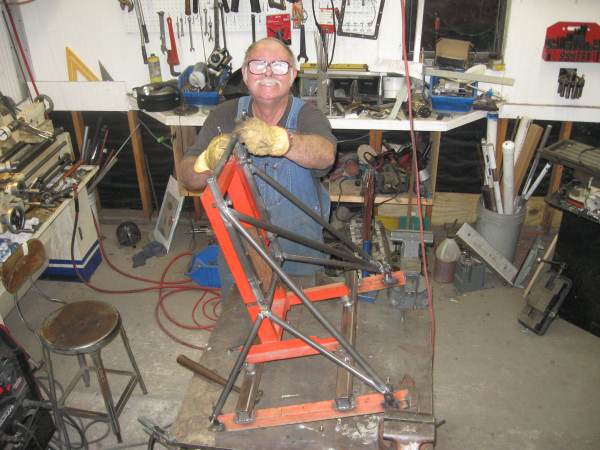
Above, our master welder and side kick Vern takes Bob “Earlybuilder” Dewinter’s motor mount out of our Piet Jig. Bob is picking this up at CC#24 after we have it powdercoated. This is what I call a high thrust line mount, as the thrust line is 3″ higher that a stock BHP mount. Later photos will show the difference on the plane. This mount has a overalll length from the firewall to the prop flange of 32″. This has plenty of room behind the engine, but most important, it is the beneficiary of all the weight and balance data we collected by measuring 30 different Piets on the same electronic scales. Piets have a chronic aft CG problem caused by heavier pilots, light engines and no planning. This mount is part of a very well-developed plan for Corvair Piet builders to follow.
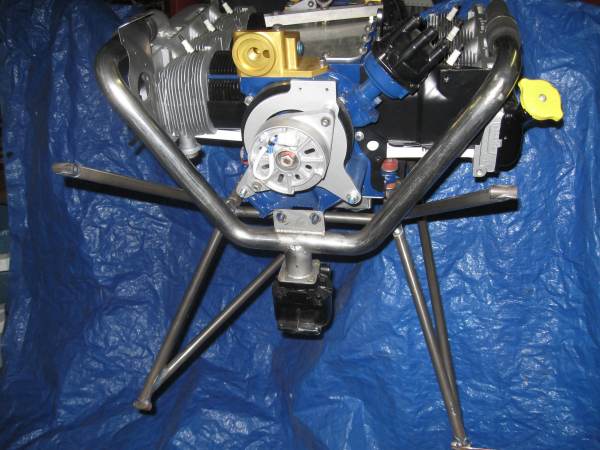
Above is the same mount bolted on a Corvair with our standard intake an MA3 carb and a rear alternator. All of our components are integrated to work together on this.
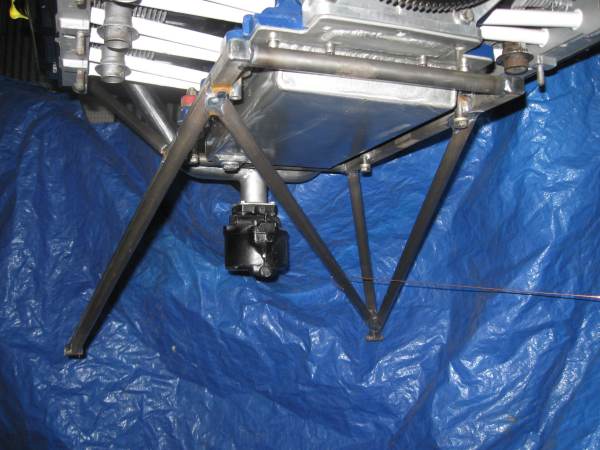
The above photo shows how our Gold oil pan or our welded oil pan clear the diagonal brace at the front of the mount. Putting it in this position makes the mount very rigid, and gives plenty of room for an uncluttered carb and air filter. The mount is very well-built and 100% TIG welded out of US made 4130 tubing. Dan Weseman stopped by, checked it out in the jig and pronounced that he would fly a snap roll with it. The mount weighs slightly over 5 pounds. It could have been built to weigh 3.5 pounds, and been fine for the way most people fly, but in my judgement, this is the wrong place to look for a 26 ounce weight savings on a plane.

Above, My Pietenpol at the last hours of Sun n Fun 1996. From L to R, Gus Warren, Steve Upson and yours truly. The photo was taken by Mary Jones, the EAA’s editor. We are all smiles, but in reality we were nursing brutal hangovers from drinking “Muzzeloader” (moonshine) at the ultralight party the night before. Note the test cowl that functions like the air box on the test stand. At this point, the plane still had a stock thrust line and stock short landing gear legs. If you look at the cowl there is a 6″ wide filler stripe of aluminum in it. That is due to the motor mount being extended 6″ in one shot to test different CG locations. It flew much better with the CG forward. There are far too many Piets flying at the aft end of the CG range. It only feels acceptable to a pilot who has not flown one with the CG where Bernard intended it to be.

Above, Grace and I stand with my Pietenpol in 2000, the day before Corvair College#1. This is the same airframe after a large re-work in 1998-99. Get a good look at the height difference in this photo and the one before. This has two factors, first the thrust line is 3″ higher on a new mount and the landing gear is completely re-made from scratch and is 6″ taller. Note that it has die springs. Get a good look at the camber angle of the tires with the plane unloaded. This is by design, it gave the plane excellent ground handling. The plane had a large muffler under the belly.

Above, side view of the plane taken the same day at Spruce Creek Fly-in, our airport from 1991-2003. My Piet had a short fuselage. No one should build a short fuse plane today, there is no reason to, it is a complete myth that they have a better CG situation. Notice the new deck angle on the plane. With more angle of attack the plane could be three point landed at 10 mph slower. Look at the axle location of the gear in relation to the LE of the wing. This gear was set to be slightly ahead of the wing in level flight. The brakes on the plane were 6×6 Cleveland hydraulic drums off a Tripacer. This combination of slow landing speed, forward gear and good brakes meant that the plane could actually make landings in 200 feet. Maybe you don’t plan on flying like that, but every year at least one builder who blindly built his landing gear 7″ behind the LE in accordance with the 1933 plans, puts his aircraft on its back. Planes in ’33 didn’t have brakes and always landed at “Airfields” where you landed directly into the wind. Cross winds and brakes mean it is best to have the gear on your plane where BHP migrated his to in the 1960s, near the leading edge of the wing.
Above, BHP’s last original, Corvair powered of course. This plane has 800 hours on it today, it lives at Brodhead and belongs to our friend Bill Knight. We did the weight and Ballance on this plane two years ago and overhauled the engine last year. On the outside it looks just like BHP made it, but inside it has a nitrided crank, Arp bolts forged pistons and one of our Black prop hubs and hybrid studs. Look closely and understand that BHP kept the thrust line low because he had the stock automotive blower fan on the engine, which sticks up higher than our electric starter set up. Running no fan is what allows us to move the engine up. BHP’s Corvair Thrust line was very near the location of the Ford’s thrust line. It was a familiar location, but if you look at most classic planes, the thrust line is closer to the top longeron. In a parasol, there are aerodynamic reasons why it is better off higher on the fuselage. There are also practical reasons like having more room under the engine for the carb and airfiler, and not having these items too low and prone to damage in an accident. Note that the last original has the main axles far forward and it has die spring in a tube gear like we made the last week for Bob lester’s Piet.

Above, another look at the 2000 version of my Piet. Long gear leges and a high thrust line contribute to the plane having a ‘jaunty’ look. The empty weight of this plane was 734#. Not bad for a plane with electric start and brakes and a wet center section of 18 gallons. The rail under the tank is a fuel manifold moulded into the bottom of the center section that would drain all the fuel out of the wing at any angle of climb or decent. My mistake was plumbing it with hard lines instead of braided steel hoses. It could fly in CG with any pilot from 128 pounds to one that weighed 290. It logged about 350 hours in this configuration. Grace produced the cowl by using 2″ scotch brite pads on a radial arm drill press to ‘machine turn’ the cowl. The curve in the paint was traced from a garbage can lid. I dislike a hard paint line between the fuselage and the cowl, a simple curve does a lot to improve the look. Same idea has been on countless classic planes including the last original.

A look at the front end of the plane: The spinner is an 11″ aluminum. I had problems with it cracking and have never had an issue with a fiberglass one. The prop is a 66″ warp drive. Cowling was hinged on the bottom panel to open up in minutes for full inspection. Boxy eyebrow cooling ducts were interconnected in the back by a 3″ scat hose. They were intended to be a quick test made of scrap aluminum, but we had enough fun flying I never got around to changing them.
If you are a Pietenpol builder and you need a motor mount, spring gear, and intake or exhaust, just drop us a note, we will be glad to help.-ww